






Tech
StreamGenie Wants Creators To Treat Archived Content As Inventory, Not Leftovers

The creator economy has no shortage of content. What it lacks, Joseph Sottile argues, is a system for turning the footage that creators already own, but never use, into sustainable revenue.
His answer? StreamGenie, a creator-first content licensing pipeline he co-founded to help creators, agencies, and studios monetize unused or archived content libraries through structured, non-exclusive licensing deals for AI and enterprise use. Launched in January 2026, StreamGenie responds to how creators think about value: not as something tied only to distribution, but as something embedded in the content itself.
Before StreamGenie, Joseph spent years running influencer campaigns and managing creators at Boston-based agency Diffraction, as well as operating within TikTok LIVE’s Creator Network. That operator background helped him expose a gap in the creator economy that exists long before a creator reaches sponsorship scale.
“There’s still this gap between ‘I’m earning enough to be a full-time content creator’ and the entrance into that,” Joseph says. “You have a lot of creators that are essentially stuck in survival mode, looking for their communities or sponsors to fund their content.”
StreamGenie’s core thesis is simple: creators already own valuable inventory. They just lack the systems to activate it without taking on more work.
The Experiment That Changed the Thesis
According to Joseph, there is a growing content graveyard across livestreaming, UGC, and long-form video, where creators produce enormous volumes of content that never generate value beyond their initial run. Livestream VODs (Video on Demand) are auto-deleted. B-roll never makes the final cut. Extra takes sit in camera rolls until they’re erased to free up space.
The scale of that waste is structural, not anecdotal. Joseph points to Twitch alone, where more than 2 million hours are streamed every day, and past broadcasts often expire quickly unless creators export them (7 days for many channels, 14 days for Affiliates, and 60 days for Partners/Prime/Turbo). UGC creators may publish a 60-second video after recording 20 minutes of footage.
Most monetization models, he argues, simply ignore this layer. Ads, sponsorships, and affiliate revenue depend on distribution, performance, and audience scale. Archived content, by contrast, has traditionally been treated as disposable.
“That’s content someone created,” Joseph says. “Someone put time and energy into it. If all we did was make it easier to organize that content for licensing, now we’re sitting on a gold mine.”
To test whether that “discarded” content held real economic value, Joseph and his co-founder used their own archive as a pilot. Instead of deleting expired livestreams and unused footage, they downloaded, organized, and packaged it for licensing.
The result became StreamGenie’s first internal case study. More than 1,100 hours of stored content were accepted for licensing across multiple deals, generating over $15,000 in revenue without any new filming, editing, or audience distribution. The content included livestream footage, vertical video, sports content, and cinematic segments, i.e., material that had previously been written off as unused.
“We sold around a thousand hours to four different partners for around $15,000,” Joseph says.
What stood out wasn’t just the revenue, but the structure of the deals. The content was licensed non-exclusively, ownership remained with the creator, and likeness rights were excluded. Buyers were limited to private AI training and testing use, with no redistribution or reproduction.
“This was super easy,” Joseph says. “We still owned all of the content. We didn’t pass over any rights. Our likeness wasn’t included. It was just video data and metadata.”
For Joseph, the case study reframed the opportunity. If an agency could generate five figures from content it had already archived (or was about to delete), then the constraint facing most creators wasn’t demand, but access.
“How many content creators are not even earning money on their content, let alone their first $10,000?” he asks. “That’s ridiculous.”
He’s referring not to creators’ efforts, but to the scale of unrealized opportunity. In Joseph’s view, licensing backlogs lowers the barrier to earning in a way that traditional monetization models don’t, yet most creators never encounter it. The gap, he argues, isn’t motivation or output, but infrastructure.
What StreamGenie Is
StreamGenie is not a marketplace, and it doesn’t buy content outright. Buyers are vetted, content is handled securely, and buyers do not receive or license any name, likeness, or IP rights.
“We are the infrastructure,” Joseph says. “We turn video, especially livestream video, into cash by automating the capture, packaging, quality control, and delivery for bulk content licensing.”
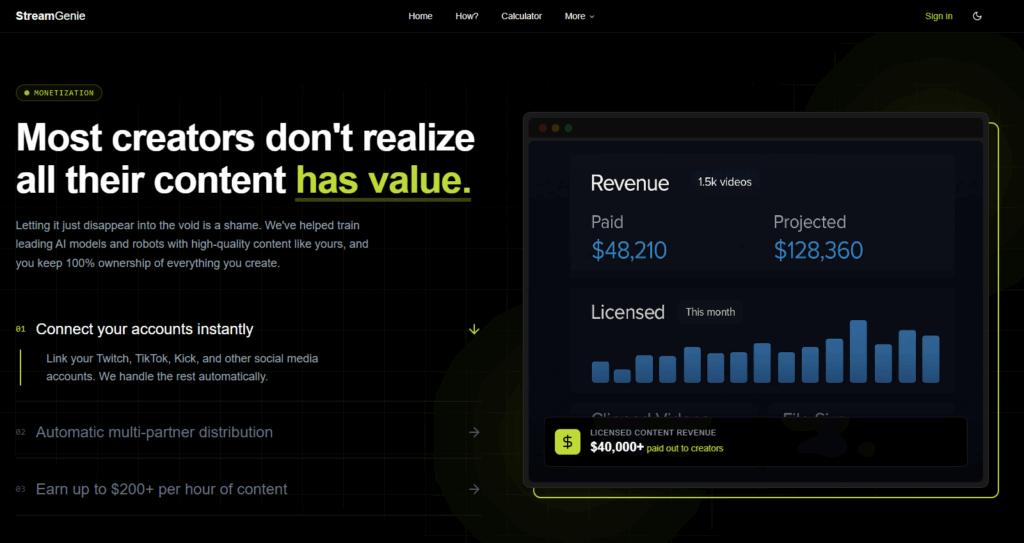
The platform supports ingestion from platforms such as Twitch, TikTok, and Kick, with YouTube support in development. Once onboarded, content uploads automatically, turning the system into what Joseph describes as “set and forget.”
Within five minutes, a creator can sign a contract, connect platforms, and begin building a licensable content library without changing how they create.
“That’s important,” Joseph states. “This isn’t replacing anything in the current content ecosystem.”
Who’s Buying the Content and Why
The demand side of StreamGenie’s marketplace looks very different from traditional media buyers.
Joseph reveals that these are technology and enterprise companies building private AI models for tasks such as robotics training, motion analysis, product testing, and crowd-movement modeling. In one recent request, he says a partner asked for 200,000 hours of people doing chores.
“There’s not really a bottleneck around demand,” he says. “The bottleneck is packaging and delivery.”
Pricing varies widely depending on content type, resolution, and use case. In Joseph’s experience, early rates can range from $8 to $200 per hour. He reports that on-camera livestream footage has ranged from $25 to $40 per hour.
“That’s aftermarket,” he says. “Anytime you’re going live, you could be earning aftermarket revenue without doing anything else.”

Rights, Ethics, and Creator Control
One of the most sensitive aspects of AI-adjacent monetization is the trust of creators. Joseph expected resistance.
“I’m not a big fan of generative AI,” he says. “I see a lot of negatives with misinformation and stolen work.”
Instead, Joseph reports that creators responded positively to StreamGenie, largely because of how the platform structures rights.
“You still own your content,” he emphasizes. “It’s not being publicly posted. Likeness isn’t included. It’s not for public-facing generative products, redistribution, or likeness cloning, and is limited to private model training/testing and no 1:1 replication of footage.”
He also notes that for many creators, the platform represents a way to regain control over content that is already being scraped elsewhere.
“Creators are increasingly worried about how their content might be used for AI,” Joseph says. “YouTube has even introduced controls that let creators decide whether third parties can use their videos for AI model training. Now, you have the opportunity to license it and get paid for it by companies that are ethically sourcing video data.”
Expanding Beyond Individual Creators
While StreamGenie began with individual creators, its roadmap increasingly centers on agencies, networks, and content owners with large catalogs.
Joseph groups users into three categories: high-volume creators and streamers; content owners with significant archives; and agencies or networks managing creator rosters.
For agencies, he frames StreamGenie as both a monetization layer and a recruiting advantage.
“That’s another reason a creator might want to join your talent agency,” Joseph says. “All of my content can be monetized now because my agency partnered with StreamGenie.”
The company is also developing task-based licensing campaigns, where creators can be paid upfront for specific types of content, layered on top of passive licensing.
Rethinking Sustainability in the Creator Economy
Joseph believes passive licensing addresses more than revenue. It changes creative incentives.
“Creators get forced into sacrificing content quality for monetization,” he says, pointing to low-effort formats driven by immediate payouts.
By decoupling income from performance metrics, StreamGenie offers a different mental model.
“You don’t have to cookie-cut,” he says. “You can focus on creating better content. If that content’s not selling for AI, people probably aren’t watching it either. If content isn’t valuable as data, it often signals something about clarity, composition, or consistency, the things viewers also respond to.”
Looking ahead, Joseph is cautious about making predictions, but clear about his belief in backlog value.
“I genuinely believe monetizing your backlog in licensing is going to surpass ads, sponsorships, and traditional partnerships,” he says.
For creators burned out on chasing the next deal, his advice is less tactical than philosophical.
“Breaking the mold does mean doing something new,” Joseph says. “You don’t have to copy others. Your style, your voice, your interests – that’s where the value is.”
Subscribe to Our Newsletter
Check Out Our Podcast