






Talent Collectives
Sidewalker Daily’s Nina Zadeh Spent a Decade on the Brand Side. Now She Teaches Creators to Fight Back


A few years ago, Nina Zadeh sat across a negotiating table from a creator and got her rate down to a number so low it felt wrong. That moment, she says, changed everything.
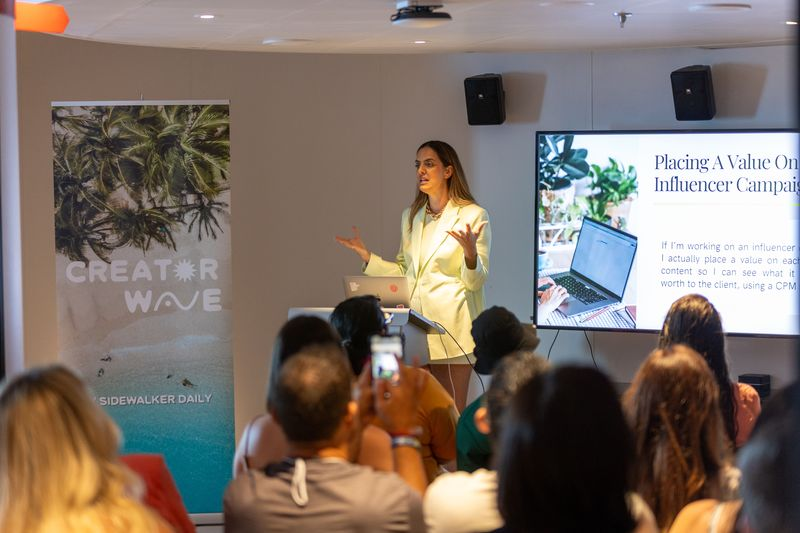
Nina is the co-founder of Sidewalker Daily, a Miami-based creator education platform with a community of more than 160,000 creators. The business runs no paid advertising and has grown entirely on results. Its core product, the “Pitching To Brands Mastercourse,” teaches creators how to negotiate and land brand deals.
“Don’t come to me to learn how to post or edit,” Nina says. “Come to me with a negotiation. That is our niche, and that’s how we got to where we are today.”
Nina co-founded the business in 2015 alongside her business partner, Clairesse Brogoitti, a lawyer, after years of managing Influencer Marketing budgets on the brand side for clients including Infant Optics, Jetsetter, and the Costa Rica Tourism Board. The combination of an MBA in marketing and a legally trained co-founder, she argues, gives the platform credibility that separates it from the wave of creator-turned-educator businesses that have proliferated in the space.
“We’re not influencers teaching you how to be influencers,” Nina says. “We’ve done the consulting work, we’ve done the business side.”
A Negotiation That Felt Like Bullying
The pivot from brand side to creator advocacy did not come from a business plan. It came from a single negotiation.
Nina recalls managing a campaign where she negotiated a creator’s rate down further than she felt comfortable with. “It didn’t sit right with me,” she says. “I realized I didn’t want to approach negotiations that way again.”
The episode clarified a problem she had been watching for years. While working in PR, Nina advocated internally for creator payments at a time when most agencies still treated social media as supplementary to traditional media. She wrote articles about media kits and creator rates when, she says, “the search volume for those keywords was literally zero.”
That brand-side vantage point now underpins the most important feature of Sidewalker Daily’s model: Nina can teach negotiation from the other side of the table. “Being on the other side and negotiating against the creator, you learn it’s okay to advocate, it’s okay to ask for more, it’s okay to get a no,” she says.
The Gifting Trap, and Why Brands Keep Falling Into It
Ask Nina what she would change about the Creator Economy if she could change one thing, and the answer is immediate.
“Gifting,” she says. “I would remove it. Paid or bust.”
Her objection operates on two levels. First, the quality problem: brands that offer product in lieu of payment tend to attract less experienced creators, not the ones who can drive commercial results. “Real people who move the needle are not going to do it for free,” Nina says. “It’s always the new people who start with free because they want to build their portfolio. But then you get what you pay for.”
Second, and less discussed, is the tax exposure. Nina describes a case she witnessed involving a creator who received nearly $100,000 worth of gifted furniture for a home renovation. Because the gifting came with posting obligations, the IRS classified it as income. The creator was left with a $20,000 tax bill payable in cash she did not have. “She didn’t want to spend $20,000 on these taxes,” Nina says. “She would have just bought the furniture.”
The lesson, in Nina’s framing, is not simply that gifting is unfair. It is that gifting is financially illiterate. She has a tax course built with her accountant available to creators in her program. It is, she admits, among her least popular products. “[Doing] Taxes is not sexy,” she says. “Until you need it.”
The AI Clause Hiding in Plain Sight
If gifting is the Creator Economy’s old problem, Nina believes she has spotted the new one: AI provisions embedded in standard brand deal contracts.
“We are seeing brands slip AI clauses into contracts so that the content can be used to train their models,” Nina says. “Your sound bites can be used to create AI agents. The likeness piece. I don’t think people are talking about these implications.”
The risk she describes is compounding. A creator signs a $10,000 brand deal, accepts standard terms without scrutinizing the AI training clause, and inadvertently licenses their voice, likeness, and content to train models that could eventually replicate or replace them.
Nina sees this as the next inflection point in creator legal literacy. She has produced video content on the topic and coaches high-ticket clients to flag and redline AI provisions before signing. Her co-founder Clairesse’s legal background, she notes, is increasingly useful as contract complexity grows. “Having a lawyer is like having a secret ace on your team,” Nina says. “She’s able to look through it and give that perspective that has been absolutely a game changer for us.”
The Follower Obsession That Won’t Die
Sidewalker Daily works with creators across the follower spectrum, including UGC creators with audiences in the hundreds who are nonetheless landing paid brand deals. The business model depends, in part, on debunking the idea that follower count determines earning potential.
And yet Nina is direct about the limits of that cultural shift. “People are saying it,” she says of the growing consensus around engagement over reach. “But I think deep down, followers still feel important.”
The dynamic plays out even inside her own community. She describes UGC creators earning $60,000 on a campaign who, despite the income, still want follower growth. “There’s a sense of worth tied to the following,” she says. “Whether they want to admit it out loud or not, it’s the elephant in the room.”
For brands, Nina argues, the same bias costs them measurable performance. Filtering out a creator based on follower count without evaluating engagement or content fit means missing the ones who can actually convert. “If a brand has a goal of creating licensed content for their ad strategy, what does a follower count even matter?” she asks.

A Job Board and Eyes on AI
Sidewalker Daily’s current priority is “The Paid Creator,” a Substack publication that distributes daily brand partnership opportunities to subscribers. Nina describes it as a job board for creators actively pitching brands. Live events and conference appearances are also expanding in 2026.
On AI, Nina is measured. When students in her membership ask whether AI tools can replace her custom design services, she tells them to try. “Feel free to use Claude,” she says. “And then they come back, and they’re like, ‘It’s not where I like it.’” She views AI as a tool to support creators, not a threat to the education business, but is watching closely for where it reshapes the contract and content spaces.
The industry Nina entered a decade ago, when creator legitimacy had to be argued for in every agency meeting, has developed real professional standards. Brand budgets for influencer partnerships now exist where they previously did not. Contracts are being read and redlined. Creators are building businesses rather than managing hobbies.
What has not changed, Nina argues, is the willingness of the industry to shortcut compensation. “I strongly believe that my time is money,” she says. “The same goes for every creator.”
Subscribe to Our Newsletter
Check Out Our Podcast