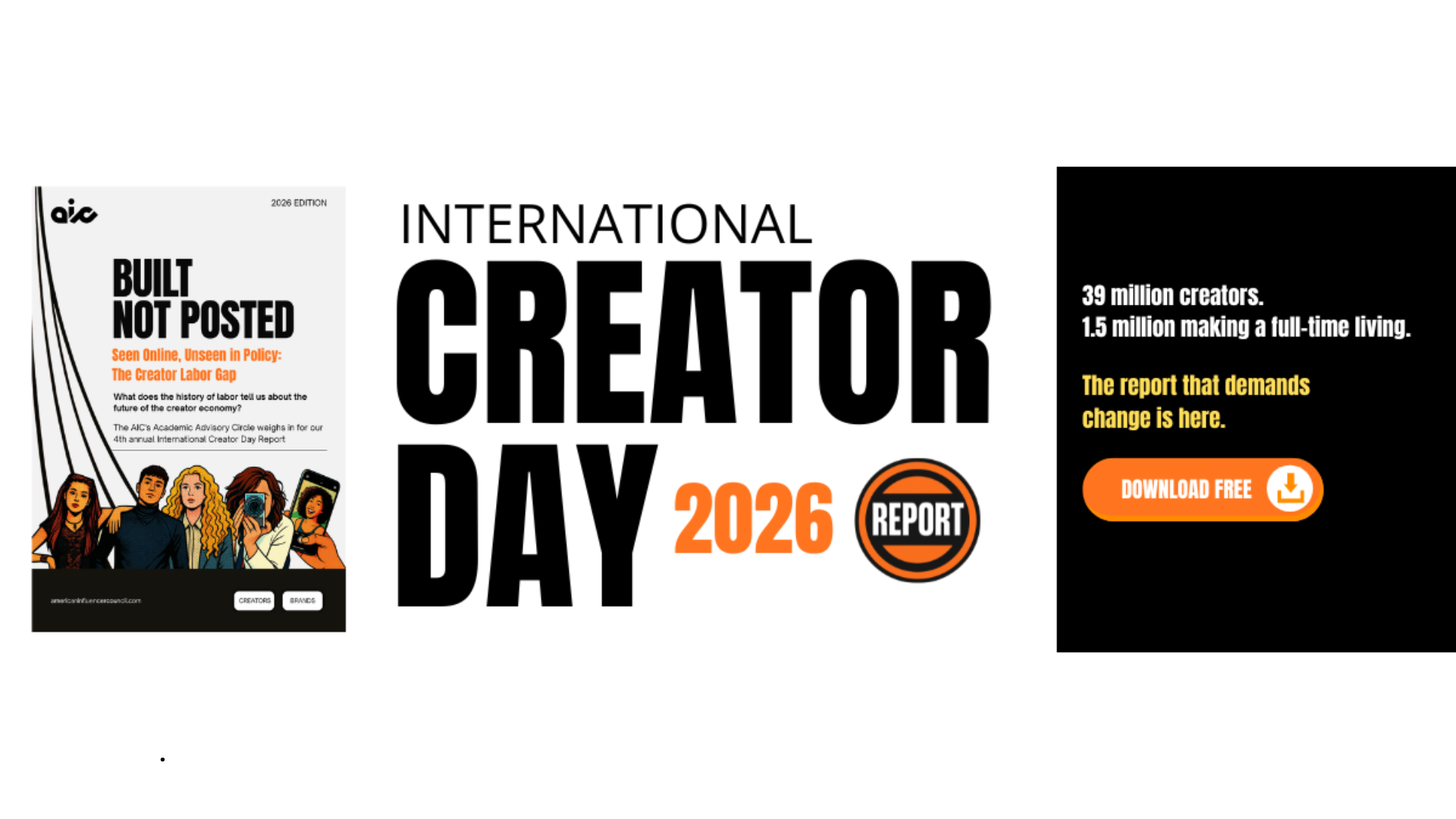
The American Influencer Council (AIC) has released its fourth annual International Creator Day Trend Report, arguing that labor policy has failed to keep pace with the growth of the Creator Economy, leaving millions of professional content creators without worker protections or small business resources.
The report, titled “Built Not Posted,” draws on contributions from eight university scholars assembled through the AIC’s newly launched Academic Advisory Circle, marking the first time the organization has sourced its annual report from academic researchers rather than brand marketers or platform executives.
A Workforce With Few Full-Time Workers
The report centers on what the AIC calls the “creator labor gap,” a participation-to-sustainability disparity it characterizes as one of the largest in any U.S. labor market. Citing a December 2024 survey by Richard Florida and the Creative Class Group, the report counts 39 million U.S.-based individuals who create and share original content with at least 1,000 followers on at least one platform.
Against that figure, the report cites a 2025 IAB study by Deighton and Kornfeld measuring 1.5 million full-time equivalent creator jobs in the U.S. digital economy. The AIC calculates that 3.9% of all U.S. creators work full-time.
The report notes that the 1.5 million figure represents a 7.5x increase since 2020. The two studies use different definitions and data collection periods, and the AIC acknowledges the figures are not directly comparable.
Classification and the Policy Gap
Cornell University Associate Professor Brooke Erin Duffy, who serves as an AIC board advisor and contributed a research section to the report, identified five key labor policy issues facing creators: platform transparency, pay gaps and inequality, incentivized harm, burnout, and AI harms.
On classification, Duffy wrote that “the fraught nature of creator labor owes much to the classification of U.S. creators as independent contractors,” describing the majority as “platform-dependent laborers” who depend on YouTube, TikTok, and Instagram for visibility, audience access, and monetization but are not considered legal employees of those platforms.
The report also notes that content creators are excluded from the U.S. census, citing a 2023 Washington Post report, and that a major lawsuit seeking copyright protection over influencer aesthetics was ultimately dismissed.
Pay Gaps and Earnings Inequality
The report cites a 2026 report from The Influencer Marketing Factory indicating that roughly half of all creators earn less than $10,000 annually. A separate 2025 survey from Influencer Marketing Hub and NeoReach found that more than half of creators earn under $15,000 per year.
Gender and race-based pay disparities also feature in the findings. A 2025 Collabstr survey found that male influencers earn 40% more from brand sponsors than female influencers. A 2024 SevenSix Agency report found that creators of color are paid significantly less than their white counterparts.
A 2026 NeoReach survey of 539 creators found that 77% price their work based on time and effort, framing their partnerships as skilled production labor. The report notes that brands continue to anchor compensation to follower count, which it describes as a structural mismatch.
The Gender Dimension of Policy Exclusion
The report draws on data from the SBA Office of Advocacy and Collabstr to highlight a policy gap with a gendered dimension. It states that 90.7% of women-owned U.S. businesses are solo operations with no employees and without a formal SBA classification, and that women hold 70% of the market share within the Creator Economy.
Scholarly Perspectives on Labor Trajectory
Loyola University Chicago marketing professor Jenna Drenten argued in her contribution that the structural position of creators is historically novel. “Influencers are simultaneously the producers of content, the content itself, and the distribution channel,” she wrote. “This triple burden has no historical equivalent in labor law, which is precisely why existing protections fail to reach them.”
Syracuse University’s Regina Luttrell, Senior Associate Dean at the S.I. Newhouse School of Public Communications, pointed to historical precedent in other labor markets. “History shows that fast-growing labor markets consistently outpace worker protections before organizing, standards, and policy catch up,” she wrote, adding that the next five years will likely bring advocacy around pay transparency, contract fairness, platform accountability, IP rights, and benefits.
Pepperdine University’s Wangari Njathi drew on her research on Instagram creators in Nairobi. “Platform capitalism extracts value globally but distributes protection unevenly,” she wrote. “The question is not whether formalization is coming. It is whether the frameworks being built will serve all creators or only the most visible ones.”
Emerging Organizing Efforts
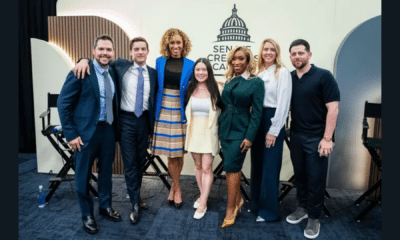
The report points to early forms of creator labor activism, including responses to YouTube’s “Adpocalypse,” the “#ADayOffTwitch” movement, and the “Black TikToker Strike.” It also references the Creator Bill of Rights and the Congressional Creators Caucus as examples of policy engagement.
Duffy described the AIC as the first U.S. trade association established to advance labor protections and small-business rights for career creators.
Image source: AIC The full report is available here
Cecilia Carloni, Interview Manager at Influence Weekly and writer for NetInfluencer. Coming from beautiful Argentina, Ceci has spent years chatting with big names in the influencer world, making friends and learning insider info along the way. When she’s not deep in interviews or writing, she's enjoying life with her two daughters. Ceci’s stories give a peek behind the curtain of influencer life, sharing the real and interesting tales from her many conversations with movers and shakers in the space.












The American Influencer Council (AIC) has released its fourth annual International Creator Day Trend Report, arguing that labor policy has failed to keep pace with the growth of the Creator Economy, leaving millions of professional content creators without worker protections or small business resources.
The report, titled “Built Not Posted,” draws on contributions from eight university scholars assembled through the AIC’s newly launched Academic Advisory Circle, marking the first time the organization has sourced its annual report from academic researchers rather than brand marketers or platform executives.
A Workforce With Few Full-Time Workers
The report centers on what the AIC calls the “creator labor gap,” a participation-to-sustainability disparity it characterizes as one of the largest in any U.S. labor market. Citing a December 2024 survey by Richard Florida and the Creative Class Group, the report counts 39 million U.S.-based individuals who create and share original content with at least 1,000 followers on at least one platform.
Against that figure, the report cites a 2025 IAB study by Deighton and Kornfeld measuring 1.5 million full-time equivalent creator jobs in the U.S. digital economy. The AIC calculates that 3.9% of all U.S. creators work full-time.
The report notes that the 1.5 million figure represents a 7.5x increase since 2020. The two studies use different definitions and data collection periods, and the AIC acknowledges the figures are not directly comparable.
Classification and the Policy Gap
Cornell University Associate Professor Brooke Erin Duffy, who serves as an AIC board advisor and contributed a research section to the report, identified five key labor policy issues facing creators: platform transparency, pay gaps and inequality, incentivized harm, burnout, and AI harms.
On classification, Duffy wrote that “the fraught nature of creator labor owes much to the classification of U.S. creators as independent contractors,” describing the majority as “platform-dependent laborers” who depend on YouTube, TikTok, and Instagram for visibility, audience access, and monetization but are not considered legal employees of those platforms.
The report also notes that content creators are excluded from the U.S. census, citing a 2023 Washington Post report, and that a major lawsuit seeking copyright protection over influencer aesthetics was ultimately dismissed.
Pay Gaps and Earnings Inequality
The report cites a 2026 report from The Influencer Marketing Factory indicating that roughly half of all creators earn less than $10,000 annually. A separate 2025 survey from Influencer Marketing Hub and NeoReach found that more than half of creators earn under $15,000 per year.
Gender and race-based pay disparities also feature in the findings. A 2025 Collabstr survey found that male influencers earn 40% more from brand sponsors than female influencers. A 2024 SevenSix Agency report found that creators of color are paid significantly less than their white counterparts.
A 2026 NeoReach survey of 539 creators found that 77% price their work based on time and effort, framing their partnerships as skilled production labor. The report notes that brands continue to anchor compensation to follower count, which it describes as a structural mismatch.
The Gender Dimension of Policy Exclusion
The report draws on data from the SBA Office of Advocacy and Collabstr to highlight a policy gap with a gendered dimension. It states that 90.7% of women-owned U.S. businesses are solo operations with no employees and without a formal SBA classification, and that women hold 70% of the market share within the Creator Economy.
Scholarly Perspectives on Labor Trajectory
Loyola University Chicago marketing professor Jenna Drenten argued in her contribution that the structural position of creators is historically novel. “Influencers are simultaneously the producers of content, the content itself, and the distribution channel,” she wrote. “This triple burden has no historical equivalent in labor law, which is precisely why existing protections fail to reach them.”
Syracuse University’s Regina Luttrell, Senior Associate Dean at the S.I. Newhouse School of Public Communications, pointed to historical precedent in other labor markets. “History shows that fast-growing labor markets consistently outpace worker protections before organizing, standards, and policy catch up,” she wrote, adding that the next five years will likely bring advocacy around pay transparency, contract fairness, platform accountability, IP rights, and benefits.
Pepperdine University’s Wangari Njathi drew on her research on Instagram creators in Nairobi. “Platform capitalism extracts value globally but distributes protection unevenly,” she wrote. “The question is not whether formalization is coming. It is whether the frameworks being built will serve all creators or only the most visible ones.”
Emerging Organizing Efforts
The report points to early forms of creator labor activism, including responses to YouTube’s “Adpocalypse,” the “#ADayOffTwitch” movement, and the “Black TikToker Strike.” It also references the Creator Bill of Rights and the Congressional Creators Caucus as examples of policy engagement.
Duffy described the AIC as the first U.S. trade association established to advance labor protections and small-business rights for career creators.
Image source: AIC
The full report is available here
Subscribe to Our Newsletter
Check Out Our Podcast