Strategy
Ashley Mady On Why Safe Social and Consumer Products Strategy Are Converging In The Kids Creator Economy

In the kids entertainment industry, distribution used to start with broadcasters. Today, it often starts with creators. Ashley Mady, President of Zigazoo, operates at the center of that shift, leading a social platform built for kid creators and the brands looking to engage them responsibly.
“Simply put, we are safe-social for the next generation, and with everything that’s going on in the world, it’s never been more important,” Ashley says.
Founded by two parents and former educators, Zigazoo was created to solve a structural problem in the digital ecosystem: children are inherently social, but most mainstream platforms are not designed with their safety (or regulatory realities) in mind. While many platforms that comply with COPPA (Children’s Online Privacy Protection Act) disable engagement features to minimize risk, Zigazoo built its model around moderation and interaction.
“One of the things that’s really different about Zigazoo and other platforms is that kids get to engage,” Ashley explains. “Because we moderate all of our content, we’re making sure that kids actually get to connect with their peers because they’re inherently social.”
Ashley reports that Zigazoo has grown to more than 10 million users, with investors from the likes of the NBA and iHeartMedia, and partnerships with over 100 brands, and over 1,000 kid creators actively participating in moderated challenges. The scale, she argues, allows Zigazoo to operate as both a safe social layer and a brand activation engine for Gen Alpha.
A Cross-Industry View of Kids IP Monetization
Ashley brings more than two decades of experience across licensing, retail, brand development, and toys to her role at Zigazoo.
“I’ve spent my whole career in consumer products and marketing and turning kids IP into products and turning products into content,” she says.
Having worked across licensing, agency representation, retail, brand development, and now platform leadership, Ashley brings a cross-functional view of how kids IP moves from content to commerce. In addition to leading Zigazoo, she serves on the Toy Association board, has held leadership roles in Women in Toys, and maintains deep ties across entertainment and retail.
Her guiding belief is what she calls a “trifecta approach.”
“I’ve always believed in this trifecta approach of having product, having content, having creators, and all the other magic around the flywheel to make it happen,” she says. “And I think we’re really starting to see a lot of that in practice.”
The Creator Economy Is Flipping
As the kids media landscape shifts from broadcaster-driven distribution to multi-platform ecosystems, Ashley sees a structural reversal underway.
“Creators are becoming brands, and brands are becoming creators,” she says. “The script is flipping.”
This transformation has direct implications for how kids IP is developed and monetized. In previous eras, securing a deal with a major broadcaster could serve as a launchpad for consumer products. In Ashley’s view, that linear path is no longer guaranteed.
“What used to work with the distribution model is no longer perfect,” Ashley notes. “It no longer means you get a deal with the biggest broadcaster that you will be an overnight hit and be able to extend into a consumer products line.”
Instead, success increasingly depends on meeting kids where they already are; on platforms like YouTube, Roblox, and increasingly, creator-led ecosystems.
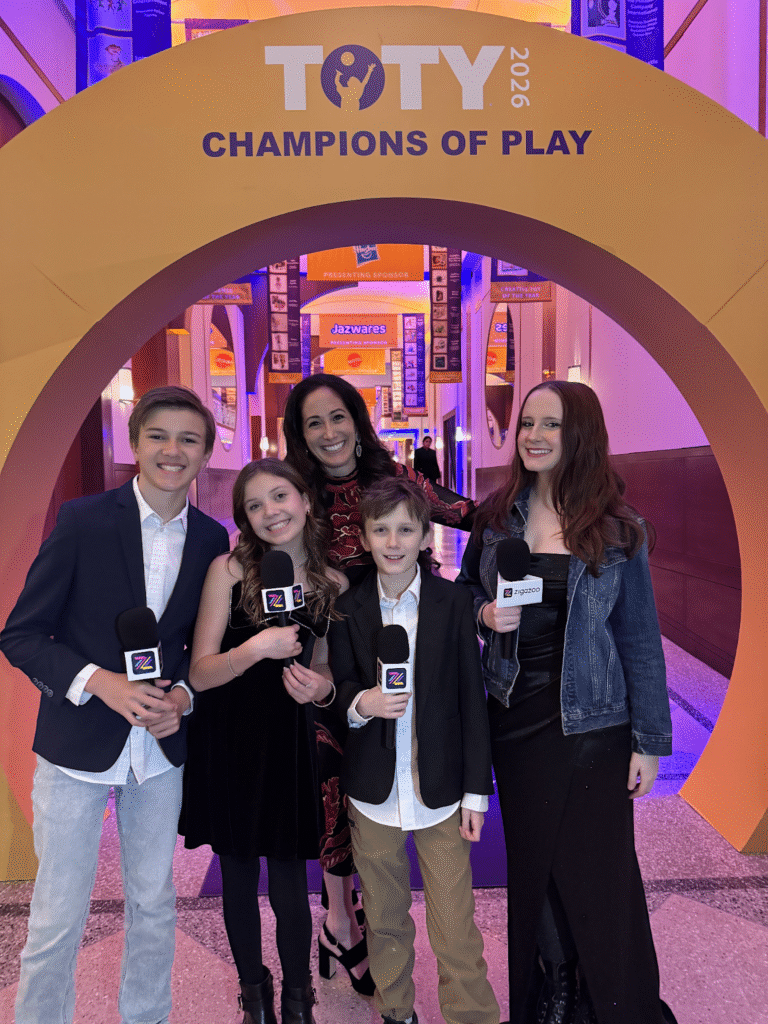
Photo: Ashley with Zigazoo Kid Reporters at the Toy Of The Year Awards at New York Toy Fair
Source: Zigazoo
Moderating ‘License to Play’ at Kidscreen Summit
At Kidscreen Summit 2026 (Feb. 22-25) in San Diego, Ashley moderated a session titled “License to Play: Building consumer products strategies for kids IPs,” which explored how studios and producers can unlock long-term value through licensing, retail, and brand extensions.
She wrote the panel questions herself and anchored the discussion around one central theme: trust.
“One of the anchors of the conversation is about trust,” Ashley says. “How do you make sure that one, your brand is trusted, but also it remains trusted as it moves into all of these different types of products?”
Her panel, featuring leaders from BBC Studios, Sesame Workshop, and Mad Engine, also addressed a critical timing question: when should licensing begin?
“Sometimes you can be really eager for a huge plan,” she explains. “You could go too early and then it’s not successful, and then you end up having to wait three years because everyone’s scared to bet on it.”
Ashley is candid about the disconnect between content fandom and product demand.
“If kids love the content doesn’t mean that products will sell,” she says. “Just because it’s great content doesn’t mean that it translates into products.”
For creators and studios eyeing merchandise expansion, she adds, that distinction can determine whether an IP becomes a franchise or stalls out.
The Safety Gap in Kid Creator Marketing
While most major brands now work with creators, Ashley sees hesitation specifically around kid creators.
“I think at this point, most companies are open to and already work with creators,” she says. “I do notice some companies haven’t yet worked with kid creators and sometimes they just don’t know how to navigate that whole space safely.”
That uncertainty, she argues, leads brands to step back entirely rather than engage carefully.
“There are environments like Zigazoo, where we could house that content just within our safe universe,” she explains.
For parents, the difference matters. “Even if it’s a parent-run account on external socials, those comments are not always okay for a child’s eyes,” Ashley says.
Community Over Reach
Ashley believes the most important shift in the creator economy is from mass audience building to community building.
“In today’s age, brands are communities,” she says. “You could very easily lose distribution on all different platforms, or platforms could become obsolete.”
The real defensible asset, she argues, is connection. “Where do you build your communities? Where can you have the deepest connections? Where can you mobilize your communities? That to me is far more important than just building an audience at large.”
This philosophy shapes Zigazoo’s product roadmap. At the Kidscreen Summit, Ashley’s goal was to bring more brands onto the platform while amplifying kids’ voices.
“Our goal in the conference was bringing even more brands onto our platform and allowing them to have a conversation with kids and also lifting kids’ voices in the process,” she says. “Using our polling features to allow kids to actually shape content and shape the consumer products that are being built around such content.”
In other words, Zigazoo positions children not only as consumers, but as collaborators.
A New Energy in Kids Media
Ashley skipped last year’s Kidscreen Summit, but she observes a noticeable shift in the industry from two years ago.
“Everything was changing so much, and a lot of the broadcasters weren’t buying in the way that they used to,” she says. “It seemed like there was a cloud over the show, and everyone was just trying to figure out how to do it differently?”
Now, she senses renewed clarity. “Fast forward to two years later. The world moved very fast. AI. There are all these different platforms and different ways to show up,” she says. “I believe this show people are coming to say, all right, now we know we have to show up differently. Here are the ways we’re going to do it.”
For Zigazoo, that means positioning itself as a distribution hub for content before scaling elsewhere.
“Now there are so many companies with content. They have hours and hours of content. Where are you going to put it?” Ashley asks. “We can be even at home for that content to at least build an audience first before it’s brought to a big screen.”
Advice for the Industry
For executives attending Kidscreen Summit for the first time, Ashley’s advice is direct:
“Talk to everyone,” she says. “Because you never know where the opportunities might be, and the opportunity may not be something that you were looking for when you went into the show.”
As for the broader outlook, Ashley’s thesis is rooted in resilience: platforms may shift. Algorithms may change. AI may redefine production. But community endures.
“It’s all about community,” she says. “The companies that just focus on mass reach are going to miss the point, especially as our world moves to more direct-to-consumer.”
Subscribe to Our Newsletter
Check Out Our Podcast