Creators are generating billions in brand value for companies they don’t own. Jeff Frommer wants to change that math.
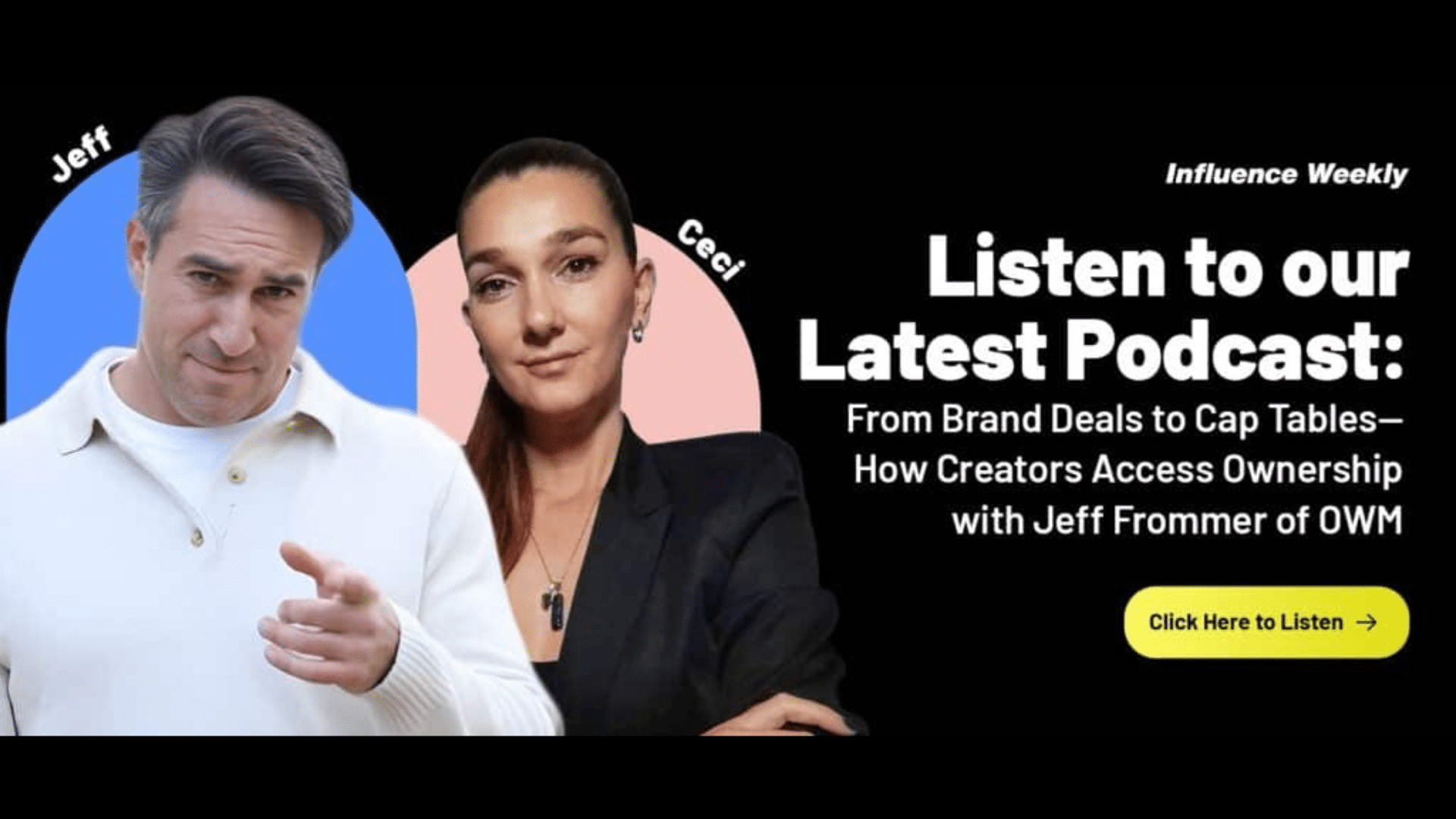
Jeff, founder and CEO of creator ownership platform OWM, sat down with Net Influencer Senior Editor Ceci Carloni to discuss why creator equity has remained inaccessible, what infrastructure is needed to fix it, and how founders can turn influence into a long-term growth engine.
Jeff bootstrapped Malka Media, a 200-person creative studio behind shows with Mike Tyson, Kevin Garnett, and Theo Von, to a $75 million exit to MoneyLion in 2021. Now, he runs OWM, a platform he describes as “Carta for creators.” His read on the industry is direct: “If no one knows you exist, you will die.” In the Creator Economy, that means building an audience and handing the upside to someone else.
1. The Creator Economy Is Maturing, But Most Operators Aren’t
The Creator Economy has a talent problem that has nothing to do with content quality.
“A lot of people fell into it,” Jeff said. “They’re thinking about transactions. They’re just waiting around for someone to call, and then they negotiate a deal, and they think that’s a business.”
The creators who are building real enterprises understand they are CEOs, not just personalities. MrBeast, Jake Paul, and Codie Sanchez have operators around them. Everyone else is monetizing attention without building equity.
“Going from I’m paid to post to actually something that is self-sustaining and is a business where people are being provided value and not being sold something,” Jeff said. “That’s the maturity of moving from the Creator Economy into the ownership economy.”
2. Passion and Audience Don’t Always Align, And That Gap Kills Deals
The first question Jeff asks any creator who wants to build a business isn’t what do you want to sell. It’s who your audience is.
“There’s a mismatch between something that you are really passionate about versus what your audience knows you for,” he said. A creator who wants to build a perimenopause brand but whose audience is young male gamers will struggle no matter how good the product is.
The opportunity exists where those two things converge. “You’re passionate about a problem to solve, and your audience is the exact customer who would buy the solution to that problem.” Without that alignment, the creator’s distribution moat doesn’t transfer.
Most creators don’t know who engages with them beyond surface-level demographics. Jeff says OWM builds audience persona data by running agents across the comment sections of a creator’s last 25 posts. “Do they have two kids? Do they hold a Starbucks card?” That granularity, according to Jeff, is what makes or breaks a brand match.
3. Three Structural Problems Have Kept Equity Out of Creator Deals
Equity hasn’t scaled in creator deals due to friction, not a lack of interest.
Jeff identifies three blockers. First, no standardization. Every deal starts from zero, negotiated by lawyers on both sides, with no agreed framework for what equity looks like. “Is it phantom equity, is it options, is it warrants, is it NSOs?” OWM partnered with DLA Piper to build the OWM Agreement, modeled after the Y Combinator SAFE (Simple Agreement for Future Equity), to reduce that legal cost to near zero.
Second, education. Most creators don’t understand what equity is or why they should want it over cash. “Make it an and conversation, not an or conversation,” Jeff advises. “Take the cash and ask for upside.”
Third, manager incentives. Agents take 20% of a deal. Equity doesn’t pay the rent today. “It’s really hard to get 20% of 1% of a business,” Jeff said, adding that OWM solved this by creating a creator stock option pool in which managers earn equity on the same timeline as the creator, removing the disincentive to pursue non-cash deals.
4. Brands Are Stuck in Performance Marketing. That’s Also an Opening.
Many brands scaling on TikTok Shop and Meta have a hidden problem. They have revenue but no brand equity.
“They put a dollar into the Zuckerberg machine, and they get a dollar ten out,” Jeff said. At $50 million or $100 million, acquirers start asking whether the business can survive without the paid-acquisition arbitrage. The answer is often no.
That vulnerability creates an opening for creator equity deals. Instead of paying a creator $1 million as a flat fee, Jeff proposes a different structure: $250,000 cash plus 1% equity worth $3 million today, earned over a year. “If you do the things I think you’re going to do, that three is going to be worth nine.”
The example he cites is British nutritional brand Huel’s exit to French food giant Danone. Brands at the cusp of scale need trust and distribution they can’t buy through ads. Creators can provide both, but only if the incentives align.
5. The Zach Justice Case Shows What Activation Actually Looks Like
Jeff helped structure a deal between Zach Justice and Vybes, a dating app. Justice took equity instead of fees and helped drive 8x weekly downloads and a 60% conversion rate.
The mechanic behind the result was creative, not contractual. Justice built a dating show, authentic to his audience and the brand’s category. It wasn’t a sponsored post. It was content his audience leaned into.
“Sell, sell, and I’ll skip, skip. Tell, tell, and I’ll lean in,” Jeff said. Brands that hand creators a script and ask them to push product get skipped. Brands that give creators creative latitude get watched.
“Equity is an incentive that ideally gets more people more bought in. But if you don’t have a good creative idea to activate them, it’s just going to be another brand deal.” Equity changes the creator’s relationship to the brand. It doesn’t automatically change the content.
6. Performance Tracking Means Milestones, Not Impressions
Once a creator is on a cap table, founders make the mistake of measuring the wrong thing.
“A lot of times brands think I’m going to pay this creator and it’s performance marketing,” Jeff said. “The first time they talked about the brand didn’t drive any sales, so cancel the contract.” That logic misunderstands how brand equity is built.
The right structure is milestone-based earned equity. The contract specifies deliverables, whether that’s quarterly advisory calls, posts, or GMV targets, and equity unlocks when those milestones are hit. “If you negotiate for the moon, you’re going to pay for the sun.” Clear tethers for both performance and termination protect both sides.
The bigger failure mode is set-it-and-forget-it. “A lot of these equity deals feel like a rotisserie chicken,” Jeff said. Founders go quiet after signing. Creators disengage. The relationship that was supposed to generate ongoing storytelling becomes another transaction with a delayed payout.
7. Being ‘Owner Ready’ Is the First Step Most Founders Skip
Jeff’s most direct advice to founders: set up the infrastructure before you need it.
“Be owner ready,” he said. Create a creator stock option pool, know your cap table, and have the agreement ready before you’re in a conversation with a creator who wants in. “Time kills all deals. Momentum is contagious.”
The second step is treating creators as advisors, not megaphones. Build a creator advisory board. Invite them into product decisions. “Creators are not just megaphones. They are incredible listening devices.” A creator who asks their audience whether to make strawberry or vanilla ice cream is doing real market research. By the time the product launches, that audience has already voted.
The underlying principle is that influence, when deployed without ownership, is a depreciating asset. Audiences notice when a creator promotes something they don’t believe in. “LeBron, I know you’re not drinking Sprite on the sidelines during halftime,” Jeff said. Ownership changes that dynamic. It gives creators a reason to say they’re invested, not just paid.
The Creator Economy has spent a decade proving that attention can be monetized. The next question is whether creators can capture the value they help create, not just the fees for creating it.
Jeff believes the answer lies in infrastructure. Standard agreements, data-driven matching, aligned manager incentives, and milestone-based performance tracking can make equity deals as repeatable as brand deals. “What we’re trying to do is take what has been reserved for VCs and public companies and democratize this conversation.”
Listen to the full conversation on “The Big Three” podcast.
Jonathan is a South African content creator, photographer and videographer with 25 years of experience in journalism and print media design. He is interested in new developments in AI content creation and covers a broad spectrum of topics within the creator economy.












Creators are generating billions in brand value for companies they don’t own. Jeff Frommer wants to change that math.
Jeff, founder and CEO of creator ownership platform OWM, sat down with Net Influencer Senior Editor Ceci Carloni to discuss why creator equity has remained inaccessible, what infrastructure is needed to fix it, and how founders can turn influence into a long-term growth engine.
Jeff bootstrapped Malka Media, a 200-person creative studio behind shows with Mike Tyson, Kevin Garnett, and Theo Von, to a $75 million exit to MoneyLion in 2021. Now, he runs OWM, a platform he describes as “Carta for creators.” His read on the industry is direct: “If no one knows you exist, you will die.” In the Creator Economy, that means building an audience and handing the upside to someone else.
1. The Creator Economy Is Maturing, But Most Operators Aren’t
The Creator Economy has a talent problem that has nothing to do with content quality.
“A lot of people fell into it,” Jeff said. “They’re thinking about transactions. They’re just waiting around for someone to call, and then they negotiate a deal, and they think that’s a business.”
The creators who are building real enterprises understand they are CEOs, not just personalities. MrBeast, Jake Paul, and Codie Sanchez have operators around them. Everyone else is monetizing attention without building equity.
“Going from I’m paid to post to actually something that is self-sustaining and is a business where people are being provided value and not being sold something,” Jeff said. “That’s the maturity of moving from the Creator Economy into the ownership economy.”
2. Passion and Audience Don’t Always Align, And That Gap Kills Deals
The first question Jeff asks any creator who wants to build a business isn’t what do you want to sell. It’s who your audience is.
“There’s a mismatch between something that you are really passionate about versus what your audience knows you for,” he said. A creator who wants to build a perimenopause brand but whose audience is young male gamers will struggle no matter how good the product is.
The opportunity exists where those two things converge. “You’re passionate about a problem to solve, and your audience is the exact customer who would buy the solution to that problem.” Without that alignment, the creator’s distribution moat doesn’t transfer.
Most creators don’t know who engages with them beyond surface-level demographics. Jeff says OWM builds audience persona data by running agents across the comment sections of a creator’s last 25 posts. “Do they have two kids? Do they hold a Starbucks card?” That granularity, according to Jeff, is what makes or breaks a brand match.
3. Three Structural Problems Have Kept Equity Out of Creator Deals
Equity hasn’t scaled in creator deals due to friction, not a lack of interest.
Jeff identifies three blockers. First, no standardization. Every deal starts from zero, negotiated by lawyers on both sides, with no agreed framework for what equity looks like. “Is it phantom equity, is it options, is it warrants, is it NSOs?” OWM partnered with DLA Piper to build the OWM Agreement, modeled after the Y Combinator SAFE (Simple Agreement for Future Equity), to reduce that legal cost to near zero.
Second, education. Most creators don’t understand what equity is or why they should want it over cash. “Make it an and conversation, not an or conversation,” Jeff advises. “Take the cash and ask for upside.”
Third, manager incentives. Agents take 20% of a deal. Equity doesn’t pay the rent today. “It’s really hard to get 20% of 1% of a business,” Jeff said, adding that OWM solved this by creating a creator stock option pool in which managers earn equity on the same timeline as the creator, removing the disincentive to pursue non-cash deals.
4. Brands Are Stuck in Performance Marketing. That’s Also an Opening.
Many brands scaling on TikTok Shop and Meta have a hidden problem. They have revenue but no brand equity.
“They put a dollar into the Zuckerberg machine, and they get a dollar ten out,” Jeff said. At $50 million or $100 million, acquirers start asking whether the business can survive without the paid-acquisition arbitrage. The answer is often no.
That vulnerability creates an opening for creator equity deals. Instead of paying a creator $1 million as a flat fee, Jeff proposes a different structure: $250,000 cash plus 1% equity worth $3 million today, earned over a year. “If you do the things I think you’re going to do, that three is going to be worth nine.”
The example he cites is British nutritional brand Huel’s exit to French food giant Danone. Brands at the cusp of scale need trust and distribution they can’t buy through ads. Creators can provide both, but only if the incentives align.
5. The Zach Justice Case Shows What Activation Actually Looks Like
Jeff helped structure a deal between Zach Justice and Vybes, a dating app. Justice took equity instead of fees and helped drive 8x weekly downloads and a 60% conversion rate.
The mechanic behind the result was creative, not contractual. Justice built a dating show, authentic to his audience and the brand’s category. It wasn’t a sponsored post. It was content his audience leaned into.
“Sell, sell, and I’ll skip, skip. Tell, tell, and I’ll lean in,” Jeff said. Brands that hand creators a script and ask them to push product get skipped. Brands that give creators creative latitude get watched.
“Equity is an incentive that ideally gets more people more bought in. But if you don’t have a good creative idea to activate them, it’s just going to be another brand deal.” Equity changes the creator’s relationship to the brand. It doesn’t automatically change the content.
6. Performance Tracking Means Milestones, Not Impressions
Once a creator is on a cap table, founders make the mistake of measuring the wrong thing.
“A lot of times brands think I’m going to pay this creator and it’s performance marketing,” Jeff said. “The first time they talked about the brand didn’t drive any sales, so cancel the contract.” That logic misunderstands how brand equity is built.
The right structure is milestone-based earned equity. The contract specifies deliverables, whether that’s quarterly advisory calls, posts, or GMV targets, and equity unlocks when those milestones are hit. “If you negotiate for the moon, you’re going to pay for the sun.” Clear tethers for both performance and termination protect both sides.
The bigger failure mode is set-it-and-forget-it. “A lot of these equity deals feel like a rotisserie chicken,” Jeff said. Founders go quiet after signing. Creators disengage. The relationship that was supposed to generate ongoing storytelling becomes another transaction with a delayed payout.
7. Being ‘Owner Ready’ Is the First Step Most Founders Skip
Jeff’s most direct advice to founders: set up the infrastructure before you need it.
“Be owner ready,” he said. Create a creator stock option pool, know your cap table, and have the agreement ready before you’re in a conversation with a creator who wants in. “Time kills all deals. Momentum is contagious.”
The second step is treating creators as advisors, not megaphones. Build a creator advisory board. Invite them into product decisions. “Creators are not just megaphones. They are incredible listening devices.” A creator who asks their audience whether to make strawberry or vanilla ice cream is doing real market research. By the time the product launches, that audience has already voted.
The underlying principle is that influence, when deployed without ownership, is a depreciating asset. Audiences notice when a creator promotes something they don’t believe in. “LeBron, I know you’re not drinking Sprite on the sidelines during halftime,” Jeff said. Ownership changes that dynamic. It gives creators a reason to say they’re invested, not just paid.
The Creator Economy has spent a decade proving that attention can be monetized. The next question is whether creators can capture the value they help create, not just the fees for creating it.
Jeff believes the answer lies in infrastructure. Standard agreements, data-driven matching, aligned manager incentives, and milestone-based performance tracking can make equity deals as repeatable as brand deals. “What we’re trying to do is take what has been reserved for VCs and public companies and democratize this conversation.”
Listen to the full conversation on “The Big Three” podcast.
Subscribe to Our Newsletter
Check Out Our Podcast