





Tech
Kerri’s Brian D’Erario on Why Audience Quality Beats Audience Size in B2B Media

Kerri, a media holding company launched in November 2025 by former Arkaea Media Chief Business Officer Brian D’Erario and digital media entrepreneur and operator Ari Lewis, is building the operations infrastructure to scale niche B2B newsletters. The company’s argument: in niche B2B, audience quality matters more than audience size, and most newsletter operators lack the structure to capitalize on that difference.
Brian spent the better part of a decade in media advertising sales, moving from Dow Jones to Morning Brew to Arkaea, where he reports closing more than $13 million in revenue for clients across B2B SaaS, aerospace and defense, and finance. Kerri partners with niche B2B content businesses to provide what most solo operators lack: sponsorship sales, event production, and software built specifically for media operations.
The company currently manages two properties in the hardware manufacturing vertical, Hardware FYI and Standard & Works, alongside Kinetic, its first conference, which drew 325 attendees and 27 sponsors from a standing start in 2025.
“It’s becoming very difficult to find value in the digital space,” Brian says. “Trust is going to become ever more important.”
Trust Is Now the Scarcest Commodity in Digital Media
Brian launched Kerri with a specific diagnosis: AI-generated content has made digital channels noisier while making trusted, expert-driven media scarcer. His company announcement described AI as having “degraded almost everything” across digital platforms, a view informed by his own usage patterns over the past year.
As a longtime LinkedIn user, Brian says the proportion of posts he found genuinely valuable fell from roughly 25% to under 10%, a decline he attributes to AI-generated output filling feeds with what he calls “middle-of-the-road, accepted by all people” content. He sees the same dynamic playing out in email inboxes and on other digital platforms.
For Kerri, that diagnosis shapes partner selection. The company targets creators with genuine domain expertise: people whose credibility with their audiences isn’t manufactured. Hardware FYI’s founder, Benjamin Chia, was a mechanical engineer before starting the newsletter. That credential, Brian argues, is what makes the newsletter’s audience commercially meaningful to a sponsor selling enterprise software into hardware manufacturers.
“When he’s delivering content to his audience, they know that’s going to be of value to them,” Brian says.
Who’s Reading Matters More Than How Many
The most common misconception Brian encounters when presenting Kerri is one rooted in consumer media economics: the assumption that more subscribers translate linearly into more sponsorship revenue.
At Morning Brew, where he worked in brand partnerships, that logic held. The audience was prosumer, ad rates scaled with volume, and growth meant adding readers below the cost of the revenue they’d generate. In niche B2B, he says, that model breaks.
“For B2B niche media, it’s a lot more important to know who’s reading your newsletter as opposed to how many people are reading your newsletter,” Brian says. He illustrates the point with an extreme: a newsletter with a single subscriber who was Elon Musk would command multimillion-dollar sponsorship rates, because every enterprise software company would pay for access to Tesla’s and SpaceX’s procurement networks.
The practical implication shapes how Kerri evaluates potential partners. Before discussing monetization, the team asks who is reading, what buying decisions those readers control, and what product categories they would purchase. Revenue strategy follows from that analysis.
“Stop thinking about adding more subscribers and think about how to add more meaningful subscribers,” Brian says.
Events as the Revenue Lever That Digital Can’t Replace
For niche B2B newsletters, there is a structural ceiling on digital advertising revenue. According to Brian, an engaged audience of 20,000 engineers is commercially valuable, but not large enough to support a full media business on ad rates alone. The scaling mechanism Kerri has built its model around is events.
“These people are used to spending millions of dollars a year on conferences and shows,” Brian says. “How do we start capturing those dollars?”
The strategy positions Kerri’s conference products against the large industry events run by private equity-backed operators like Clarion and Informa. Rather than competing on scale, the goal is density: a smaller room where every attendee is a qualified buyer of what sponsors are selling.
At Kinetic, some sponsors compared the event to DesignCon, a major hardware conference, and noted that at larger shows, many attendees weren’t familiar with printed circuit boards, a core concept in hardware manufacturing. At Kinetic, every attendee was. With packages starting at $5,000 and reaching $25,000, the sponsorship pitch was straightforward.
“You get one person in the room and have one good conversation that’s going to be worth well more than $5,000,” Brian says. “When you match a really expensive product with a really high decision-making audience, the sales pitch is actually not that hard.”
Brian says this was the fourth event he has launched from zero across his career, and he describes the accumulated experience as a replicable playbook for taking partner properties from newsletter to conference operation.
Where Kerri’s AI Helps, and Where It Falls Short
Kerri has built proprietary software that combines CRM, newsletter inventory tracking, and event operations into a single platform. At the center is an AI agent also named “Kerri,” designed to handle operational work that would otherwise require additional headcount across each partner company.
Day to day, Kerri manages task summaries, scans email and drafts reply suggestions, tracks event logistics, researches venues, and generates post-event surveys and sponsor reports. Brian says Kerri plans to route a dedicated conference phone number through the agent so attendees can ask questions about the event, a capability he argues would be impractical for a small company without AI support.
“No three-person company could ever put their phone number on there and do that in a reasonable time frame,” he says.
The limits are equally clear. Kerri cannot generate content that meets the editorial standards of the publications she supports, and Brian has stopped trying to use her for that purpose. Sales presents the same constraint: AI can surface leads and organize outreach, but closing enterprise sponsorship deals still requires human relationships, particularly as cold outreach volume increases across inboxes.
“Sales, I think, for now and for a long time still, is going to need a very heavy human touch,” Brian says. The broader principle he articulates is that AI executes well against defined briefs and poorly at generating ideas from scratch. “When you have an idea, and you say help me execute this idea, it’s fantastic at that,” he says. “It’s terrible at coming up with new ideas.”
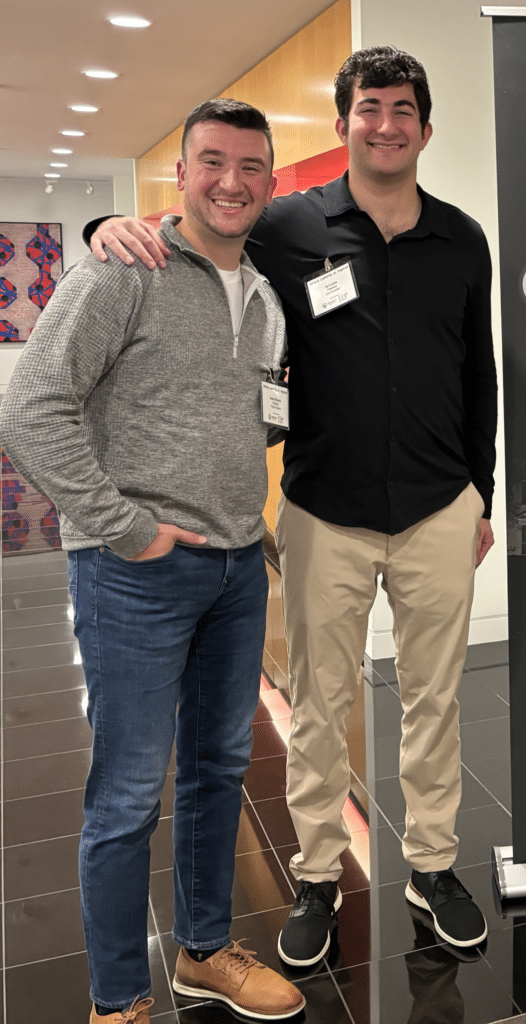
Photo: Brian D’Erario & Ari Lewis
Kerri Bets on Vertical Depth Over Horizontal Spread
Kerri’s current portfolio is concentrated in hardware manufacturing. Hardware FYI covers technical content for engineers: the kind of newsletter where, on SpaceX IPO day, the founder wrote about Starlink’s phased array system rather than the IPO itself. Standard & Works, which Brian is building with a creator named Zach Silber, targets the executive layer at hardware companies: CEOs, CFOs, and COOs focused on deal flow, investment activity, and manufacturing economics.
The design is cross-promotional without overlap. An engineer reading Hardware FYI might share Standard & Works with their leadership team; an executive reading Standard & Works might recommend Hardware FYI to their technical staff. Brian describes the goal as a full media footprint within one industry, serving different decision-makers without diluting the sponsorship value of either property.
The formula he articulates for expansion beyond hardware is portable: any vertical where products are expensive and audiences have meaningful buying authority is a candidate.
“Any industries that meet expensive product plus high-value audience, we can find ourselves in,” Brian says.
The Holding Company as a Long-Term Bet
Brian’s stated ambition is to build what he calls the next great American media institution, a phrase he acknowledges sits in sharp contrast with a company currently operating two newsletters and one conference.
The structural analog he reaches for is News Corp, which built its media portfolio through incremental additions rather than a single founding moment. The near-term version of that compounding involves deepening the hardware manufacturing portfolio, scaling Kinetic toward a larger audience, and adding properties in adjacent verticals as opportunities emerge. For creators and small media operators, Kerri is positioning itself as an alternative to the existing exit paths of private equity acquisition or conglomerate buyout.
“We want to create lasting properties that scale beyond this moment of podcasts and newsletters and folks getting big followings,” Brian says. “We are a lending hand to all creators and small media companies, whether we do official work together or not.”
Subscribe to Our Newsletter
Check Out Our Podcast