








Tech
Is Influencer Marketing Ready for Performance Discipline? Jeremy Grinacoff Makes the Case for Infrastructure

A senior marketer at a multi-billion-dollar brand recently described their influencer program to Jeremy Grinacoff. The company spends millions annually on creator partnerships. Yet the team still manages those campaigns in spreadsheets and waits for creators to send screenshots of performance.
“Nine out of ten conversations I have with brands, they’re still using spreadsheets,” Jeremy says. “Multi-billion-dollar companies that are waiting for creators to send screenshots.”
For an industry that now commands tens of billions of dollars in marketing spend, the operational reality can feel surprisingly analog. That disconnect is one of the reasons Jeremy started building ChannelCore, a tech platform designed to bring performance-marketing discipline to influencer campaigns.
The company initially focused on helping creators manage negotiations and pricing for brand partnerships, but its positioning has changed over the past year. Today, Jeremy describes ChannelCore as infrastructure for the Creator Economy, a system designed to connect brands, creators, and campaign data inside a unified operational layer.
The repositioning reflects what he sees as the next stage of Influencer Marketing’s development. “The Creator Economy is moving from experimentation to operational maturity, and ChannelCore sits at the infrastructure layer that supports that maturity,” Jeremy says.
One of the problems he believes the industry must address is the amount of influencer spending that brands struggle to measure. Jeremy estimates that roughly $18 billion in Influencer Marketing spend remains effectively untracked, based on industry spending estimates and surveys showing that 50% to 79% of marketers still struggle to measure campaign ROI.
“If you take the growth of Influencer Marketing and combine that with the number of marketers who say they can’t reliably track ROI, there’s a lot of money being spent without clear visibility,” he says.
Why Influencer Marketing Still Runs on Spreadsheets
For brands trying to scale creator programs, the lack of standardized infrastructure creates operational friction.
According to Jeremy, influencer campaigns often involve dozens or even hundreds of creators, each with separate deliverables, timelines, and pricing arrangements. Without centralized systems, marketing teams frequently rely on spreadsheets to track those variables.
In many cases, performance reporting remains manual.
“Sometimes, the brand is not dealing directly with the creator. They are dealing with their team, who has to wait for the creator to go in, take the screenshot, send it to the team, and then it gets forwarded to the brand,” Jeremy says. “It becomes this endless loop.”
For marketers responsible for proving campaign impact internally, the process creates challenges. “If I’m spending hundreds of thousands or millions on influencer campaigns and I want more budget, I have to go to the CFO and prove the impact,” Jeremy says. “Without that data, it becomes very difficult to justify scaling.”
The result is a disconnect between the size of Influencer Marketing budgets and the infrastructure used to manage them. “If we’re still using screenshots and spreadsheets to manage multi-million-dollar campaigns five years from now, there’s a problem,” he says.
Why Influencer Marketing Infrastructure Is Still Fragmented
Despite the number of Influencer Marketing platforms available today, Jeremy believes the industry still lacks a unified operational framework.
“There are amazing platforms out there, but many focus only on one side of the ecosystem,” he says. “Some help brands track campaigns, others help creators manage their business, but they’re not connected.” The marketing veteran adds that this fragmentation often forces marketing teams to assemble multiple tools while continuing to rely on manual processes.
Jeremy’s strategy for ChannelCore is to build a connective infrastructure between brands and creators. The platform operates through two primary environments: a brand portal and a creator portal, all powered by proprietary agentic models.
Brands can create campaigns, define objectives, and receive creator matches based on campaign parameters. Contracts, deliverables, messaging, and payments are managed through automated workflows within the platform.

Image: ChannelCore Brand Portal
On the creator side, ChannelCore provides a full end-to-end suite that enables creators to operate and scale their businesses. From managing brand partnerships, pricing, and campaign operations to content scheduling and data.
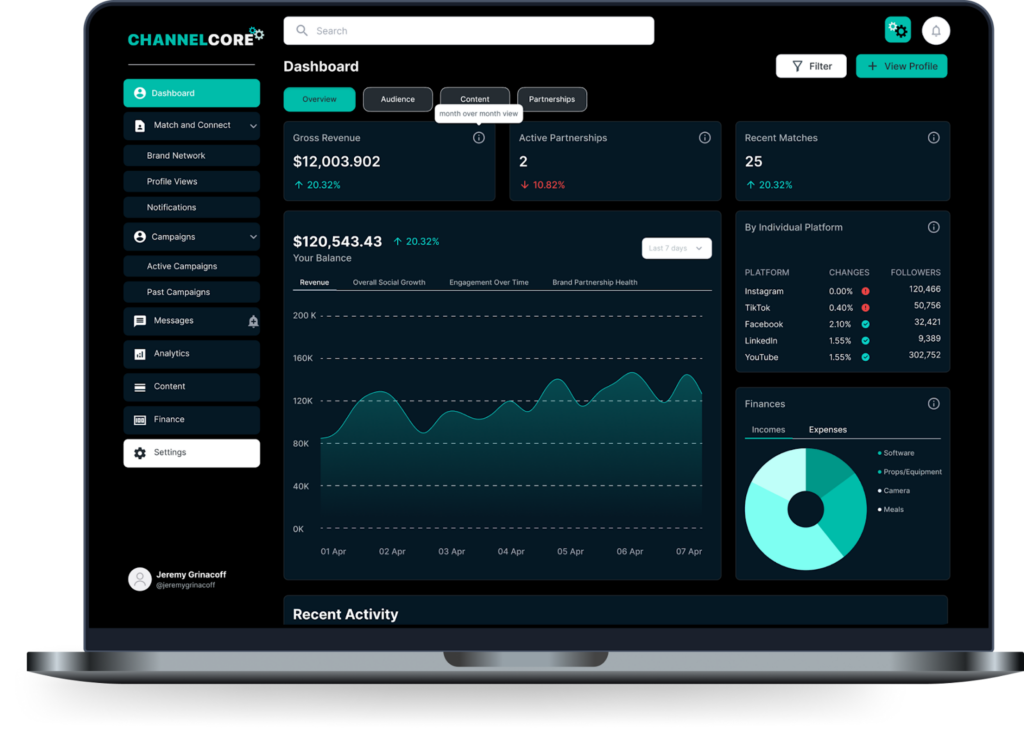
Image: ChannelCore Creator Portal
Together, the two systems generate performance data that can be tracked across campaigns.
Jeremy describes the goal as creating a “system of record” for Influencer Marketing, much like advertising platforms provide centralized reporting for paid media campaigns. “Better tools for creators create better outcomes for brands,” he says. “And better outcomes for brands justify larger creator budgets.”
Turning Influencer Marketing Into a Performance Channel
Jeremy’s background in performance marketing heavily influenced ChannelCore’s approach. Before founding the company, he spent nearly two decades managing marketing programs and advertising budgets across multiple industries.
“For me, coming from the brand side, I always had challenges with Influencer Marketing because I wanted to run it with the same rigor as performance media,” he says.
Performance marketing channels provide marketers with real-time attribution data, automated reporting, and optimization tools. Influencer campaigns, by contrast, often rely on fragmented reporting structures.
ChannelCore attempts to close that gap by integrating campaign management and performance tracking into a single system.
“The goal is to help brands turn Influencer Marketing into a true performance channel,” Jeremy says.
Building a ‘System of Record’ for Creator Pricing
According to Jeremy, one of the most persistent challenges in Influencer Marketing is pricing. Creators often set rates based on follower counts, average engagement, CPM estimates, or past brand deals. Brands, meanwhile, struggle to determine whether those prices reflect performance.
ChannelCore addresses the issue through what Jeremy calls Rate Intelligence™. “There are so many different ideologies around how creators price themselves,” he says. “We analyze more than 30 different data points that allow creators to price themselves based on performance.”
Those data points include engagement metrics, campaign performance, and historical partnership data. As the system gathers more information, pricing recommendations expand as well and learn over time.
If creators consistently perform well in campaigns, the platform may recommend increasing their pricing tiers. If results decline, the system may suggest adjustments.
“It could go the opposite way and say your last five campaigns didn’t perform that great, so we should lower the pricing,” Jeremy says.
Reducing the Operational Burden for Creators
While ChannelCore’s brand tools focus on campaign measurement and operational workflows, the creator side of the platform addresses a different challenge: administrative workload.
Jeremy says many creators spend significant time on business operations rather than on content production. “About 60% of creators’ time is spent on admin work,” he notes.
Tasks such as negotiating deals, tracking campaign requirements, managing invoices, and updating pricing can consume hours each week.
ChannelCore attempts to automate much of that work through AI-driven tools that assist with pricing, campaign coordination, and operational management. “The messaging is simple: you create, we handle the rest,” Jeremy says.
Balancing Performance With Creativity
As Influencer Marketing becomes more data-reliant, Jeremy acknowledges that the shift toward heavy measurement could begin to commoditize the creativity that makes creators valuable in the first place.
“It’s a risk if we go too heavy on performance,” he says. “Creators care about performance, but it’s not always attractive for them to think of themselves in those terms.”
For him, the goal is not to replace creativity with analytics but to create infrastructure that supports both. “There’s always a performance aspect to creativity, but creators still need the freedom to create the content that resonates with their audience,” he says.
From Experimentation to Infrastructure
Jeremy believes the Creator Economy is entering a new phase of maturity.
In its early years, he notes, brands experimented with creator partnerships, often allocating relatively small budgets to test the channel. As spending increases, however, marketers increasingly expect the same accountability and operational systems they rely on in other forms of digital advertising.
Jeremy argues that the next stage of growth will depend on infrastructure. “Creators were empowered, and brands were experimenting with budgets, but the connective layer between them was still manual,” he says.
“We built that connective layer, and that’s what this infrastructure phase is really about.”