



Agency
How Dubai Agency Yamammi Is Building Creator Infrastructure for Luxury and D2C Brands


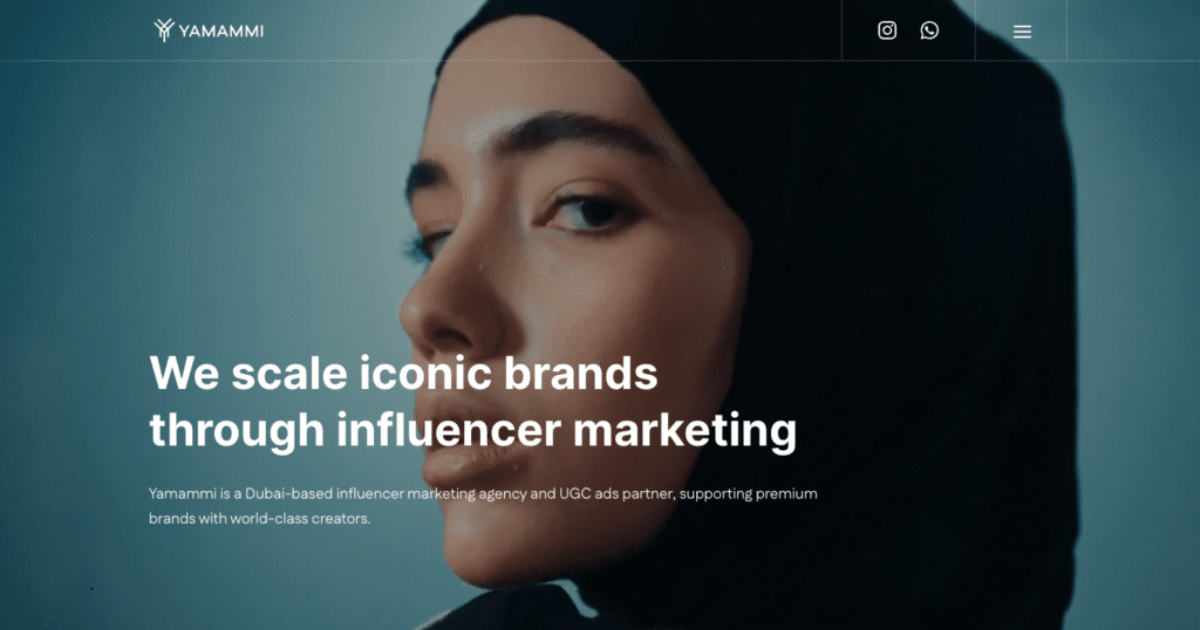
Yamammi, a Dubai-based Influencer Marketing and UGC (user-generated content) agency founded in 2024, was created to solve a problem its founder, Shawn Munir, kept seeing across the Creator Economy: brands were spending heavily on influencer campaigns but often struggling to produce consistent results.
“Campaigns are often unstructured, and brands are spending a lot of money without getting results. ” Shawn says.
That observation became the foundation for Yamammi’s strategy. Rather than running one-off influencer campaigns, the company focuses on building structured creator systems designed to help brands scale creator collaborations across platforms such as Instagram, TikTok, YouTube, and paid media.
Yamammi works primarily with premium D2C (direct-to-consumers), luxury, wellness, and lifestyle brands entering or expanding within the Middle East market. Its model combines micro-creator networks, audience analysis, and internal technology to manage the entire lifecycle of creator marketing from sourcing and matching to content production and performance tracking.
For Shawn, the core question has remained the same since the company’s launch: “How do you turn Influencer Marketing into something systematic and repeatable, rather than a gamble?”
A Lawyer’s Path Into Influencer Marketing
Before founding Yamammi, Shawn worked as a corporate lawyer in Norway and later held roles across startup investment and Web3 companies.
“I believe that is the secret sauce for setting up the systems,” he says.
After relocating to Dubai several years ago, he began paying closer attention to the regional influencer economy. The city was attracting international brands expanding into the Middle East, particularly in the luxury, hospitality, and lifestyle sectors.
At the same time, Shawn noticed that Influencer Marketing infrastructure had not kept pace with the region’s growth. “When I moved to Dubai, I identified this as the next Creator Economy hub,” he says. “But the quality was really bad.”
Brands entering the region often relied on informal creator relationships or traditional campaign structures that lacked audience analysis and measurable performance benchmarks.
Seeing that gap led Shawn to build Yamammi around operational systems rather than campaign management.
Building Structured Creator Systems
Yamammi positions itself around what Shawn calls structured creator systems. The concept centers on creating infrastructure that helps brands consistently identify the right creators, produce content, and measure performance over time.
“We have internally built a system,” Shawn says. “It analyzes every influencer’s audience and segments them based on personas like wellness, fashion, lifestyle, travel, and hospitality.”
The system then analyzes a brand’s online presence and positioning before matching it with suitable creators. “It figures out which influencers, specifically micro-influencers, are the right fit to collaborate with,” he says.
Once the collaboration begins, Yamammi continues to monitor and optimize content performance. “We analyze the delivery and suggest edits to the video that you can make to get the highest engagement with that influencer’s audience,” he says.
The agency refers to this process as a white-glove service in which brands outsource the operational complexity of creator marketing. Yamammi manages creator sourcing, audience analysis, campaign execution, and performance tracking within a single system.
According to Shawn, brands using the model have seen engagement levels increase 3-13x compared with more traditional campaign approaches.
The Operational Reality of Scaling Creator Marketing
Scaling influencer marketing programs introduces challenges that many brand teams underestimate, Shawn notes.
“When brands say they want to scale, what they underestimate is the operational overload,” he says.
He notes that managing dozens or even hundreds of creators requires coordinating timelines, content revisions, deliverables, and campaign reporting. “Without proper systems, the coordination alone becomes a headache,” he says.
Shawn believes structured systems allow brands to treat creators not simply as promotional partners but as ongoing content producers for the broader marketing ecosystem. “We treat creators as content producers for the brand ecosystem,” he explains. “Instead of a single post, we use content that can be used across multiple channels.”
That content may appear on organic social media, in paid advertising campaigns, on product pages, and on brand websites.
Micro-Creators as a Scalable Model
A central component of Yamammi’s model is its focus on micro-creators. The agency typically works with creators who have between 5,000 and 200,000 followers.
Shawn describes the structure as a scalable network of creators working with brands over time. “We call it the creator army,” he says.
Instead of relying on a small number of large influencers, Yamammi collaborates with many smaller creators whose audiences often demonstrate stronger engagement. “Micro-influencers produce authentic and relatable content,” Shawn says. “From an ROI perspective, brands get bigger reach and better conversion for their budget.”
The agency has built a database of roughly 10,000 creators globally, including approximately 5,000 based in the UAE, according to Shawn. He adds that those creators are onboarded into the agency’s network and maintain ongoing relationships with the company.
Applying Micro-Creator Models to Luxury Brands
Working with micro-creators can pose challenges for brands operating in luxury sectors that emphasize exclusivity and visual identity.
In response, Yamammi includes strict creator selection and close collaboration with brand teams throughout the process. “The luxury brand is involved every step of the way,” Shawn says. “We focus on visual identity and brand alignment.”
Only creators whose aesthetics and audiences align with the brand’s positioning are selected for collaborations.
According to Shawn, the goal is to maintain brand perception while still benefiting from the reach and authenticity of smaller creators. “For premium brands, what great looks like is content quality and brand perception,” he says.
Dubai’s Expanding Creator Economy
Yamammi operates in a regional market that Shawn believes is becoming an increasingly important hub for creator marketing.
He reports a steady influx of European brands launching or expanding in the region, attracted by the city’s tourism, luxury retail, and hospitality industries. “Every day, European brands are launching here,” he says.
The market is also shaped by regulation. The UAE recently introduced an advertiser permit requirement for influencers posting promotional content. Creators who fail to obtain the permit risk significant fines. “Getting all influencers’ permits has been a real operational constraint,” Shawn says.
However, he believes the regulation will ultimately strengthen the market by professionalizing Influencer Marketing. “Spending energy on this now will future-proof businesses for the future,” he says.
Building Technology to Support Creator Marketing
To support its operational model, Yamammi has also built internal tools to support creator sourcing, audience analysis, and campaign management across large creator networks.
Shawn reveals that the decision was driven by the complexity of managing large creator networks. “Scaling creator marketing manually is very demanding of people,” he says.
The platform analyzes creator audiences, brand positioning, and campaign objectives to improve collaboration matching, and campaign management.
For now, the app primarily supports Yamammi’s internal operations and creator relationships rather than serving as a standalone software product.
Brands continue to interact with the agency primarily through its managed service model. “Brands currently love the white-glove service,” Shawn says. “They allow us to handle the entire process for them.”
A Shift Toward Creator Infrastructure
Shawn believes the Creator Economy is entering a new phase in which operational systems will become as important as creative campaigns.
“The agencies that are winning are those that build creator systems, not just run campaigns,” he says.
As brands increasingly rely on creator content across marketing channels, influencer partnerships are becoming part of a broader infrastructure for producing digital media. “The biggest shift is that creator content is the base for the entire marketing stack,” Shawn says.
For Yamammi, the next stage involves expanding its creator network and continuing to develop its technology platform.
But Shawn believes the direction of Influencer Marketing is already clear.
“Influencer Marketing is no longer about finding influencers,” he says. “It’s about building creator infrastructure that can grow with the brand.”
Subscribe to Our Newsletter
Check Out Our Podcast