




Strategy
YouTube Strategist Andrii Salii Explains Why Platform Success Depends on Systems, Not Luck

Millions of creators upload to YouTube each year, but most underestimate what it takes to turn a channel into a sustainable business.
For Andrii Salii, that misunderstanding is the opportunity. Over six years, the Warsaw-based YouTube strategist reports scaling more than 50 media projects on the platform by replacing guesswork with structured systems.
“I believe in data,” Andrii explains his philosophy. “Believing is wonderful, but let’s stick to the ground and check our figures and data.”
His approach centers on helping creators, media companies, and businesses build what he calls “data-driven content ecosystems”: operational systems designed to increase watch time, retention, and revenue rather than chase short-term virality.
From Film Experiments to YouTube Systems
Before specializing in YouTube, Andrii experimented with other formats, including full-featured films, dubbing, caption creation, short films, advertisements, and nonprofit campaigns. But the feedback loops were slow and monetization uncertain.
“It was either too long or without any money inside it,” he says. “Very long cycle of production and very long size of a loop of feedback.”
When he discovered YouTube, the immediacy of distribution and data changed everything.
“It is a combination of very smart, dedicated people, the platform with immediate distribution across the planet, and an instant feedback on how good your efforts [are] or should you adjust and tweak your approach a bit, and then it’s clicked.”

After years of working in-house across various media roles, clients began approaching him directly for channel audits and growth support. That consulting base became the foundation of his current work.
Today, his services range from content strategy and monetization funnels to cross-functional team leadership across multiple countries. He has managed distributed teams across 10 countries and 7 time zones, applying standardized workflows that reduce production time while increasing output.
At Fintech Garden, for example, he reports doubling YouTube views in 90 days, increasing watch time by 41%, and quadrupling podcast consumption.
The Compounding Game
Andrii often describes YouTube as “a compounding game.” But in practice, he notes, that compounding requires structure.
“In practical terms, it’s a hell of a job,” he says. “It’s a long-term, sustainable, repeatable system. Sporadic efforts, random inspiration, occasional posting? Not working anymore.”
For new creators, the invisible layers are the biggest shock, according to Andrii. Beyond filming and editing, they must understand viewers’ psychology, storytelling, packaging, monetization, team building, and financial management.
“You’re not creating funny shorts,” he says. “You’re creating a media product which you are trying to sell to catch the viewers from the very first seconds.”
Many beginners stall early due to unrealistic expectations. “The main problem is biased expectations because people like to compare themselves to millionaires on YouTube,” Andrii notes.
Instead, he advises creators to compare themselves only to their past output. “If you posted one more video than yesterday, you are brilliant.”
But sustainability also requires financial realism. “You can’t expect to monetize yourself and live on your YouTube income, which does not yet exist.”
For established channels, monetization gaps and poor P&L management often halt growth. In Andrii’s view, forecasting and external income support are critical in the early stages.
The Invisible Layer: Ideation
While many creators obsess over gear and editing, Andrii argues that ideation is the real differentiator.
“The idea [of the future video] is supposed to be ‘Wow’ in the idea stage. In the stage of a text.”
He describes a rigorous pre-production process: generating 50 to 200 ideas, visualizing thumbnails before filming, and stress-testing concepts with honest critics outside the payroll. “If it’s hard to visualize it, get out,” he states.
Sample: Ideation pipeline
Source: Zach King
Only a handful of ideas survive the filtering process. Once production begins, the core must already be strong. “Editing and color grading are salad dressings. They can’t save a weak core.”
For him, YouTube is a negotiation. Creators promise value through titles and thumbnails, and viewers exchange time. “You are offering to the viewer some story, and you are asking for his time.”
If the video fails to deliver on that promise quickly, the viewer leaves.
“You need to deliver value immediately and overdeliver within the first 30 seconds.”
Testing as a Daily Routine
Post-production, in Andrii’s framework, is equally strategic. He emphasizes structured testing, especially Thumbnails and Titles optimization.
“YouTube allows testing three different Thumbnails and three Titles,” he notes.
The metric is not simply views, but retention duration. Andrii says that “even a 0.1% increase in click-through rate” can translate into “hundreds or even thousands of additional views and, what is more important watchhours” for scaled channels.

Sample: Recurring A/B tests for established channels
Channel: Thickets(540K subscribers)
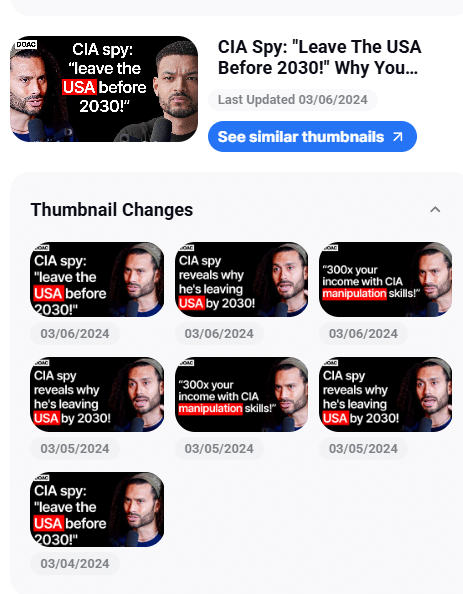
Sample: Recurring A/B tests for established channels
Channel: “The Diary of a CEO”(15.1M subscribers)
But testing does not stop at a single upload. Andrii advocates re-launching older content, updating thumbnails, connecting videos via end screens, and redistributing across Shorts, TikTok, Instagram Reels, LinkedIn, newsletters, and community posts.
“Successful channels do it as a daily routine on every video,” the strategist points out.

Sample: Repurposing content into multimedia and multiplatform entities
Channel: Family Budget Ukraine(85.4K subscribers)
YouTube’s Structural Advantage
Despite the rise of short-form platforms, Andrii believes YouTube retains structural advantages.
“Nobody on the planet can offer you, as a creator, long-term videos that compound over the years,” he says.
He sees short-form as a hook mechanism; the top of a “sand clock.” Shorts capture attention; long-form builds depth, retention, and monetization.
“You can grab attention, but then it’s also a matter of redirecting them to the long forms,” Andrii says.
He also notes YouTube’s increasing vertical integration, citing features like memberships that help reduce reliance on external subscription-based platforms.
For creators selling products or services, YouTube’s long shelf life is especially powerful. According to Andrii, “a single video can generate leads years after publication.”
That compounding, he argues, makes YouTube uniquely valuable for long-term business creation.
Are Most People Built for It?
The question of who is actually built for high-performing YouTube careers, Andrii believes, comes down to scale. In his view, not everyone is built for the intensity required at the top.
“Very successful YouTubers are obsessed with ideas, with testing, with execution,” he says. “It’s a terrible work-life balance.”
But he does not see that as a flaw in the platform. YouTube is both an empire-building tool and a space for expression.
“Maybe not everyone is wired as high-impact, 24/7 creators, but that’s not the point about YouTube,” he says. “It’s a platform you can use in whatever way you can think of.”
Streaming, Sports, and AI
Over the next five years, Andrii expects structural shifts driven by live streaming, sports rights, and deeper platform consolidation.
“YouTube is like a big octopus trying to get everywhere,” he says.
He points to expanding partnerships with major sports leagues and live-event streaming as key growth areas, alongside new monetization tools that keep transactions within the platform. AI will likely accelerate editing, packaging, and production workflows. But he remains cautious about fully synthetic content replacing human creators.
“People watch YouTube because of other people,” Andrii says. “We are really hooked to other people, not to some pixels.”
Subscribe to Our Newsletter
Check Out Our Podcast