








Tech
Ernst Rustenhoven Joins The Cirqle As CSO, Betting Creator Marketing’s Defining Moment Has Arrived

Creator marketing has spent a decade fighting for budget. Ernst Rustenhoven, a former investment banker and venture capitalist who spent 15 years backing consumer brands, thinks that fight is nearly over.
Ernst has joined The Cirqle, the Amsterdam-based Meta and TikTok marketing partner, as Chief Strategy Officer. His background is unconventional for the role: seven years in mergers and acquisitions, six years as an investor at Slingshot Ventures, and, most recently, a nearly two-year stint as CEO of ILGM.com, a cannabis seed company serving U.S. consumers. He arrived at The Cirqle not as an outsider, but as a customer, having used the platform while running ILGM to manage and scale creator campaigns in a category where traditional advertising channels were largely off-limits.
“In the cannabis industry, it’s not so easy to find the right creators,” Ernst says. “But cracking that code was therefore even more important because, if we could do it, then it was a really big competitive advantage compared to any of our competitors.”
The experience crystallized something he had observed since his venture capital days: the brands that consistently outperform their categories are not necessarily the ones with the best products alone. They are the ones who know how to build trust through creator-led commerce. “If the product is good, then this is what sets apart the really stellar brands from the ones that just perform okay,” he says.
Creator Marketing Was Always a Venture Capital Thesis
Ernst’s path to creator marketing runs through the early history of European e-commerce. When he entered M&A in 2008, e-commerce was still considered a genuine technology play. He advised fashion brands, helped founders understand buy-and-build strategies, and eventually moved into venture capital at Slingshot Ventures, where he backed consumer companies including Wild, a vegan deodorant brand, and Yepoda, a Berlin-based K-beauty company.
Watching those brands scale, he began to notice a pattern. “You saw that people were looking for trust,” he says. “And who do you trust more? It’s the people you follow. You consume their content, you feel related to them. So, creator-led commerce was a very logical extension of what general e-commerce marketing channels offered.”
The potential was visible early. So were the limits. Outreach happened via DMs. Performance was tracked in spreadsheets. There was no reliable way to predict which creator would move the needle for a specific product in a specific category.
“Very fragmented, very labor-intensive, just messy, not scalable at all, difficult to track performance,” Ernst says.
The Industry’s Unsophisticated Middle
The industry’s fragmentation, Ernst argues, has not disappeared. It has simply been obscured by growth.
One of the observations that struck him in his first weeks at The Cirqle is how much manual, undisciplined work still characterizes creator marketing at the brand level. Companies are still DMing creators individually, sourcing contact addresses directly, and running campaigns out of spreadsheets. “A lot of people say they’re tech and self-serve and everything runs by itself, but it’s not,” he says. “A lot of parties are trying to present themselves as platforms, but are basically agencies behind the scenes.”
That gap is compounded by inertia. Brands that have developed internal workflows, however inefficient, are often reluctant to replace them. “If something works, in your opinion, that’s what good looks like,” Ernst notes. “It’s scary to go for something you don’t know, even if we outperform that way of working.”
What Creator Marketing Needs to Earn Its Place in the Budget
For Ernst, the more notable challenge is structural rather than operational. He notes that creator marketing has historically lived within brand teams, been evaluated on awareness metrics, and remained disconnected from the performance marketing stack. That separation, the former banker argues, is what has kept it off the core budget.
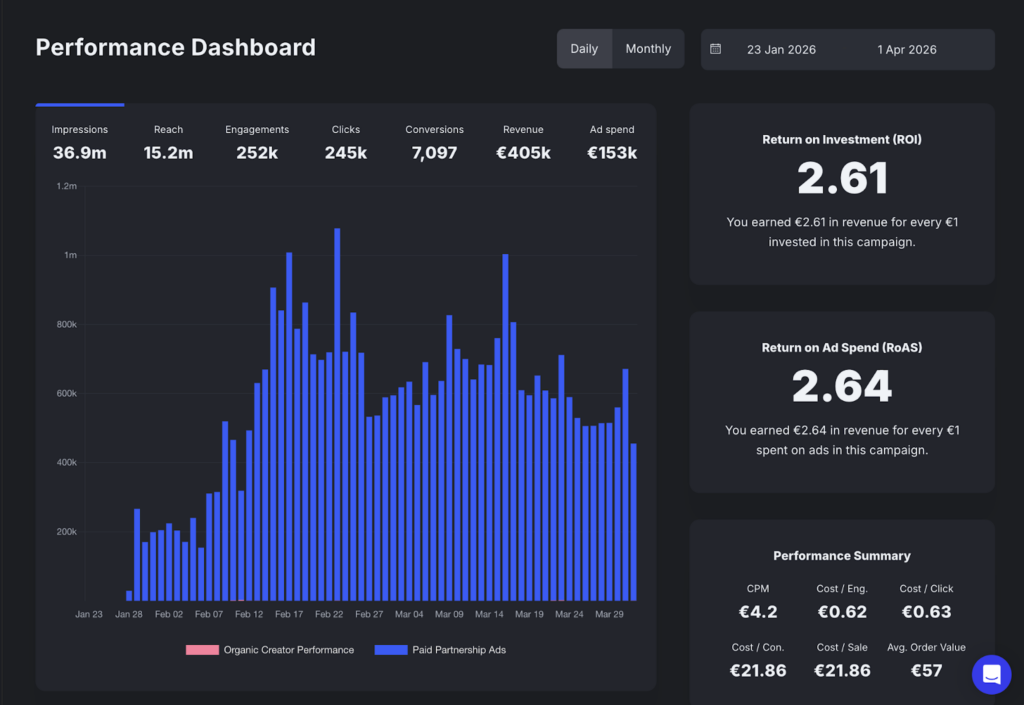
“In bigger companies, if you can’t prove to your CFO that something is worth the money, these budgets tend to go away fastest,” he says. “But now, because we can actually attribute performance to creator marketing, it is really earning its space in the general performance marketing suite.”
According to Ernst, the shift requires brands to reorganize internally, not just adopt new tools. “You will see the whole marketing team basically coming together,” he says. “A typical brand team, a typical creator team, a typical performance team. If you don’t connect all of these elements, you are going to miss out because you will look at creator marketing from a brand perspective when you should also be looking at it from a performance perspective.”
Why The Cirqle Passed the Investor Test
Ernst had followed The Cirqle’s founder, Steven Lammertink, since his time at Slingshot Ventures, where he would have invested in the company had the fund’s focus and parameters allowed it. What stayed with him was one specific operational decision: Lammertink transitioned The Cirqle from an agency to a software platform.
“A lot of agencies try to do this, but probably 95% of them fail,” Ernst says. “Steven succeeded in that, which I think is extremely impressive. He also had to make hard choices.”
The platform’s first-party data infrastructure was the differentiator that mattered most to him. Because The Cirqle has worked directly with its creator network, it holds performance data from those relationships, including conversion rates, category-level return on ad spend, and audience behavior that cannot be replicated by platforms relying on third-party signals.
“We can suggest to our customers which creators actually delivered in terms of return on ad spend,” Ernst explains. “And based on what we know of these creators, we can suggest others with the same characteristics that performed well for brands in the same vertical.”
AI as the Scaling Mechanism
The Cirqle’s technology roadmap is where Ernst is investing the most attention in his first year. The company is preparing to launch a model context protocol (MCP) that will allow customers to query their own campaign data directly through an AI interface, without relying on manual reporting or analyst interpretation.
“If you want to know why your campaign is underperforming or overperforming, you can just talk to the AI, and it will tell you everything,” Ernst says. “And it will also help you scale that.”
He is also watching a broader shift in what AI tooling now makes possible for small, specialized teams. The Cirqle currently operates with approximately 10 people, a size Ernst says surprised him. “I’m just really amazed by what this small team can do and how successfully we’re scaling,” he says. “What two or three months ago nobody in the tech space would have imagined we could build, we are actually building.”

Consolidation Is the Next Chapter
Looking beyond the product roadmap, Ernst sees the creator marketing technology space entering a consolidation cycle.
“You will see this industry start to consolidate, which is a massive opportunity for The Cirqle to lead in that area,” he says. “We can grow organically very fast. But joining forces with other companies is also an opportunity.” Fundraising, if necessary to accelerate that process, is within the scope of his role. “But so far we don’t need it, which is an even better position to be in”, he adds.
For Ernst, the convergence of these factors, the professionalization of creator marketing, the emergence of reliable attribution, the maturation of AI tooling, and the pending consolidation of the platform layer, is what makes the timing feel less like a bet and more like a thesis he has been building toward for 15 years.
“I’ve been working with consumer brands, advising and investing in them for 15 years,” he says. “Now, we’re helping those same brands scale in a market, at a company, that my investor’s heart says I would invest everything I have.”
Subscribe to Our Newsletter
Check Out Our Podcast