



Technology
As Generative AI Floods Content Feeds, EditWithAva Is Betting on Editing the Real Thing

Everyone building AI video tools right now is racing toward the same destination: synthetic footage that looks real enough to replace a camera crew. EditWithAva has gone in the other direction.
Matthias Rossini, the company’s Berlin-based co-founder, is building AI designed to work with footage that already exists, helping agencies and creators turn hours of raw video into finished cuts without a human editor spending days in a timeline. Founded in 2025, EditWithAva targets professional teams who have more footage than they can edit, not teams that want to manufacture content without shooting any.

“Real video matters more in the age of AI, not less,” Rossini says. That conviction comes from a production-side career spanning freelance photography and filmmaking, creative strategy at FYPX, Germany’s first TikTok one-stop shop, and a strategy director role at ODALINE, a social video agency running high-volume campaigns for major brands. From those positions, Matthias watched two things accumulate in parallel: footage that went unused because editing it was too expensive, and evidence that audiences remained more responsive to content made by real people.
The Story Nobody Had Time to Tell
Matthias didn’t build EditWithAva because editing felt broken. He built it because he kept watching footage go to waste.
At his last agency, a production for an outdoor brand sent a crew to Morocco for two weeks. The shoot generated roughly 50 hours of footage. The team extracted about five hours of material, produced six episodes for a YouTube series, and shipped. The remaining 45 hours sat there, stories no one had the time or budget to tell.
“How much more fun could it be if you could actually access this?” he says.
The obstacle wasn’t inefficiency in the traditional sense. A new editor arriving at that company would need two to three months to screen 50 hours of footage, organize it, and understand what it contained. Nobody had that time. So the material sat, economically unviable to process. Matthias saw it not as a problem, but as an opportunity: if AI could screen and surface footage at speed, the economics of production would shift. Footage, instead of accumulating as a cost, could function as an asset.
What 37 Years Didn’t Change
Matthias’s launch post declared that editing hasn’t changed in 37 years. He calls it “intentionally provocative,” but the underlying argument is specific.
The nonlinear editor, the NLE, transformed production by freeing editors from sequential tape cuts. Tools from Premiere to CapCut still operate on this model: a single timeline, one piece of content, one editor. For a contained project, it works.
The problem, Matthias argues, is that the model breaks at scale. When a brand needs localized cuts for multiple markets, or a creator wants 20 versions of a video for different platforms and audiences, the NLE architecture shows its limits. “You’d have 45 different timelines you’d have to look through and kind of switch back and forth,” he says. Managing that volume requires a different architecture entirely, one where AI handles the versioning while a human manages the story.
This is what EditWithAva is building toward: not a better timeline, but a system for managing multiple outputs from the same source material.

From Brief to Edit, Without a Timeline
The product, which Matthias says is currently undergoing rework, operates in two phases.
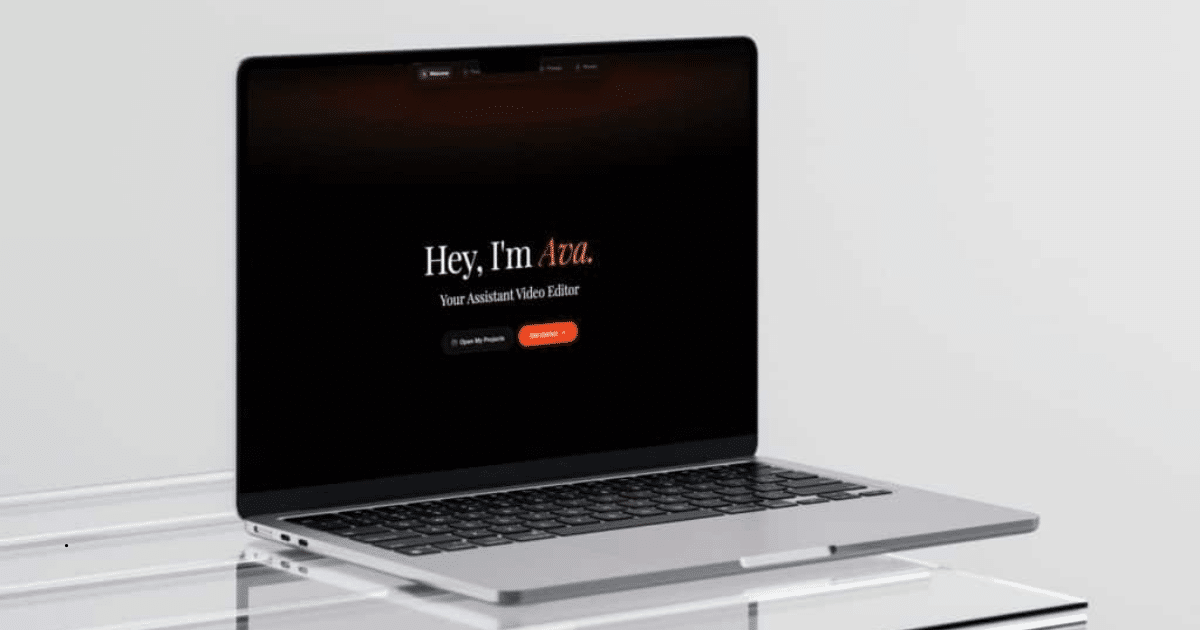
The first is video understanding. Creators and agencies often arrive without a clear picture of what they want from their footage. Ava is designed to analyze uploaded material, whether that’s raw footage, a brief, a shot list, or a storyboard, and surface a structured story the user can examine and adjust. “You receive a story,” he says. “And this story you can play around with almost like building blocks.” Users can see which video assets Ava would select for each segment and why, then iterate before any video is rendered.
The second phase is execution. Once a vision is shaped, Ava renders the output and allows for collaborative review. Agencies can share links for team feedback, leave comments on specific sections, and Ava incorporates the changes, removing the cycle where editors spend time on a full cut only to have a stakeholder reject it in the first thirty seconds.
Where Ava separates itself from clipping tools, Matthias says, is in the depth of assembly. Clipping tools extract a hook from a long video. Ava is designed to piece a story together from multiple source files, including unlabeled audio tracks, unscripted raw footage, and material spread across several folders that a human editor would need days to organize before touching a timeline. The company’s stated benchmark: ten videos in roughly 35 hours the traditional way versus about two hours with Ava.
Where the System Still Falls Short
The most notable limitation Matthias acknowledges is natural language. Much of Ava’s current workflow runs through conversational instruction, and natural language breaks down fast when precision matters.
His example: a video call where headphones fly across the screen at a specific moment. If a user wants that exact frame, trimmed to a specific duration, shifted five seconds earlier in the cut, describing it in words becomes nearly impossible to execute without ambiguity. “There are just certain limitations of natural language,” he says. “Our job as a product company, not just an AI company, is to build around these limitations.”
The rework currently underway is aimed directly at this problem: adding interface layers that give users precise control over edits that prose cannot accurately specify.
What the Market Keeps Confirming
Matthias describes a pattern repeating among agencies this year. A team experiments with AI-generated user-generated content, produces synthetic talking-head videos at scale, and then comes back.
He doesn’t offer hard numbers on synthetic versus real content performance, but his read of the market is consistent with his founding thesis. In many verticals, audiences detect synthetic creators, and the response isn’t the same. “In the end, humans do like to consume from humans,” he says.
The direction he sees this heading is toward what he calls a “proof of human”: a point at which content provenance, whether it was produced by a real person, carries signal value of its own. Fictional formats and some advertising categories may tolerate synthetic production. But for content that depends on human experience and audience trust, the underlying source material matters.

Treating Footage as an Asset
The downstream implication of EditWithAva’s model extends beyond time savings. When editing capacity stops being the bottleneck, Matthias argues, teams should rethink how they approach production itself.
“Stop treating footage like a cost and start treating it like an asset,” he says. “When capacity is no longer the bottleneck, more footage becomes more opportunity, not more backlog.” The immediate rethink he recommends: stop pre-producing exhaustively to minimize the volume of material that needs editing. When editing is cheap, shooting more becomes viable. Localized cuts, channel-specific variants, B-side stories, ten angles instead of betting on one, these shift from aspirations to operational choices.
The second reallocation is talent. Matthias estimates that roughly 90% of editing is operational labor: screening, logging, syncing, hunting for the right clip, brief-based assembly. “The recovered time and budget should flow entirely into that 10 percent,” he says. “Namely: taste, narrative, and distribution.”
Five years out, he expects video assembly to become infrastructure in the same way spellcheck did: something that happens automatically, below the threshold of conscious decision. That shift, he argues, opens the door for a new category of creator, the time-poor professional who has something worth saying but no capacity to edit. “It’s not that this person necessarily lacks the skills to create videos,” he says, “but they lack the time to edit, and they lack the trust to outsource.”
As for the incumbents, Matthias draws the clearest possible line. “Adobe owns the timeline,” he says. “Adobe will bolt AI onto the timeline. We’re not trying to add AI to a timeline; we’re changing what the job is entirely.”
Subscribe to Our Newsletter
Check Out Our Podcast