


Technology
Kale CEO Isha Patel On Turning Superfans Into A Scalable Marketing Force

What if the most powerful marketers for a brand aren’t influencers, but its everyday fans? That question guided Isha Patel, co-founder and CEO of Kale, as she set out to reimagine how brands measure and reward social influence.
A former senior product manager at LinkedIn, Isha helped launch video, creative tools, and Stories to more than a billion users and 30 million brands. But during the pandemic, she noticed a shift: people who never saw themselves as “creators” were suddenly building micro-communities on TikTok around their interests – from coffee rituals to yoga routines.
“During Covid, our friends were making funny videos, doing dances with their siblings, and talking about their favorite products,” Isha recalls. “They didn’t call themselves influencers, but they loved sharing what made them happy.” Many of these users organically mentioned brands they loved, without seeking sponsorships or payment. “They weren’t chasing deals,” she adds. “They had jobs, stability, and just wanted to share.”
For Isha and her co-founder and CTO Luis Molina, that insight – that social connection rather than follower count drives brand storytelling – became the foundation of Kale. The New York-based platform, founded in 2021, rewards consumers for creating content about the products they genuinely use and love.
“We’re on a mission to translate everyone’s social value into economic value,” Isha says. “Before Kale, the only metric was follower count, and I never believed that was true social value.”
Building a Marketplace for Everyday Advocates
Kale was designed to connect everyday advocates with brands searching for credible, scalable voices. Through its mobile app, users can browse partner brands, create videos in response to specific prompts, such as showing a “day in the life” using a product, and earn cash rewards based on engagement performance.
For marketers, Kale offers an alternative to traditional influencer campaigns. “Every social team has influencer marketing as a KPI (Key Performance Indicator),” Isha notes. “But most feel shackled to outdated systems, sending free products to hundreds of influencers and hoping for a 20% post.”
Instead of large-budget sponsorships, Kale enables brands to activate hundreds or thousands of superfans simultaneously. “A brand like Chili’s could maybe get 50 videos live in a quarter,” Isha says. “With Kale, they can get thousands, and they don’t have to pay with a gift card.”
Each video’s reward is tied to measurable engagement (likes, comments, shares, and saves) rather than follower count. “We consistently deliver 8-10% engagement rates,” Isha says, “which is about 20 times higher than a typical influencer campaign.”
Brand Loyalty Through Data
Kale’s growth is grounded in measurable outcomes. Isha believes that the platform’s model of rewarding superfans for creating authentic content helps brands convert everyday enthusiasm into quantifiable reach, engagement, and sales.
Its earliest success came from OLIPOP, the functional soda brand that wanted to “give the mic back to its community.” Through Kale, OLIPOP launched a series of TikTok activations focused on gut health and wellness, owning the hashtag “#guttok” in the process.
“One in every three videos under #guttok is now an OLIPOP x Kale video,” Isha notes. Kale’s creators account for more than 30% of the hashtag’s total content, contributing to a 15% overall increase in “#guttok” videos during the campaign and a 50% lift in OLIPOP’s revenue. “TikTok has become their SEO (Search Engine Optimization) engine,” Isha says. “When you search for gut health, you’ll find OLIPOP at the top, powered by their superfans.”
Another standout was Chili’s, which used Kale to “seed” a new menu hack before announcing it publicly. According to Isha, the activation drove 200,000 engagements, over 3 million impressions, and more than 7,400 user videos, achieving an average engagement rate of 10%. “For Chili’s, we turned customers into cultural participants,” Isha says. “They weren’t just eating there; they were co-creating the brand story.”
Other partners have seen similar effects. CAVA tapped into TikTok’s blind box trend to promote its Harissa Bowls, earning a 7% engagement rate and growing social mentions by 15%, while Cinnabon captured dominance under “#bestcinnamonrolls,” with Kale creators responsible for two in every five videos under the tag and a 40% surge in hashtag activity during the campaign.
For Isha, these data points validate Kale’s thesis: community is the new media channel. “Every marketer knows how many mentions they’re getting,” she says. “Our goal is to double or triple those mentions through real people, not polished influencers, but superfans who genuinely care.”
Why Brands Are Re-Evaluating ‘Influence’
Isha believes Kale’s growth signals a larger shift in marketing psychology. “The brands that are winning on social have redefined what virality means,” she says. “It’s no longer about one polished video hitting a million views. That’s risky and fleeting. The algorithms now reward volume from relatable people.”
According to Isha, brands still adjusting to this new reality often conflate “brand safety” with rigid creative guidelines. “There’s a difference between safety and aesthetic control,” she says. “If your brand colors are bright pink, but your New York creator only wears black, forcing that visual is going to feel fake. Engagement rate is the real measure of quality.”
The rise of short-form video has further blurred the lines between professional creators and everyday users. “Someone with one follower can go viral on TikTok,” Isha says. “The rules have been rewritten.”
‘The Kaley Awards’: Brand Love in Real Time
Kale’s growing dataset on consumer engagement led Isha and her team to create “The Kaley Awards,” a new annual celebration honoring marketers who turn their brands into cultural phenomena. This year, the second annual in-person ceremony took place on November 12 at Lightbox NYC, bringing together marketing leaders from DoorDash, Starburst, The Ordinary, Planet Fitness, Chili’s, Nuuly, Urban Outfitters, Cinnabon, Free People, OLIPOP, CAVA, and others.

“We founded the Kaleys to honor the marketers who are rewriting the rules,” Isha says. “Community is the queen. Content can’t stand alone.”
Unlike traditional industry awards that focus on creative execution, the Kaleys draw from Kale’s proprietary data measuring brand love, sentiment, and consumer demand. “We actually know if a brand has community,” Isha explains. “Our model gives us a litmus test for that.”
The event’s dinner format reflected that same community ethos: guests sampled dishes and cocktails made with Kale-partner brands, from Tru Fru cheesecake to Cinnabon pudding and a Starburst pink martini. “We wanted to celebrate our brands at the heart of the experience,” Isha says.
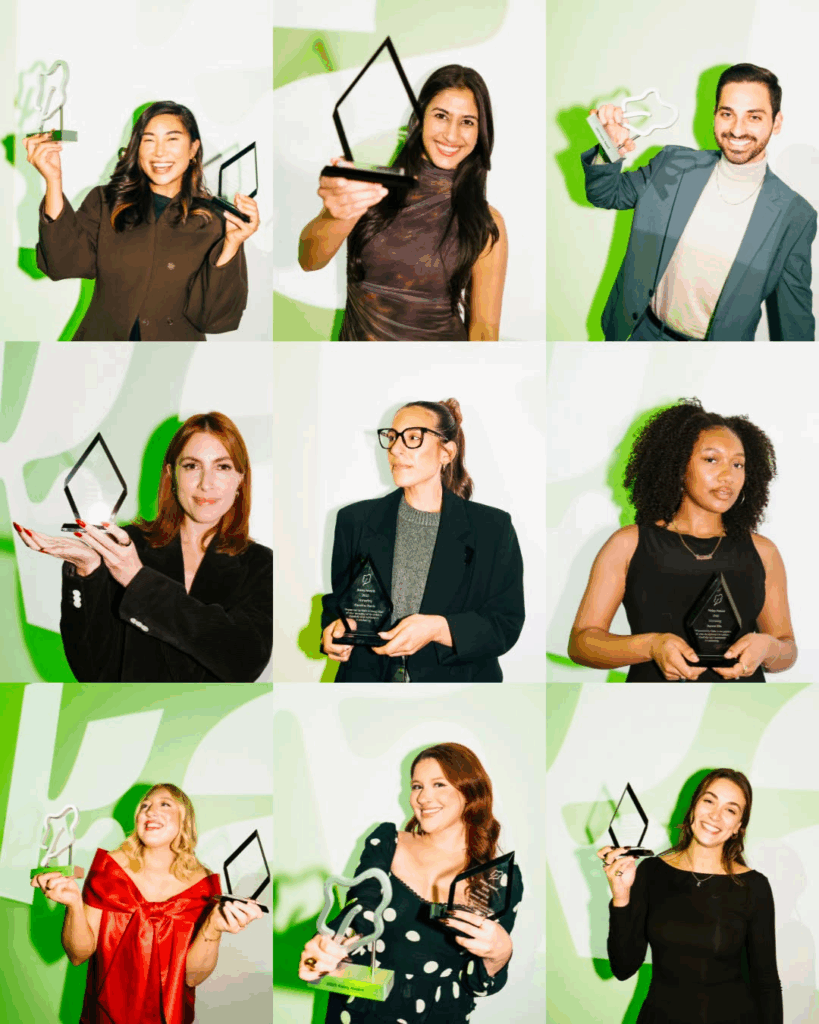
The Kaley Awards winners this year include Evan Ponter from Urban, Olivia Caridi from Kao, Iayana Elie from Nuuly, Richa Anand from Eat Legendary, and Steven Vigilante from OLIPOP. Other recipients are Krista Mercado from The Ordinary, Bailie Bridges from Cava, Caroline Adams and Libby Strachan, both from Free People, and Catherine Gammie from Starburst. Additional honorees include Lauren Janis and Hannah Gregus from GoTo Foods, Jack Hailey from Chili’s, Jane Hong from DoorDash, Kunku Wangdi from AESTURA, Caroline Nevin from Planet Fitness, and Emily Tumminia from Unilever. Lara Adekola from Glossier rounds out this year’s group of marketing professionals.
The Future of Consumer-Led Storytelling
As social algorithms change, Isha expects brand-led storytelling to become more participatory – what she calls “co-creation at scale.” Kale has already run challenges where consumers propose the next wave of video prompts, effectively shaping campaigns themselves.
“For a brand like OLIPOP, a superfan who drinks it 15 times a week will come up with a better social idea than 15 employees sitting in a room for 10 hours,” Isha says. “That’s what excites marketers … hearing from their own consumers.”
Isha predicts that in 2026, co-creation will move beyond content into new forms of brand participation. “Content is just where we’re starting,” she says. “We’re building ways for consumers to get rewarded for interacting with their favorite brands beyond video.”
Future Plans
Building on its recent success, Kale is expanding its footprint through a series of strategic partnerships with carefully selected brands set to roll out in 2026. “The model won’t work for every brand,” she says. “We’re selective. We look for brands with strong communities and a real emotional connection.”
Kale also plans to expand how users earn rewards, offering more “lightweight actions” tied to engagement and advocacy.
Isha remains focused on the broader cultural role that brands now play. “Consumers today see brands as connective tissue,” she says. “In a world where people feel more distant, they look to brands to help them feel seen and connected.”
Her advice to marketers: resist automation’s shortcuts. “With the rise of AI, it’s tempting to use avatars or generated voices,” Isha says. “But consumers will see right through that, just like they do with gifted influencer posts. Focus on real human stories.”
For Isha, the creator economy’s next phase won’t hinge on follower counts or viral hits but on genuine connection. “Brand building needs to be every CMO’s priority,” she says. “Ads fatigue, algorithms change, but community endures.”
Subscribe to Our Newsletter
Check Out Our Podcast