






Influencer
From Skits To World Tour: How Sooshi Mango Turned Cultural Comedy Into A Global Business

When Joe Salantiri, Carlo Salanitri, and Andrew Manfre first placed a camera on a car dashboard and started filming, there was no roadmap to a global entertainment business.
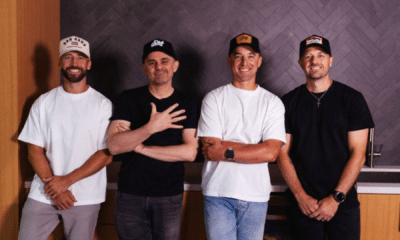
More than a decade later, Sooshi Mango, the Australian comedy trio founded in 2015 by Joe, Carlo, and their longtime friend Andrew Manfre, has built one of the most recognizable, character-driven brands in the Creator Economy. With over 800 million views across social media, including Instagram, YouTube, and TikTok, as well as multiple sold-out theatrical shows, including three consecutive performances at Melbourne’s Rod Laver Arena, the group has expanded beyond short-form sketches into podcasting, live tours, hospitality, and film.
“We’ve been idiots for a very long time,” Joe says. “We just put a camera in front of us now.”
Their trajectory did not begin in entertainment boardrooms. It began in scrap yards, corporate sales roles, and small businesses.
Joe spent years in various sales roles while performing in a wedding and corporate band for about 15 years. Andrew owned a scrap metal recycling and export company. Carlo ran a lighting business. “In the beginning, it was more just that we were messing around,” Carlo says. “It was more a thing of therapy.”
That therapy turned into a business. But not overnight.
An Organic Formation Rooted in Family
Carlo is Joe’s brother. Andrew has been a family friend for more than three decades. The chemistry was not engineered. It already existed.
“We’ve known Andrew for 30-odd years,” Joe says. “We’ve been around each other for a very long time, so the chemistry was easy to work with.”
“We were inspired by early YouTube and Vine creators,” Joe shares. “I saw YouTube and Vines, and I was like, ‘I think we could do something like this.’”
They began with simple car sketches and improvised bits. Then came a pivotal video: Italians Vs Greeks. Dressed as exaggerated versions of both cultures, they tapped into something broader than a one-off joke. “That was the [moment],” Joe notes.
Andrew points to the introduction of their “dad” characters as the true inflection point. “The dad’s characters seem to translate universally,” he explains. “Everyone seemed to understand because anyone who’s of an immigrant family would understand those characters.”
What began as culturally specific humor evolved into something more universal. “We’ve gone from making cultural comedy to tapping into a much larger audience where it’s just funny,” Andrew says. “They look funny, they talk funny, they move funny, and everyone seems to enjoy them.”
Building Characters That Don’t Expire
Sooshi Mango’s comedic philosophy is rooted in legacy acts. Carlo cites the Marx Brothers, Laurel and Hardy, Dean Martin, and Jerry Lewis as creative benchmarks. The ambition was not to create fleeting trends but to create enduring personas.
“Our goal was to create and develop the character rather than give it some life for a year and then put it away,” Carlo says.
Unlike trend-based digital comedy, which often relies on topical moments with short shelf lives, Sooshi Mango’s characters are intentionally timeless. “These characters are already old,” Andrew says. “We’re bringing those characters back to life and keeping them relevant.”
On stage, jokes cannot be repeated. “Comedy is not like music,” Carlo notes. “If you say a particular joke and then you do it the next show, they’re like, ‘Oh, he said that joke in the other show.’”
Online, however, characters become anchors. Audiences return not just for punchlines, but for personas. If the trio experiments too far outside those core characters, fans push back. “Every time we take them away, they yell at us,” Carlo says.
The lesson is clear: identity builds equity.
A Process Defined by Improv and Precision
Despite their scale, Sooshi Mango’s production process remains simple.
Ideas live in phone notes and WhatsApp threads. “I’ve got a hundred different ideas,” Carlo says. “We’ll send it through on WhatsApp. If we all like it, we jot it down.”
Shooting is largely unscripted. “There’s no script,” Carlo says. “It’s just on the spot.” An initial idea can “twist” or “morph” as the improvisation unfolds.
Yet, while performance is loose, editing is meticulous. “We are sticklers for .002 of a second in an edit,” Joe says. “Cut it a little bit earlier, cut it a little bit later. It’s very important in the comedy and in the pace of a video.”
Being real is the central production principle. “I think the authenticity is the most important part of what we do,” Joe says. “There are other people trying to do this genre, and there’s something about it that just doesn’t hit the mark.”
That balance of free-form performance and exacting post-production has allowed the trio to adapt to platform shifts without losing identity.
Adapting to Shorter Attention Spans
In their early years, three-minute sketches were common. Now, attention spans demand compression.
“The content that’s being consumed has changed,” Carlo says. “It’s gone from longer form to shorter and shorter. So, the process is about getting the message across in under a minute.”
Joe observes a broader pattern across platforms. “It has to be really long and elaborate or really short and punchy,” he says. He highlights the increasing tactic of placing punchlines at the beginning of videos to capture viewers immediately.
Andrew notes another development: less dialogue. “In some videos, there’s no need to talk,” he says. “Just shut up and let the comedy do its thing.”
The strategy has also helped them overcome language barriers as their live shows expand into markets such as Poland, Bulgaria, and, soon, the UAE (United Arab Emirates).
Listening to the Audience
For Sooshi Mango, data is not abstract analytics. It is immediate feedback.
“Let the interaction determine whether you’re onto something,” Carlo says. “Drop an idea or don’t continue with a series if it’s not working.”
He observes other creators repeating formats that fail to resonate. “If you try a specific format and it doesn’t work and the next video is the same, you haven’t learned your lesson.”
Andrew adds a caution for creators too attached to their own humor. “Sometimes you create a piece of content, watch it, and really laugh hard at it. If we really laugh hard at our content, we go, ‘Oh, maybe this isn’t the right content.’”
The trio credits audience response as the engine behind their growth from an initially ethnic-focused fanbase to a broad, multi-generational audience. “If you go to one of our live shows, it’s every nationality you can think of,” Andrew says.
Being Underestimated by Brands
Despite their scale, the trio says brand recognition did not come easily.
Joe argues that brands should involve creators earlier in the creative process. “The creator knows how to best interact with their audience,” he says.
Andrew goes further. “Some brands need to learn to stop taking themselves so seriously and have a bit of a laugh,” he says. “Just shut up and just be human for a bit.”
The takeaway is consistent across the group. “Let the creator do the creating,” Carlo says.
Expanding Beyond Social
What began as weekly “therapy” sessions has grown into a diversified business.
The trio launched the “Sooshi Mango Podcast” in 2021, which has since become one of the biggest and most listened-to podcasts in Australia.
They operate a restaurant, Johnny, Vince and Sam’s in Melbourne, Australia, that is approaching its third year. In 2026, they are focused on a multi-part world tour, opening an Italian sandwich shop, and producing their first feature film.
“We’ve got quite a busy year,” Joe says. “We’re shooting our first feature film and opening up an Italian sandwich shop.”
As the trio prepares for international tours and a feature film release, their focus remains on applying the same principles that powered their early sketches: authenticity, discipline, and listening.
“We just basically implement everything we’ve done with Sooshi Mango to everything else that we touch,” Joe says.
For aspiring creators watching their trajectory, the message is less about virality and more about longevity.
“You need time,” Joe repeats. “You’ve got to be consistent and disciplined by just putting out videos over and over again and eventually finding one and finding a rhythm that works.”
Subscribe to Our Newsletter
Check Out Our Podcast