



Strategy
Creator Content Now Accounts for 44% of Paid Media Creative, Exposing a New Gap Between Leaders and Laggards

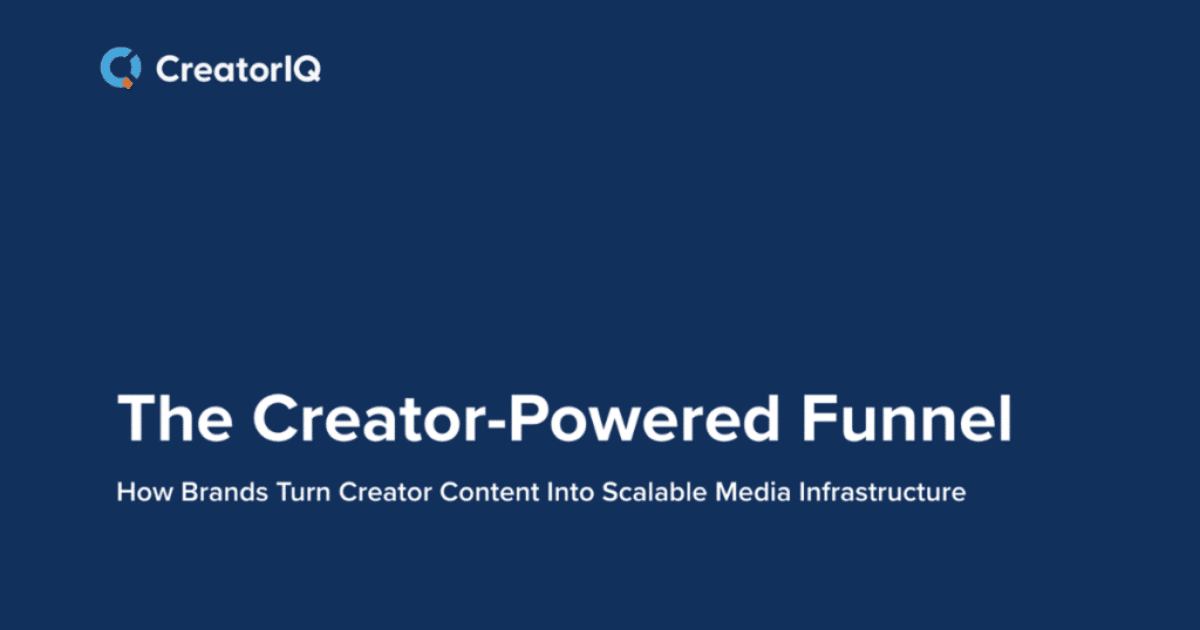
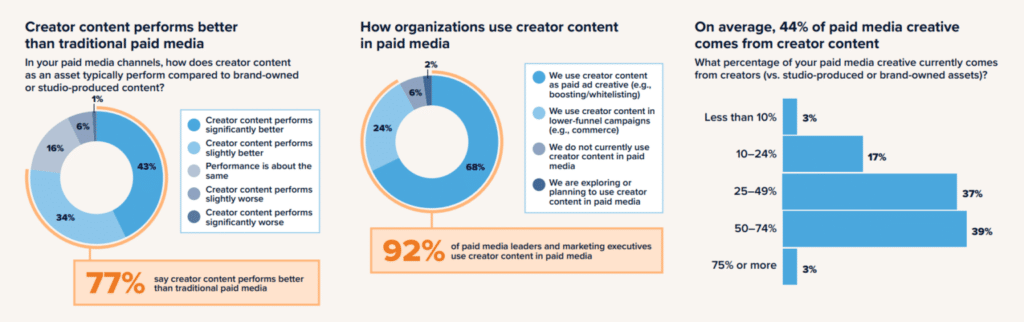
Creator content now accounts for 44% of paid media creative on average, according to new research from CreatorIQ, marking a shift in how brands are using Influencer Marketing beyond organic reach and one-off sponsorships.
The report, “The Creator-Powered Funnel,” published in June 2026, found that 92% of paid media leaders and marketing executives now use creator content in paid campaigns. That number surprised even the executive who helped frame it.
“I was really surprised by the 92%,” says Tim Sovay, Chief Partnerships Officer at CreatorIQ. “That number a year or two ago was half that.”
Tim spent more than 15 years building toward this moment. He co-founded one of the industry’s first Influencer Marketing agencies in 2010, sold it in 2015, and joined CreatorIQ. Nearly a decade later, he oversees strategy, partnerships, and customer success at a platform serving more than 1,300 brands and agencies, including dentsu, Delta Air Lines, Google, Beiersdorf, Nestlé, Wella, and Unilever.
CreatorIQ’s report surveyed 100 paid media managers and marketing executives and analyzed 38,100 creators across 59,600 campaigns. Its central finding points to a market where creator content is no longer a peripheral asset for social teams. The question is whether brands have built the measurement, rights, workflow, and paid media infrastructure to use it at scale.
“We see a really big jump in ROI from leaders versus laggers,” Tim says.
Three Phases, One Inflection Point

To understand where the industry is, Tim traces where it has been. He frames the transition in three distinct phases.
The first, pre-pandemic, was what he calls the “Wild West.” Follower counts and reach dominated, performance measurement was largely absent, and technology lagged behind ambition. “I still believe impressions are important,” Tim says. “We measure impressions and views in every other channel.” But the performance side, he concedes, was missing.
The pandemic forced the second phase. Every brand became an e-commerce company overnight, and creators filled a production vacuum when agencies shut down. Creator affiliate commerce, already familiar to D2C and mid-market companies, suddenly became urgent for enterprise brands.
The third phase, underway for the past 12 to 24 months, is defined by measurement infrastructure finally catching up to adoption. Platform investments led by TikTok’s Spark Ads, followed by Meta’s Partnership Ads and YouTube’s Partnership Ads, gave brands the technical pathway to treat creator content as scalable paid media inventory. According to Tim, the IAB reported that in 2026, for the first time, more dollars will be spent against creator ads than creators will receive in direct fees. “I’m not saying that’s right or wrong,” he notes, “but it just shows you where the growth of the space is.”
Tim frames the opportunity against a $250 billion global paid social advertising market and argues that creator content’s share is growing two to three times faster than digital advertising overall. “That’s where dollars work,” he says.
What 92% Adoption Actually Signals
The 92% figure is striking, but it is not a measure of sophistication. The report draws a sharper picture: Fortune 100 brands now receive 33 times more creator posts than owned posts across TikTok, Instagram, and YouTube. Most of those brands, Tim argues, are not yet extracting full value from that volume.
Performance data reinforces the shift. Tim points to Meta’s own figures showing creator content delivers 20% lower cost per acquisition and 50% higher click-through rates compared to standard brand creative. TikTok’s Spark Ads show even larger performance differences. The report found that 77% of respondents say creator content outperforms traditional paid media creative, with 43% describing the advantage as substantial. Eighty-six percent of respondents report achieving at least 2x ROI from creator marketing.
“The right approach is a blend of the two and sequencing and knowing when to deliver creative versus a targeted performance ad,” Tim says. Creator content is not replacing branded creative. It is taking a larger structural role in how brands allocate media spend. The distinction between organic and paid is collapsing, but what replaces it requires more deliberate infrastructure than most brands currently have.
That infrastructure, in Tim’s framing, means predictive tooling that recommends which assets to amplify, at what budget, and with what expected return on ad spend. “That’s where the space is going,” he says.
The Confidence Paradox in Measurement
One of the report’s sharper tensions involves measurement confidence: 95% of respondents say they are confident their current approach accurately captures creator marketing’s revenue impact. Yet the most common barrier to scaling creator content in paid media is difficulty measuring creator-driven performance separately from other creative assets, cited by 58% of respondents.
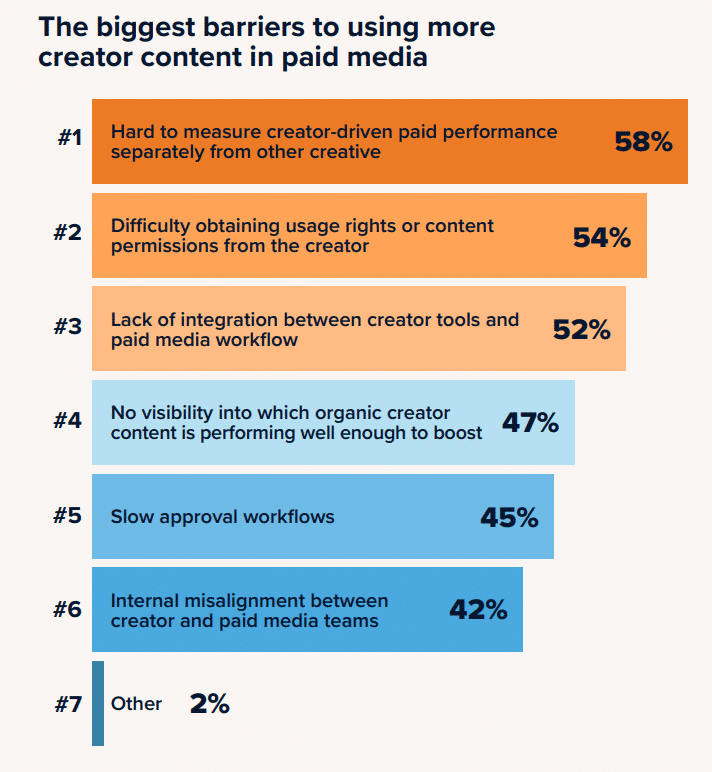
Tim’s interpretation: the tools exist, but adoption is uneven. “The measurement solutions are now there and in place,” he says. “Three or four years ago, the hurdle was just not having the right attribution or performance solutions there.” The barriers today, he argues, are internal. “Do you have the right expertise in-house, do you have the right partners, do you have the right framework?”
That gap between confidence and capability reflects the maturity divide Tim consistently highlights. The most sophisticated brands run full attribution, brand lift studies, and e-commerce performance signals simultaneously across their creator programs. Others have outsourced the entire function to agency partners. “That is sacrilegious,” Tim says of the latter group. “You are just letting this flow out your door without any kind of ownership control, data management. It is just the exhaust leaving the building.”
Creator Friction Is the Industry’s Unfinished Business
Operational complexity is one barrier to scale. The creator relationship itself is another.
The report identifies securing usage rights and content permissions as the second most common barrier to scaling creator content in paid media, cited by 54% of respondents. For Tim, this is not a legal technicality. It is a structural mismatch between how brands want to operate at scale and how creator contracting currently works.
“There is still friction between creators and brands right now,” he says. “Creators absolutely need to get paid additionally for usage rights. They should understand the opportunity behind it, but they should get paid, 100%.” The negotiation overhead compounds at scale. “It’s a lot of back and forth, brands not knowing what to pay or lowballing, creators being skittish about giving up paid rights.”
Tim is clear that this friction is not inherently adversarial. Creator marketing does not operate like programmatic buying. “This isn’t programmatic,” he says. “It’s not about hitting a button and reaching a million people.” But with brands like Unilever seeking to activate 50,000 creators globally across more than 100 countries for the World Cup, and then deploying that content across their entire paid ecosystem, friction scales proportionally to ambition.
The Widening Gap Between Leaders and Everyone Else
Tim describes the current market as sitting on a wide maturity curve, with notable distance between the brands that have figured this out and those still working on it.
At one end, the most advanced brands run what he describes as a closed-loop system: creator performance data feeds back into paid media decisions in near real time, informing creator selection, spend allocation, and expected return simultaneously. At the other end, large organizations still manage creator programs in silos that don’t connect to their paid media stack at all. “If I go talk to 10 brands, there’s a really wide gap on where they are on their journey,” he says.
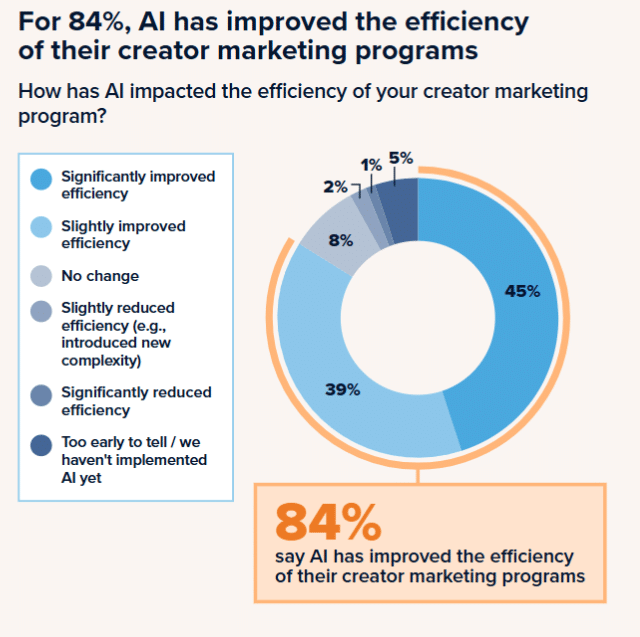
The gap is about to accelerate. The report found that 84% of respondents say AI has already improved the efficiency of their creator marketing programs. Tim sees AI’s next contribution as predictive performance modeling. “That closed loop solution, where every campaign, every post, every dollar spent is feeding back into a front end, that’s where we’re going to get,” he says.
More mature digital advertising channels have built this kind of infrastructure over 20 years. Creator marketing, roughly half that age, is building it faster.
Paid Is No Longer Optional
“The Creator-Powered Funnel” was designed to validate a thesis Tim has argued for years: creator marketing’s next chapter is a paid media story. The data now supports it across 100 respondents and nearly 60,000 campaigns.
“The ROI is there, the opportunity is there, the data is there,” he says. “It’s not just us. IAB is reporting this, the social platforms are reporting this, we’re reporting this. There’s a lot of momentum here, and now it needs to filter down into the agencies and the brands.”
The maturity gap, Tim argues, is not a question of access to information. The tools are built. The case has been made. For brands still treating creator content and paid media as parallel but separate functions, his conclusion is direct.
“Paid is here,” he says, “and it needs to become an absolutely critical part of your creator ecosystem.”
Image source: CreatorIQ
The full “The Creator-Powered Funnel” report is available here.
Subscribe to Our Newsletter
Check Out Our Podcast