




Influencer
Ecomm Cowboy Is What Happens When the Creator Economy Comes for Trade Media

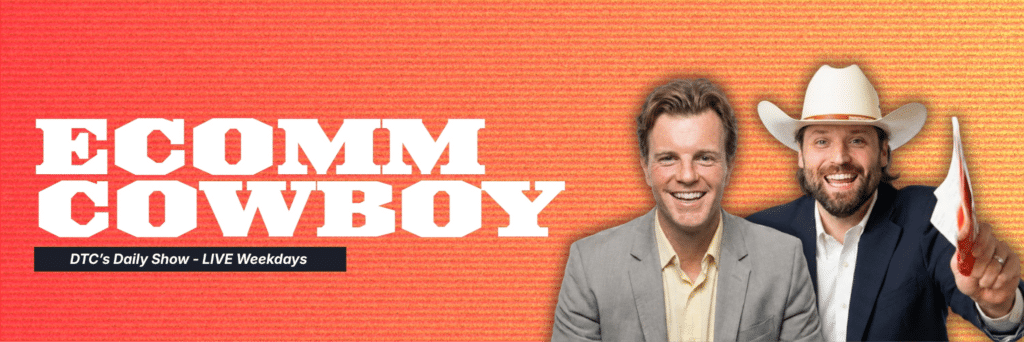
At 11:50 a.m. Central, Chris Hall is in his chair, hat on, scrambling to get tweets out before noon. In 12 minutes, he will be live for two and a half hours on X, co-hosting Ecomm Cowboy, the DTC industry’s daily briefing. The function he performs, putting an entire industry in the same room each day to discuss Meta costs, live selling, and whatever AI development broke overnight, used to require a media company to pull off. Chris now performs that function through a creator-led, bootstrapped operation built around his own daily presence.
The question worth asking is not how he built a following. It is what, structurally, he replaced.
The Desk Nobody Filled
For most of the 20th century, industries understood themselves through institutions. Trade magazines, newswires, conference circuits. These organizations sat between an industry and its own information, controlled what got covered, and charged rent on the gap. In e-commerce, that institutional layer appears to have arrived late and remained fragmented. The result was fragmented media: a long tail of podcasts, webinars, and newsletters, none operating daily, none live.
The DTC media space was saturated with content produced on a delay. “There’s very little authentic right here, now, in the moment, live,” Chris says. “We’ll be here tomorrow for you to come and interact.” In e-commerce B2B, that combination barely exists.
That vacancy is what Chris identified and moved into. He launched Ecomm Cowboy six months ago after more than a decade working inside DTC brands, most recently as director of ecommerce at 20North Inc. and, before that, Director of Marketing at BRUCE BOLT, a baseball equipment company.
The show, co-hosted by Chris and Colin Dougherty, runs daily from noon to roughly 2:30 p.m. Central on X, covering platform changes, brand strategy, and AI developments. Its purpose, in Chris’s framing, is for marketers to survive and thrive. “Ignorance is expensive,” he says. It is, for him, a business thesis as much as a content principle.
The positioning was not one he had anticipated. “I guess I live in the Creator Economy now,” he says.
The Moat Is the Hard Part
Chris could have launched an agency or a consultancy. He chose a daily live show, and the choice was deliberate. “Because it’s hard to do, and even harder to do it every single day,” he says, “if we can do it, it’s going to be harder for everybody else to do too.”
This is a specific kind of competitive logic. Most content formats get easier to replicate as tools improve. Editing software advances; AI generates scripts, summaries, and distribution schedules. A two-and-a-half-hour live show that goes out every weekday at noon, built on real-time news and genuine audience interaction, gets harder to copy as the standard for polished, on-demand content rises everywhere else. The obstacle is the moat. Real-time and human become scarce goods precisely because the alternative gets cheaper.
The format reflects a deliberate stance on what e-commerce content gets wrong. Podcasts and webinars dominate the space; very little of it is live, immediate, or built for engagement. Chris’s goal is “the best edutainment on the internet.” Information delivered without entertainment does not stick.
Community Is the Product, Not the Audience
The loneliness of e-commerce is something Chris returns to often. Founders working from laptops in home offices, optimizing ad accounts in isolation, separated from anyone who understands the problem in front of them. “Working from a laptop in e-commerce is really sad,” he says. “It’s kind of lonely, especially for founders.”
That observation shapes what Ecomm Cowboy actually provides. The show delivers information, but information alone is not scarce. The scarcity is the daily gathering, a place where practitioners across the industry assemble in real time rather than consume recorded content alone.
The community is most alive on X, where the show goes live and where short-form clips from each broadcast are distributed. A LinkedIn expansion is on the roadmap, though the two platforms read differently. LinkedIn moves more slowly and runs more corporate. X, for now, is where the daily interaction lives.
One Person, All the Assets
Before the show, there was a decade of doing the work it now covers. Chris played football at the University of Texas, was named an All-American, then spent roughly ten years in ministry and live events with college students across the U.S. and parts of Eastern Europe and Southeast Asia. E-commerce followed, across marketing, agency, and brand roles in Austin.
“There’s something about talking with people,” he says. “You miss that when you’re typing behind a keyboard.”
Six months into operation, Ecomm Cowboy sits at roughly 10,000 followers, growth Chris attributes primarily to volume. Daily live shows generate far more clips, posts, and distribution points than a podcast that drops twice a week. “More shots on goal,” he says.
The production runs on a team of four: Chris and his co-host Colin, both full-time, alongside a producer and a production assistant. The daily rhythm starts at 7:45 a.m. with emails, moves into clip editing from the previous day’s show, then run-of-show prep, newsletter writing, and a pre-show call with Colin before the chair at 11:50. The operation is bootstrapped.
What Chris has assembled in a short time is the asset stack a trade publisher would have built over decades: a daily audience, an editorial agenda, a sponsor portfolio of roughly ten brands, and a community with genuine network effects. A traditional media company holds those assets on its balance sheet. Chris holds them himself.
That career path shapes how he approaches the sponsors on his balance sheet. Someone who spent years running marketing budgets and answering to revenue targets does not apologize for ad reads. “Ads are not bad. Advertising is awesome,” he says. “I try to win an Oscar when I’m delivering it.”
What the Show Keeps Proving
Chris books guests according to a framework he calls the four-legged stool: brands, agency operators, software partners, and capital. Most e-commerce shows talk only to brand founders. The reasoning for including the others is analytical. “Agency operators see many more clients,” he says. “They know what’s going on industry-wide.” Brand founders, he adds, are like “frogs in a well. They only see their world.”
In June, Chris hosted a dinner in Austin with roughly 30 DTC brands in attendance. Combined revenue in the room, by his estimate: approximately $1 billion. He asked how many had heard of Whatnot, the live selling platform. Three hands went up. Of those, one brand was actively using it.
That brand was BattlBox, a subscription box company with its own Netflix show, and was reacquired by its CEO, John Roman, after a private equity run. Roman came on the show and described what happened when BattlBox’s TikTok creators began running live selling sessions on Whatnot, selling products in bundles, with no paid media costs behind them. “Whatnot has become their #2 revenue generator, even more than Amazon,” Chris says.
A traditional trade publication might have surfaced that finding later through reporting or analyst research. Chris had it live, the same week, from a room he assembled. That is what the position looks like when a creator holds it instead of an institution.
The Frontier Nobody Has Claimed
The Creator Economy disrupted entertainment first: individuals replaced studios. It then disrupted consumer media: individuals replaced lifestyle publications. The assumption, for a long time, was that the B2B information layer was different, too institutional, too dry, too reliant on editorial infrastructure for a single person to occupy. The desk required a company to hold it.
Ecomm Cowboy is about six months old. The show has already demonstrated that the assets transfer, the creator-native advantages are real, and the desk can be held by two hosts and a bootstrapped operation.
The publication that tells an industry what it is doing is no longer only a company. It is now a position a person can occupy. The open question is how many other industries are sitting on the same vacancy, waiting for someone to notice. Chris’s own framing is simpler.
“I want there to be live, entertaining, dynamic, real-time, informative,” he says. “I don’t have to wait for this episode to get produced and then released weeks later. It’s here, it’s now. It’s authentic, and I’m part of it.”
Subscribe to Our Newsletter
Check Out Our Podcast