Podcast advertising still hasn’t cracked the Fortune 500, but that’s about to change.
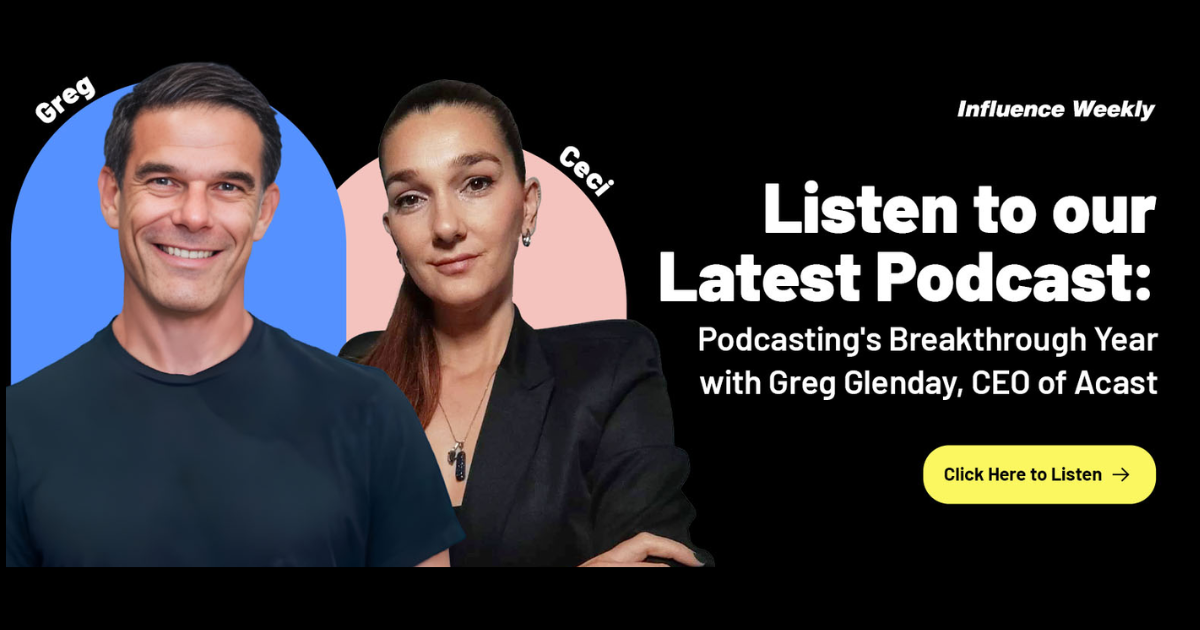
Greg Glenday, CEO of Acast, sat down with Net Influencer Senior Editor Ceci Carloni to explain why 2026 could be podcasting’s breakthrough year with major brands. Greg leads a publicly traded podcast company with 16 offices and 500 employees. Before Acast, he spent 18 years at iHeartMedia and held CEO roles at Shazam and Undertone.
The conversation covered discovery challenges, measurement gaps, and why most top advertisers still don’t buy podcast inventory despite two decades of proof it works.
1. Podcasting Is a Meritocracy, And That’s What Makes Discovery Hard
Podcast listeners decide what succeeds. No algorithm controls distribution.
“The listener, the audience is in complete control,” Greg said. “YouTube and TikTok, they put their thumb on the scale sometimes with the algorithm to decide what they’re going to show. With podcasting, there’s really never been anything like this where you seek it out.”
Building trust takes time. You can’t judge a podcast from five minutes the way you judge a Netflix show. “It’s like a friendship. You can’t just say, we’re best friends. You meet somebody at school and you’re not like, we’re best friends. It takes time.”
That companionship dynamic makes discovery slow. But it also makes the audience relationship stronger.
2. Most Top 250 Advertisers Still Don’t Buy Podcast Ads
Despite 20 years of podcasting, most major brands haven’t committed spend.
Greg’s pitch to Fortune 500 CMOs relies on peer pressure. Direct response advertisers such as Athletic Greens, BetterHelp, and Stamps.com have bought podcasts for years because they measure every ad. “Are they smarter than you?” Greg asks big brand executives.
“This little tiny company is building their business every quarter with podcasting for years. And you guys are dabbling. You’re still doing the same old stuff.”
Once Coca-Cola commits, Pepsi can’t sit out. “If Coca-Cola goes big in podcasting, Pepsi can’t sit out and watch them,” he said.
The tipping point comes when brands realize they’re late.
3. Revenue Is Shifting from 200 Shows to the Long Tail
Five years ago, almost all podcast revenue went to roughly 200 shows. That concentration is breaking apart.
“You shouldn’t have to have 10 million downloads to make a living,” Greg said. “It should be much lower than that.”
Acast now sells both vertically (specific shows) and horizontally (audience demographics). Instead of paying premium rates for Joe Rogan, brands can buy 25 mid-sized shows with overlapping audiences at lower CPMs.
“You now are buying a bunch of communities that add up to the same size. You don’t have to spend a premium on this big, big show.”
Niche shows often convert better. When listeners hear an ad on a small show, “I’m like, oh, they’re supporting my friend,” Greg explained. On a megashow, “I know that’s just a transaction.”
4. Curation and Transcription Data Are Solving Discovery
Acast is testing playlists and feed drops to surface related content. In France, the team groups fashion podcasts into branded playlists so listeners can discover similar shows.
The company’s Podchaser acquisition provides transcription data. That allows Acast to identify topical clusters. How many podcasts discuss the intersection of media and creativity? Can those be grouped into a global playlist?
“You know how many podcasts out of Argentina are talking about media or talking about the intersection of creative and media?” Greg asks.
Discovery tools are getting more sophisticated. They’re just not algorithmic.
5. Podcast Ads Work Because They’re Not Interruptive
Greg separates podcasting from other creator platforms based on pacing and ad load.
“You can have a conversation that’s, like, a little more calm. You’re not in the middle of a sporting event trying to get their attention. You’re not a roadside billboard. It’s a conversation.”
Acast limits ad loads. “We’re not going to do 10 commercials in a row on any of the Acast shows. It might be one or two.”
The company also runs “sponsorship plus,” where a host’s live read from a flagship show gets cut into dynamic ads that run across similar audiences. “That’s good for those shows, that’s good for him, that’s good for the brand. It’s not just an ad.”
Listeners can skip. Brands know this. The ads that work are worth hearing.
6. Brand Safety and Measurement Are the Last Holdouts
Major advertisers need third-party verification before committing budgets. “Nobody’s allowed to grade their own homework,” Greg said.
Acast recently partnered with Barometer to provide brand safety ratings at the episode level. This matters when a comedy show does one serious episode that gets flagged for sensitive content while the rest of the catalog is fine.
Measurement is improving. The company’s fastest-growing product is its self-serve platform, where brands build media plans without sales support.
“We know we can fill parking lots, we can fill shopping carts, we can get people to sign up for things. Podcasting can make people move and do things. It’s very influential.”
The infrastructure is catching up to what direct response advertisers already know.
7. Podcasting Will Become Standard in Media Plans This Decade
Greg sees podcasting following the same path as websites, social media, and programmatic advertising. Brands buy individual properties first, then learn to buy audiences.
“Brands need to go read their own history. They’ve done this many times,” he said. “Social media did the same thing. It was, we’re buying these platforms and people on social, and then it became, what are the audiences we can deliver?”
The shift is underway. “I think it’s our time for On Demand. There’s going to always be people that just want to listen. Then there’s going to be some people that want to listen sometimes, watch sometimes. That’s me.”
Video podcasts serve a different function. When Bill Simmons appears on Netflix’s homepage, “that’s not a podcast to me. That’s a talk show. And that’s okay. It’s awesome. But that’s not the same way people think about the companionship of a podcast.”
Audio remains the core format. Discovery will improve. Revenue will spread. The question is how long major brands wait before committing.
Listen to the full conversation on The Big Three podcast.
David Adler is an entrepreneur and freelance blog post writer who enjoys writing about business, entrepreneurship, travel and the influencer marketing space.









Podcast advertising still hasn’t cracked the Fortune 500, but that’s about to change.
Greg Glenday, CEO of Acast, sat down with Net Influencer Senior Editor Ceci Carloni to explain why 2026 could be podcasting’s breakthrough year with major brands. Greg leads a publicly traded podcast company with 16 offices and 500 employees. Before Acast, he spent 18 years at iHeartMedia and held CEO roles at Shazam and Undertone.
The conversation covered discovery challenges, measurement gaps, and why most top advertisers still don’t buy podcast inventory despite two decades of proof it works.
1. Podcasting Is a Meritocracy, And That’s What Makes Discovery Hard
Podcast listeners decide what succeeds. No algorithm controls distribution.
“The listener, the audience is in complete control,” Greg said. “YouTube and TikTok, they put their thumb on the scale sometimes with the algorithm to decide what they’re going to show. With podcasting, there’s really never been anything like this where you seek it out.”
Building trust takes time. You can’t judge a podcast from five minutes the way you judge a Netflix show. “It’s like a friendship. You can’t just say, we’re best friends. You meet somebody at school and you’re not like, we’re best friends. It takes time.”
That companionship dynamic makes discovery slow. But it also makes the audience relationship stronger.
2. Most Top 250 Advertisers Still Don’t Buy Podcast Ads
Despite 20 years of podcasting, most major brands haven’t committed spend.
Greg’s pitch to Fortune 500 CMOs relies on peer pressure. Direct response advertisers such as Athletic Greens, BetterHelp, and Stamps.com have bought podcasts for years because they measure every ad. “Are they smarter than you?” Greg asks big brand executives.
“This little tiny company is building their business every quarter with podcasting for years. And you guys are dabbling. You’re still doing the same old stuff.”
Once Coca-Cola commits, Pepsi can’t sit out. “If Coca-Cola goes big in podcasting, Pepsi can’t sit out and watch them,” he said.
The tipping point comes when brands realize they’re late.
3. Revenue Is Shifting from 200 Shows to the Long Tail
Five years ago, almost all podcast revenue went to roughly 200 shows. That concentration is breaking apart.
“You shouldn’t have to have 10 million downloads to make a living,” Greg said. “It should be much lower than that.”
Acast now sells both vertically (specific shows) and horizontally (audience demographics). Instead of paying premium rates for Joe Rogan, brands can buy 25 mid-sized shows with overlapping audiences at lower CPMs.
“You now are buying a bunch of communities that add up to the same size. You don’t have to spend a premium on this big, big show.”
Niche shows often convert better. When listeners hear an ad on a small show, “I’m like, oh, they’re supporting my friend,” Greg explained. On a megashow, “I know that’s just a transaction.”
4. Curation and Transcription Data Are Solving Discovery
Acast is testing playlists and feed drops to surface related content. In France, the team groups fashion podcasts into branded playlists so listeners can discover similar shows.
The company’s Podchaser acquisition provides transcription data. That allows Acast to identify topical clusters. How many podcasts discuss the intersection of media and creativity? Can those be grouped into a global playlist?
“You know how many podcasts out of Argentina are talking about media or talking about the intersection of creative and media?” Greg asks.
Discovery tools are getting more sophisticated. They’re just not algorithmic.
5. Podcast Ads Work Because They’re Not Interruptive
Greg separates podcasting from other creator platforms based on pacing and ad load.
“You can have a conversation that’s, like, a little more calm. You’re not in the middle of a sporting event trying to get their attention. You’re not a roadside billboard. It’s a conversation.”
Acast limits ad loads. “We’re not going to do 10 commercials in a row on any of the Acast shows. It might be one or two.”
The company also runs “sponsorship plus,” where a host’s live read from a flagship show gets cut into dynamic ads that run across similar audiences. “That’s good for those shows, that’s good for him, that’s good for the brand. It’s not just an ad.”
Listeners can skip. Brands know this. The ads that work are worth hearing.
6. Brand Safety and Measurement Are the Last Holdouts
Major advertisers need third-party verification before committing budgets. “Nobody’s allowed to grade their own homework,” Greg said.
Acast recently partnered with Barometer to provide brand safety ratings at the episode level. This matters when a comedy show does one serious episode that gets flagged for sensitive content while the rest of the catalog is fine.
Measurement is improving. The company’s fastest-growing product is its self-serve platform, where brands build media plans without sales support.
“We know we can fill parking lots, we can fill shopping carts, we can get people to sign up for things. Podcasting can make people move and do things. It’s very influential.”
The infrastructure is catching up to what direct response advertisers already know.
7. Podcasting Will Become Standard in Media Plans This Decade
Greg sees podcasting following the same path as websites, social media, and programmatic advertising. Brands buy individual properties first, then learn to buy audiences.
“Brands need to go read their own history. They’ve done this many times,” he said. “Social media did the same thing. It was, we’re buying these platforms and people on social, and then it became, what are the audiences we can deliver?”
The shift is underway. “I think it’s our time for On Demand. There’s going to always be people that just want to listen. Then there’s going to be some people that want to listen sometimes, watch sometimes. That’s me.”
Video podcasts serve a different function. When Bill Simmons appears on Netflix’s homepage, “that’s not a podcast to me. That’s a talk show. And that’s okay. It’s awesome. But that’s not the same way people think about the companionship of a podcast.”
Audio remains the core format. Discovery will improve. Revenue will spread. The question is how long major brands wait before committing.
Listen to the full conversation on The Big Three podcast.
Subscribe to Our Newsletter
Check Out Our Podcast