







Tech
The High-Frequency Trader Who Decided Creators Were a Better Bet Than Stocks

Joy Tang spent seven years building machine learning systems that bought and sold financial instruments in milliseconds. She left to build a company around a behavior she says is easier to model: how people buy from creators.
If 10,000 people see a piece of content and a certain percentage buy, she argues, 10 million viewers will respond almost identically. “Human psychology is much more predictable,” she says. “In trading, you never know what’s going to happen tomorrow.”
That insight sits at the center of Markable, the Seattle-based social commerce platform Joy founded in 2016. The company deploys AI to help creators build affiliate businesses, from product recommendations and content optimization to deep-linking and paid amplification. In the past 12 months, according to Joy, creators on the platform collectively generated more than $1 billion in product sales. The top creator alone moved 10 figures in product sales.
Joy holds a degree in economics and mathematics from MIT and spent years before Markable as a senior high-frequency trading strategist in Chicago, designing AI-powered trading systems. She describes the move to creator monetization not as a pivot, but as a transfer of method.
From Visual Search to Creator Infrastructure
Markable’s current model is not the one Joy originally built. Her first direction took five years and, according to Joy, raised $15 million before she abandoned it.
The original concept was a visual search tool: Joy says users who spotted an outfit in a social media photo could identify and purchase similar products on Amazon or Walmart without knowing what they were looking at. Markable launched the feature with major Asian social platforms and found early traction. Then the platforms began replicating the technology themselves.
“Selling technology-as-a-service to a huge technology company is not a viable model,” Joy says.
The pivot came from a conversation with a local creator who described managing her affiliate business across 30 separate apps. Joy saw the fragmentation as a solvable engineering problem and rebuilt the company around creator-side infrastructure: a unified platform covering product discovery, content creation, link management, and traffic amplification.
“We really focused on solving creators’ biggest pain points,” she says. “And it was immediately rewarding. One of the first creators I worked with was selling $2 million worth of products a year. After Markable, she was selling $10 million. Now she is selling over $100 million.”
The Architecture of a Creator Commerce Stack
Markable’s platform spans several layers, most of them available to creators at no cost.
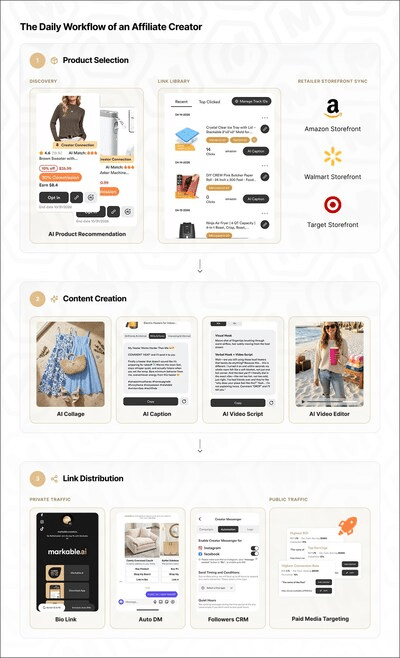
“There are companies out there charging creators $1,000 a month or more for just one of the features we offer,” Joy says. “We made our app mostly free for all the important features.”
The entry point was deep linking. A standard affiliate link clicked inside Instagram opens in the app’s browser, requiring users to re-enter payment credentials before completing a purchase. A deep link routes directly to the retailer’s native app, where users are already authenticated. Joy says deep links convert at three times the rate of standard ones.
Other free features include auto-DM, which sends personalized shopping links when followers comment keywords, and bio links that dynamically surface a creator’s top-trending products. Markable also offers AI-generated captions and collage tools. The tools are designed around a principle Joy cites consistently: authenticity converts. “After investing in the mid-eight figures in social content advertising and helping drive over $1 billion in sales for major retailers, we’ve consistently seen that highly authentic creator content converts about 3x better than lower-authenticity content,” she says.
The platform’s AI caption editor reflects that logic. Markable trains its recommendations on conversion data, and the output is constrained to include original creator commentary about personal use. “You have to talk about why you use this product and how it changed your life,” Joy explains.

The Performance Program: Markable as Investor
Above the free tier sits Markable’s performance program, which Joy describes as its primary competitive differentiation. The structure is unusual: Markable identifies creators whose content converts sales reliably, then spends its own capital amplifying that content. For top participants, the company deploys on average $500,000 per month per creator in paid distribution.
“Many families won’t agree to put that kind of money into social media,” Joy says. “With $500,000, you can buy a new house every month.”
Only 5% to 10% of Markable’s 2,000-plus active creators qualify. Selection is algorithmic: the platform monitors conversion data from the free tier and identifies content it predicts will generate sufficient returns to justify the spend. Joy says the average profit margin across the program runs at 60%, and some creators regularly make $50,000 profit a month on paid earnings.
Joy also pushes back on a common creator concern that paid amplification cannibalizes organic reach. “That’s outdated thinking,” she says. “Paid and organic work together. Many creators in our program ultimately earn more through organic because paid amplification helped them grow faster, expand their audience, and build stronger momentum overall.”
She points to creator Elnaz Hamai, who has 1.1 million followers across platforms, as one example of the program’s target user: a creator with an existing audience and commerce traction who can use outside capital to scale distribution.
Creators Own the Leverage, Not the Inventory
Joy is direct about where she thinks power in the social commerce ecosystem actually sits. “Social commerce isn’t driven by brands, it’s driven by creators,” she says. “Creators are at the top of the food chain here. There are countless companies serving brands, but very few truly serving creators. Whoever brings the consumer traffic owns the leverage, not the inventory.”
The argument has implications for how she reads brand behavior. When brands run their own social advertising rather than routing spend through creators, Joy says the math turns against them. “We have real data showing that when brands post advertisements from their own social accounts and run ads, they pay almost 10 times more per click than if we promote creator content,” she says.
Joy also sees a broader reallocation underway. A few years ago, most brands allocated 5% to 10% of marketing budgets toward social creators. For many digitally native and performance-focused brands today, Joy says that figure can exceed 70%. In high-performing campaigns, creator-led content can drive click-to-purchase rates of 10% to 20% with a good attribution system, compared with the 2% to 3% click-through rates typically seen in traditional advertising.
She adds a caveat that brands often overlook. “Social is not a silver bullet,” she says. “Conversion outcomes still depend heavily on fundamentals: landing page quality, pricing, product-market fit, and the depth of customer reviews. Social can accelerate demand, but brands still need the operational readiness to convert it.”
What Retailers Don’t Know Yet
Major platforms, including Amazon and Walmart, are increasingly dependent on creator-driven traffic to move product. Joy’s read on whether they fully grasp that dependency is nuanced.
“The biggest challenge they face right now is attribution,” she says. “Which sales were truly incrementally driven by creators versus what shoppers may have purchased anyway?” Some platforms, she notes, have more advanced measurement capabilities than others.
The response from retail platforms, Joy observes, is escalating incentives. “Retailers like Amazon and Walmart are building out additional brand-funded commissions on top of their platform commissions to further incentivize creators,” she says. “When one platform improves creator payouts or tooling, creators shift attention quickly. That competition is ultimately good for the industry because it forces retailers to invest seriously in creator infrastructure, attribution models, and monetization programs.”
The U.S. market, she argues, is still early by the standard that matters most. In Asia, 30% of e-commerce flows through social channels. In the U.S., the figure is roughly 6-7%. “This market is going to grow five times in the next few years,” Joy says.
Trading Algorithms for Something That Moves People
What would the version of Joy running trading algorithms in Chicago think of Markable?
“She’d be jealous,” she says. “The old me was talking to a computer every day. My world was very small. I only knew how to do one thing.”
The observation points to something structural about Markable’s design. Predicting human behavior at scale and allocating capital against that prediction is close, methodologically, to what Joy did at trading firms. The difference, she argues, is legibility of outcome.
“We’re changing people’s lives in a positive way,” she says. “Creators who started from $3,000 to $4,000 a month are now making $3 million a year. I wouldn’t be as happy if I were still in trading, making my bosses, who are billionaires, even richer.”
Subscribe to Our Newsletter
Check Out Our Podcast