




Tech
Postr Launches With a Bid to Standardize Creator Marketing Pricing and Campaign Workflows

Demetrios Kafouros spent more than two decades running retail and real estate operations, often as the kind of customer that creator-marketing platforms claim to serve. What he saw was not a single system, but a chain of disconnected tasks: finding creators, negotiating terms, shipping products, reviewing content, tracking results, and paying everyone involved.
That administrative frustration became the basis for Postr, a creator-marketing platform that officially launched in May 2026 with a stated goal of consolidating the fragmented toolkit most brands currently use into a single automated system. The company is headquartered in Miami’s Wynwood neighborhood and operates across three participant types: brands, creators, and a network of paid referrers it calls recruiters.
Demetrios co-founded Postr alongside Gabrielle Pressas, a content creator on TikTok and Instagram who contributed the creator-side perspective, and Matthew Lim, who leads technical development. The team spent roughly four and a half years in development before the public launch.
“I just couldn’t believe that there was no company out there that handled the solution end to end,” Demetrios says. “Seeing that gap in the market, feeling the need for the solution, and being a potential customer myself put me in a position to set out and build it.”
Why Creator Campaigns Still Run Across Too Many Tools
The problem Postr targets is structural rather than technical. Brands and creators currently navigate separate systems for introductions, contract negotiation, product fulfillment, content review, and payment, each demanding its own workflow and timeline.

“One is the introduction to the initial creators and getting those responses, hammering out legal terms and coming to terms there,” Demetrios says. “Pricing is all over the place. There’s no standard industry pricing.” For retail operators who managed campaigns across multiple vendors before a single post delivered, that fragmentation translated directly into lost time and inconsistent results.
Postr consolidates the process into a 12-step campaign setup. Brands sign up for free, assign a budget, define audience parameters, and upload product details. The platform handles matching, logistics, content delivery, and payment within a single dashboard. Funds are held in escrow between deposit and content approval, with defined resolution procedures for canceled or disputed campaigns.
Platform integrations with TikTok, YouTube, Instagram, Facebook, X, and LinkedIn pull live performance data, giving brands real-time visibility as content is published and enabling targeting adjustments during active campaigns.
How the Platform Runs
Demetrios describes the creator experience as designed to eliminate negotiation entirely. When a creator joins Postr, the platform analyzes their audience demographics, content category, and platform reach, then surfaces only the campaigns they are already approved for.
“You’re seeing jobs that you’re already pre-approved for,” he says. “You literally just commit to it, read the specifications, create your content, and you get paid.” Standard campaigns carry a 14-day creation window.
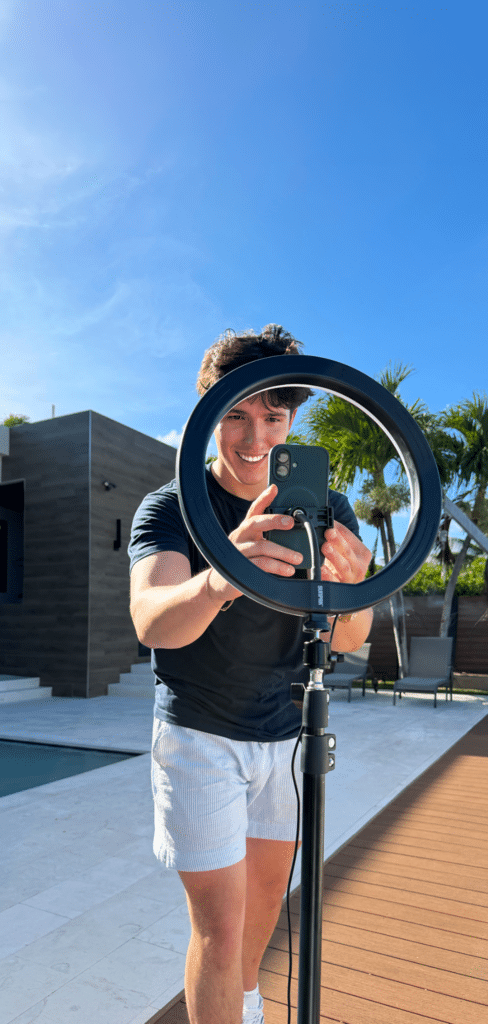
For campaigns involving physical products, logistics are built directly into the platform. Brands ship inventory to Postr’s Miami facility, which distributes individual units to participating creators within the campaign timeline.
The recruiter layer adds a third dimension to the marketplace. Individuals who bring brands or creators onto Postr earn a 2% residual commission on any campaigns those parties run, indefinitely. Demetrios says the structure was designed to accelerate network growth while distributing the platform’s economic upside more broadly.
Quality control runs through a waitlist and manual vetting process: every creator is individually reviewed before being approved to accept campaigns, and a strike system monitors behavior over time. “Everyone sharing the success, from the people turning others on to making money. Then it’s a win all the way around,” he says.
Creator Pricing Has Never Had a Standard
Creator pricing is, Demetrios says, “probably one of the biggest Wild West points that exists in the industry.” Rates currently vary by platform, post format, follower count, category, and geography, with no standardized benchmark. Brands frequently overpay, underpay, or have no reliable basis for comparison across potential creator partners.
Postr’s response is the Postr Index, a publicly available pricing tool built on what Demetrios describes as millions of proprietary data points collected over several years of development. The index provides national averages for creator rates organized by platform, post type, industry vertical, and location, with high and low ranges for each combination. It adjusts in real time as new campaign data flows through the platform.

Most companies that build comparable data sets charge for access or keep the information proprietary. Postr is making the results publicly available. “Our goal is to become the industry standard in Creator Marketing,” Demetrios says. “And one of those ways is by setting the industry standard in creator pricing.”
What Brand Overcontrol Actually Costs
Demetrios identifies creative control as the largest structural failure in Creator Marketing, beyond fragmentation and pricing. Brands that approve or script individual lines of creator content remove the authenticity that makes the channel effective.
“They want so much control over every word, every inflection of every word, to the point where they murder the authenticity out of it,” he says. “It becomes like an ad. We all get up and go grab popcorn when the ad comes on.”
Postr, Demetrios continues, gives brands full visibility over content as it is produced, with the ability to flag material that violates platform terms of service. But the system is designed to discourage intervention in the creative process itself. The same logic extends to audience matching: a brand spending budget on a creator whose followers are geographically mismatched with its target market gains reach that produces nothing.
“We basically take the most effective form of marketing and overlay that with another level of authenticity, having creators themselves authentically deliver these messages,” Demetrios says. Postr’s targeting approach distributes campaign budgets across multiple creators who already reach the relevant geography rather than concentrating spend on a single creator with a broad but unfocused reach.
He applies similar skepticism to commission-based and shoppable content arrangements, arguing they convert creators into salespeople and erode audience trust over time. “Creators don’t care about the brand’s products,” he says.
A Push Beyond Campaign Management
Demetrios does not frame Postr as another layer in the Creator Marketing stack. He frames it as a replacement for that stack. “We intend to fundamentally change the way marketing, the primary method of marketing, is conducted moving forward,” he says.
“Postr University,” an educational component built into the platform, guides creators on how to participate in brand campaigns without disrupting their primary content. Onboarding for brands includes recommendations on budget allocation, audience targeting, and long-term creator relationship development.
Whether Postr can execute at this scale depends on variables still being tested: how quickly brands adopt standardized pricing, whether creators trust an automated system with their livelihood, and whether the recruiter model generates quality network growth without introducing integrity problems.
Demetrios has spent four and a half years building toward this launch. As far as he is concerned, the remaining question is how fast the industry moves, not whether the infrastructure problem is real.
“We are in the attention awareness business,” he says. “We’re not here to sell the product that you love and that you created. We’re here to get the word out about it. If your product is right and you put it out there, people will move to it.”
Subscribe to Our Newsletter
Check Out Our Podcast