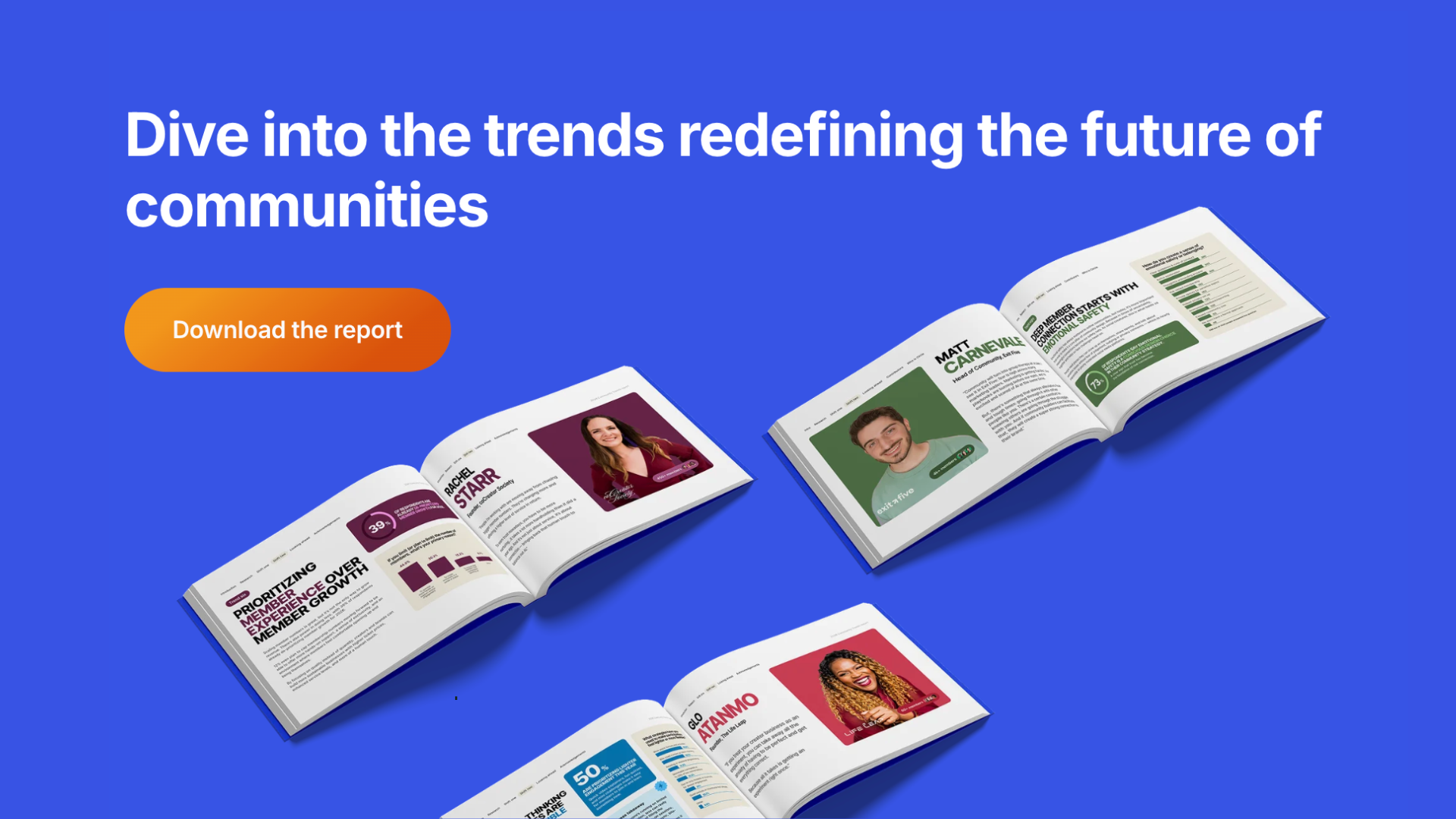
Nearly half of community builders surveyed by community platform Circle say that having a community gives their business a competitive edge over rivals relying on traditional branding alone, according to the company’s “2026 Community Trends Report.”
Circle surveyed more than 750 community builders worldwide and interviewed 12 industry experts, overlaying those findings with product data from over 18,000 communities on its platform.
The report identifies two core shifts reshaping how creators and brands approach community building: communities have become a key business differentiator, and there is no single correct method for building them.
Belonging Drives Competitive Advantage
The data suggests shared identity plays a central role in that dynamic: 67% of respondents report that members say they joined or stayed because of shared identity and values. The report frames this shift within a broader environment in which creators and brands are entering what it describes as uncharted waters, where AI-generated content spreads quickly and authentic voices face growing competition for attention.
Pat Flynn, founder of Smart Passive Income, which operates a community of more than 8,000 members on Circle, framed the dynamic in terms of member storytelling. “Your members are the heroes of the story. When you talk about their transformation, whether it’s in a 60-second short or a long-form podcast episode, you don’t even need a funnel. Our role is to facilitate those moments where people can find results, and find each other.”
Member Transformation Becomes the Top Growth Strategy
69% of respondents identify member transformation as their most important strategy for growth and retention. When asked what kind of transformation members typically experience, 61.4% cited achieving goals, followed by mindset shifts at 56.5%, skill mastery at 54%, career growth at 43.4%, and lifestyle changes at 41.3%.
The report connects transformation directly to business outcomes, arguing that celebrating member wins attracts new members who want to achieve similar results and benefits creators and brands equally.
Community Extends Beyond the Post-Purchase Experience
Community engagement now spans the full customer lifecycle, according to the report. 48% of respondents say people first engage with their community before making a purchase. Looking ahead, 69.4% say the community will play a larger role in their overall business strategy, while 18.4% expect their approach to remain roughly the same, and 7% say they are scaling back investment.
Community Teams Win Dedicated Budgets and Cross-Department Roles
As community functions grow, so does their organizational footprint. 32% of respondents now have a dedicated community budget, with some reaching $1 million, and software typically accounts for 30% to 50% of that spend. 39% of respondents say their community teams now work across multiple departments, with customer success and support the most common overlap at 47%, followed by marketing and brand at 40%.
Nikki Thibodeau, Regional VP of Digital Engagement and Community at Calix, which runs a community of more than 10,000 members, described the development at her organization. “There was a time when we focused solely on the community and its members, but that’s no longer the case: we’ve become a lot more integrated with teams across the business. Operating outside of our baseline support use case, we’re now integrated with Customer Success and Customer Marketing, Sales and Renewals, and so much more.”
Experimentation Replaces Playbook Thinking
Twenty-nine percent of respondents say they are developing their own community growth and engagement methods rather than sourcing best practices or playbooks from other communities. Forty-three percent test new initiatives, including event formats, content series, ambassador programs, peer-learning cohorts, and member matching, in small groups or time-bound pilots before scaling. The report notes that creators are among those ditching the copy-and-paste approach in favor of strategies designed for their specific audiences.
Jocelyn Hsu, Head of Community at Hint Health, whose community counts 2,000 members, summarized the argument for customization. “Your customers are different. Your product is different. Your team is different. Your brand is different. Focus on building a community unique to your specific audience and needs.”
Quality Overtakes Scale
39% of respondents are already de-prioritizing member growth for 2026. 12% plan to cap membership numbers, with the primary reason being the ability to provide more hands-on support and engagement, cited by 44.9% of respondents. Creating exclusivity or a sense of status was cited by 30.3%, while 15.2% said caps help ensure members feel comfortable opening up. The report notes that by focusing on quality over quantity, creators and brands can build more sustainable businesses with higher price points and enhanced service levels.
AI Use Grows but Stays Behind the Scenes
68% of respondents plan to expand their use of AI in 2026. Current applications skew toward content creation and planning, cited by 74.6% of respondents, followed by generating insights or analyzing data (46.4%), member support (33.8%), community moderation (17.7%), and AI agents acting autonomously (12.8%).
The report characterizes the current moment as early-stage, noting that community builders are using AI to automate repetitive tasks, redirecting time toward member relationships and engagement.
Jonathan is a South African content creator, photographer and videographer with 25 years of experience in journalism and print media design. He is interested in new developments in AI content creation and covers a broad spectrum of topics within the creator economy.
















Nearly half of community builders surveyed by community platform Circle say that having a community gives their business a competitive edge over rivals relying on traditional branding alone, according to the company’s “2026 Community Trends Report.”
Circle surveyed more than 750 community builders worldwide and interviewed 12 industry experts, overlaying those findings with product data from over 18,000 communities on its platform.
The report identifies two core shifts reshaping how creators and brands approach community building: communities have become a key business differentiator, and there is no single correct method for building them.
Belonging Drives Competitive Advantage
The data suggests shared identity plays a central role in that dynamic: 67% of respondents report that members say they joined or stayed because of shared identity and values. The report frames this shift within a broader environment in which creators and brands are entering what it describes as uncharted waters, where AI-generated content spreads quickly and authentic voices face growing competition for attention.
Pat Flynn, founder of Smart Passive Income, which operates a community of more than 8,000 members on Circle, framed the dynamic in terms of member storytelling. “Your members are the heroes of the story. When you talk about their transformation, whether it’s in a 60-second short or a long-form podcast episode, you don’t even need a funnel. Our role is to facilitate those moments where people can find results, and find each other.”
Member Transformation Becomes the Top Growth Strategy
69% of respondents identify member transformation as their most important strategy for growth and retention. When asked what kind of transformation members typically experience, 61.4% cited achieving goals, followed by mindset shifts at 56.5%, skill mastery at 54%, career growth at 43.4%, and lifestyle changes at 41.3%.
The report connects transformation directly to business outcomes, arguing that celebrating member wins attracts new members who want to achieve similar results and benefits creators and brands equally.
Community Extends Beyond the Post-Purchase Experience
Community engagement now spans the full customer lifecycle, according to the report. 48% of respondents say people first engage with their community before making a purchase. Looking ahead, 69.4% say the community will play a larger role in their overall business strategy, while 18.4% expect their approach to remain roughly the same, and 7% say they are scaling back investment.
Community Teams Win Dedicated Budgets and Cross-Department Roles
As community functions grow, so does their organizational footprint. 32% of respondents now have a dedicated community budget, with some reaching $1 million, and software typically accounts for 30% to 50% of that spend. 39% of respondents say their community teams now work across multiple departments, with customer success and support the most common overlap at 47%, followed by marketing and brand at 40%.
Nikki Thibodeau, Regional VP of Digital Engagement and Community at Calix, which runs a community of more than 10,000 members, described the development at her organization. “There was a time when we focused solely on the community and its members, but that’s no longer the case: we’ve become a lot more integrated with teams across the business. Operating outside of our baseline support use case, we’re now integrated with Customer Success and Customer Marketing, Sales and Renewals, and so much more.”
Experimentation Replaces Playbook Thinking
Twenty-nine percent of respondents say they are developing their own community growth and engagement methods rather than sourcing best practices or playbooks from other communities. Forty-three percent test new initiatives, including event formats, content series, ambassador programs, peer-learning cohorts, and member matching, in small groups or time-bound pilots before scaling. The report notes that creators are among those ditching the copy-and-paste approach in favor of strategies designed for their specific audiences.
Jocelyn Hsu, Head of Community at Hint Health, whose community counts 2,000 members, summarized the argument for customization. “Your customers are different. Your product is different. Your team is different. Your brand is different. Focus on building a community unique to your specific audience and needs.”
Quality Overtakes Scale
39% of respondents are already de-prioritizing member growth for 2026. 12% plan to cap membership numbers, with the primary reason being the ability to provide more hands-on support and engagement, cited by 44.9% of respondents. Creating exclusivity or a sense of status was cited by 30.3%, while 15.2% said caps help ensure members feel comfortable opening up. The report notes that by focusing on quality over quantity, creators and brands can build more sustainable businesses with higher price points and enhanced service levels.
AI Use Grows but Stays Behind the Scenes
68% of respondents plan to expand their use of AI in 2026. Current applications skew toward content creation and planning, cited by 74.6% of respondents, followed by generating insights or analyzing data (46.4%), member support (33.8%), community moderation (17.7%), and AI agents acting autonomously (12.8%).
The report characterizes the current moment as early-stage, noting that community builders are using AI to automate repetitive tasks, redirecting time toward member relationships and engagement.
Image source: Circle
Get the full report here
Subscribe to Our Newsletter
Check Out Our Podcast