Employee-generated content (EGC) has crossed a threshold. What began as a supplementary tactic, with employees occasionally posting about their employer on LinkedIn, is now treated by a growing number of organizations as a structured growth channel with measurable business outcomes.
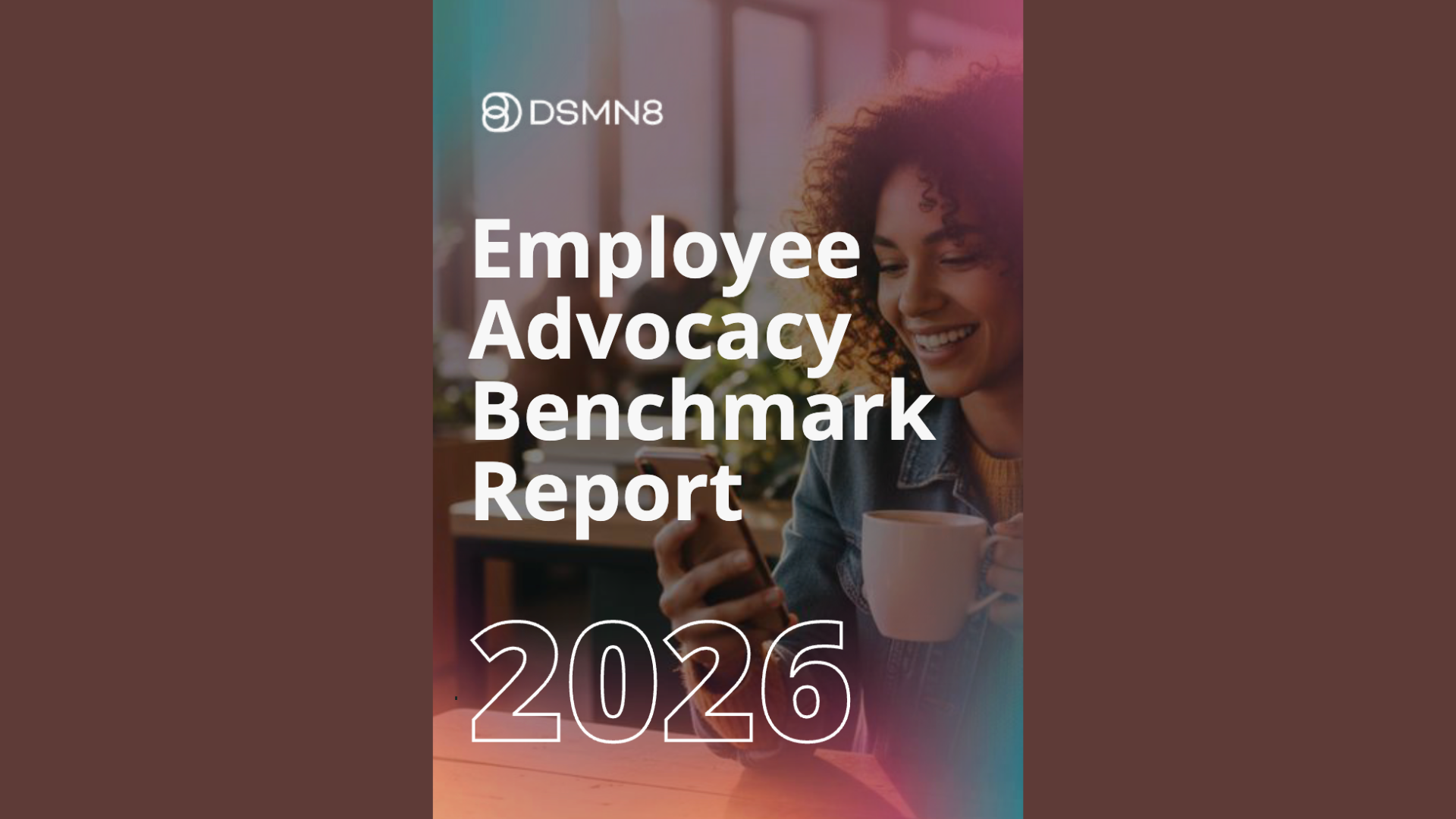
According to DSMN8’s “Employee Advocacy Benchmark Report 2026,” which brings together insights from roughly 200 programs across industries and regions, including Cisco, Capgemini, Nissan, and Toyota, “employee advocacy has moved from amplification to infrastructure.”
The shift reflects a broader recalibration in how brands approach social media. According to the report, algorithms remain volatile, paid costs remain high, and audiences are “more selective about who they trust.” EGC, which is content created and shared by employees rather than brand accounts, is filling that gap, not because it is new, but because it is now being built with intent.
Participation Is Rising, and So Is Frequency
One of the clearest signals of EGC’s maturation is the increase in the frequency with which employees post. The 2026 DSMN8 report finds that 68% of employee advocates share content three or more times per week, up 13 percentage points year over year. 21% post more than five times per week.
That increased activity is also shifting closer to revenue. Sales teams now account for 33% of advocacy activity, making them the most active department in employee advocacy programs.
Bradley Keenan, co-founder and CEO of DSMN8, notes that the change reflects a broader cultural shift in how sales functions view social media. “The idea of ‘social selling’ has moved from a nice-to-have to a core prospecting channel,” he told Net Influencer. “If you’re in sales today, your LinkedIn presence is often as important as your email signature.”
For brand marketers, Keenan argues that the rise of sales as the dominant participant has direct implications for how EGC programs should be structured. “That means providing industry insights and commentary, not just company announcements, segmenting content so salespeople see posts relevant to their sector or territory, and encouraging original posts alongside curated content,” he said. “When it’s done well, sales teams strengthen their personal brands and relationships with buyers, while the company benefits from a much larger and more credible distribution network.”
Content Is Becoming More Personalized
The composition of what employees share is also shifting. The 2026 report finds that 59% of advocates say they share original employee-generated content, rather than just company-distributed posts or pre-approved materials. Company social posts remain the most common content source provided to advocates, cited by 73% of programs. EGC ranks fifth at 53%, reflecting its growing presence alongside more traditional content types.
Video is accelerating within that mix. 60% of programs now provide video to employee advocates, making it the second most common content format offered, behind images at 81%. The report identifies video as the format most closely associated with effective visual storytelling in advocacy programs.
The 2025 report pointed more broadly to participation and confidence barriers, including uncertainty about what content to share. In 2026, the emphasis has shifted toward making employee advocacy more personal and intentional. As the report states, “the content employees share is becoming more personalized,” implying that authenticity, not just volume, now differentiates high-performing programs.
AI Adoption Is Widespread, but Personalization Remains the Priority
A total of 92% of employee advocacy programs now use AI to scale content production, according to the 2026 report. That figure underscores how quickly AI has become embedded in employee advocacy workflows by 2026.
Jody Leon, VP of Marketing at DSMN8 and co-author of the 2026 report, frames the current moment in the introduction: “While AI has made content easier to produce, it’s also made it harder to stand out. The result is more output, less impact, and growing pressure to show that attention actually leads to something meaningful.”
Keenan sees that tension as solvable, provided programs are designed with the right sequence in mind. “AI should assist creativity, not replace it,” he said. “The strongest programs typically use AI in three ways: to generate multiple caption options, to tailor content for different roles or regions, and to reduce the time it takes employees to get started. But the final step is always left to the employee.”
The data supports that approach. According to Keenan, posts that are only slightly modified from an original AI-generated caption still perform dramatically better than posts shared exactly as written. “That tiny layer of personalisation is often the difference between a post that feels corporate and one that feels human,” he said. “The winning formula is AI to remove friction, and people to add context.”
Executives Are a Key Lever, but a Gap for Many Programs
Leadership visibility within EGC programs has emerged as one of the most consistent differentiators in the 2026 data. Nearly 80% of programs already involve executives.
Among programs that do not, leadership engagement ranks as the top priority for 2026, cited by 75% of program managers when asked how they intend to boost advocacy engagement, up from 67% in the 2025 report.
The 2025 DSMN8 report had already identified encouraging leadership involvement as the top-ranked strategy for increasing participation, with 67% of respondents citing it. The 2026 data reinforces that finding and extends it: programs with active executive participation consistently report stronger overall advocacy outcomes, and the report states that “executives drive results and boost program participation.”
The Structural Barriers Have Not Disappeared
Despite the gains, the 2026 report identifies persistent friction points. Lack of time remains the single largest barrier for employees, cited by 28.7% of respondents. Lack of interest follows at 17.7%, with concerns about company policies and privacy each cited by 13.2%. Uncertainty about what content to share is among the challenges program managers face when encouraging participation, reported by 18% of managers.
The report’s framing is precise: “The biggest barrier to advocacy isn’t motivation, it’s uncertainty.” Providing training, pre-written content options, and clear governance policies are identified as the primary mechanisms for addressing these objections.
Closing the Measurement Gap
Last year, 61% of programs were not tracking cost-per-click from employee shares, a figure the 2025 report described as “a missed opportunity.” By 2026, 42% still do not measure it. Where CPC (cost-per-click) is tracked, the most commonly reported average falls under $1. The 2026 report places this in direct contrast with LinkedIn Ads, which typically run between $5 and $10 per click, and paid B2B social, which ranges from $2 to $6. The report calculates an employee advocacy cost efficiency advantage of 73% over LinkedIn Ads and 50% over paid B2B social.
Keenan identifies two reasons the measurement gap persists. The first is technical: tracking CPC from employee shares requires proper attribution through links and analytics integration, and many programs were historically run as engagement or employer-brand initiatives rather than performance marketing channels. The second is organizational. “Employee advocacy often sits between marketing, communications, HR, and sales,” he said. “When ownership is fragmented, measurement tends to lag.”
For marketers building the business case internally, his guidance is direct. “Start with attribution and track just three things: clicks, cost per click, and earned media value,” Keenan said. “Once you show that employees can drive meaningful traffic at a lower cost than paid campaigns, the conversation around investment becomes much easier.”
The Business Case Extends to Employees Themselves
The 2026 report adds a dimension to the EGC value proposition that goes beyond brand outcomes: 94% of employee advocates say posting on LinkedIn has benefited their careers.
That figure is consistent with the 2025 report, in which 96% of respondents said social media activity had positively influenced their careers, suggesting that EGC programs, when well-designed, function as a professional development channel alongside a marketing one.
The 2026 report summarizes the trajectory: “Employee advocacy is no longer improvised. Programs that combine AI, visible leadership, and confident employee voices are delivering lower costs and higher impact.”
For brand marketers evaluating where EGC fits in their 2026 strategy, that combination of structured programs, executive participation, and personalized content at scale defines the practice’s current standing.
Image source: DSMN8 The full report is available here
Dragomir is a Serbian freelance blog writer and translator. He is passionate about covering insightful stories and exploring topics such as influencer marketing, the creator economy, technology, business, and cyber fraud.












Employee-generated content (EGC) has crossed a threshold. What began as a supplementary tactic, with employees occasionally posting about their employer on LinkedIn, is now treated by a growing number of organizations as a structured growth channel with measurable business outcomes.
According to DSMN8’s “Employee Advocacy Benchmark Report 2026,” which brings together insights from roughly 200 programs across industries and regions, including Cisco, Capgemini, Nissan, and Toyota, “employee advocacy has moved from amplification to infrastructure.”
The shift reflects a broader recalibration in how brands approach social media. According to the report, algorithms remain volatile, paid costs remain high, and audiences are “more selective about who they trust.” EGC, which is content created and shared by employees rather than brand accounts, is filling that gap, not because it is new, but because it is now being built with intent.
Participation Is Rising, and So Is Frequency
One of the clearest signals of EGC’s maturation is the increase in the frequency with which employees post. The 2026 DSMN8 report finds that 68% of employee advocates share content three or more times per week, up 13 percentage points year over year. 21% post more than five times per week.
That increased activity is also shifting closer to revenue. Sales teams now account for 33% of advocacy activity, making them the most active department in employee advocacy programs.
Bradley Keenan, co-founder and CEO of DSMN8, notes that the change reflects a broader cultural shift in how sales functions view social media. “The idea of ‘social selling’ has moved from a nice-to-have to a core prospecting channel,” he told Net Influencer. “If you’re in sales today, your LinkedIn presence is often as important as your email signature.”
For brand marketers, Keenan argues that the rise of sales as the dominant participant has direct implications for how EGC programs should be structured. “That means providing industry insights and commentary, not just company announcements, segmenting content so salespeople see posts relevant to their sector or territory, and encouraging original posts alongside curated content,” he said. “When it’s done well, sales teams strengthen their personal brands and relationships with buyers, while the company benefits from a much larger and more credible distribution network.”
Content Is Becoming More Personalized
The composition of what employees share is also shifting. The 2026 report finds that 59% of advocates say they share original employee-generated content, rather than just company-distributed posts or pre-approved materials. Company social posts remain the most common content source provided to advocates, cited by 73% of programs. EGC ranks fifth at 53%, reflecting its growing presence alongside more traditional content types.
Video is accelerating within that mix. 60% of programs now provide video to employee advocates, making it the second most common content format offered, behind images at 81%. The report identifies video as the format most closely associated with effective visual storytelling in advocacy programs.
The 2025 report pointed more broadly to participation and confidence barriers, including uncertainty about what content to share. In 2026, the emphasis has shifted toward making employee advocacy more personal and intentional. As the report states, “the content employees share is becoming more personalized,” implying that authenticity, not just volume, now differentiates high-performing programs.
AI Adoption Is Widespread, but Personalization Remains the Priority
A total of 92% of employee advocacy programs now use AI to scale content production, according to the 2026 report. That figure underscores how quickly AI has become embedded in employee advocacy workflows by 2026.
Jody Leon, VP of Marketing at DSMN8 and co-author of the 2026 report, frames the current moment in the introduction: “While AI has made content easier to produce, it’s also made it harder to stand out. The result is more output, less impact, and growing pressure to show that attention actually leads to something meaningful.”
Keenan sees that tension as solvable, provided programs are designed with the right sequence in mind. “AI should assist creativity, not replace it,” he said. “The strongest programs typically use AI in three ways: to generate multiple caption options, to tailor content for different roles or regions, and to reduce the time it takes employees to get started. But the final step is always left to the employee.”
The data supports that approach. According to Keenan, posts that are only slightly modified from an original AI-generated caption still perform dramatically better than posts shared exactly as written. “That tiny layer of personalisation is often the difference between a post that feels corporate and one that feels human,” he said. “The winning formula is AI to remove friction, and people to add context.”
Executives Are a Key Lever, but a Gap for Many Programs
Leadership visibility within EGC programs has emerged as one of the most consistent differentiators in the 2026 data. Nearly 80% of programs already involve executives.
Among programs that do not, leadership engagement ranks as the top priority for 2026, cited by 75% of program managers when asked how they intend to boost advocacy engagement, up from 67% in the 2025 report.
The 2025 DSMN8 report had already identified encouraging leadership involvement as the top-ranked strategy for increasing participation, with 67% of respondents citing it. The 2026 data reinforces that finding and extends it: programs with active executive participation consistently report stronger overall advocacy outcomes, and the report states that “executives drive results and boost program participation.”
The Structural Barriers Have Not Disappeared
Despite the gains, the 2026 report identifies persistent friction points. Lack of time remains the single largest barrier for employees, cited by 28.7% of respondents. Lack of interest follows at 17.7%, with concerns about company policies and privacy each cited by 13.2%. Uncertainty about what content to share is among the challenges program managers face when encouraging participation, reported by 18% of managers.
The report’s framing is precise: “The biggest barrier to advocacy isn’t motivation, it’s uncertainty.” Providing training, pre-written content options, and clear governance policies are identified as the primary mechanisms for addressing these objections.
Closing the Measurement Gap
Last year, 61% of programs were not tracking cost-per-click from employee shares, a figure the 2025 report described as “a missed opportunity.” By 2026, 42% still do not measure it. Where CPC (cost-per-click) is tracked, the most commonly reported average falls under $1. The 2026 report places this in direct contrast with LinkedIn Ads, which typically run between $5 and $10 per click, and paid B2B social, which ranges from $2 to $6. The report calculates an employee advocacy cost efficiency advantage of 73% over LinkedIn Ads and 50% over paid B2B social.
Keenan identifies two reasons the measurement gap persists. The first is technical: tracking CPC from employee shares requires proper attribution through links and analytics integration, and many programs were historically run as engagement or employer-brand initiatives rather than performance marketing channels. The second is organizational. “Employee advocacy often sits between marketing, communications, HR, and sales,” he said. “When ownership is fragmented, measurement tends to lag.”
For marketers building the business case internally, his guidance is direct. “Start with attribution and track just three things: clicks, cost per click, and earned media value,” Keenan said. “Once you show that employees can drive meaningful traffic at a lower cost than paid campaigns, the conversation around investment becomes much easier.”
The Business Case Extends to Employees Themselves
The 2026 report adds a dimension to the EGC value proposition that goes beyond brand outcomes: 94% of employee advocates say posting on LinkedIn has benefited their careers.
That figure is consistent with the 2025 report, in which 96% of respondents said social media activity had positively influenced their careers, suggesting that EGC programs, when well-designed, function as a professional development channel alongside a marketing one.
The 2026 report summarizes the trajectory: “Employee advocacy is no longer improvised. Programs that combine AI, visible leadership, and confident employee voices are delivering lower costs and higher impact.”
For brand marketers evaluating where EGC fits in their 2026 strategy, that combination of structured programs, executive participation, and personalized content at scale defines the practice’s current standing.
Image source: DSMN8
The full report is available here
Subscribe to Our Newsletter
Check Out Our Podcast