




Talent Collectives
Red Seat Ventures Backs Top Creators to Build a Cross-Platform Media Network

Red Seat Ventures debuted at No. 4 on the Edison Podcast Ranker by total reach this year with roughly 60 shows. Most podcast networks operating at that level have catalogs numbering in the hundreds or even thousands.
The contrast reflects Red Seat Ventures’ strategy: concentrate on a relatively small roster of top creators, then build out the genres around them. The New York-based creator media company, acquired by Fox Corporation in February 2025, currently works with more than 40 creators.
“The goal for us is to go into new genres with the top personalities in each genre,” says Chris Peterson, the company’s Vice President of Business Development. “Our goal is to become the leading media company in the entire Creator Economy.”
Chris joined Red Seat Ventures in August 2025 after helping build the iHeartRadio Podcast Network and serving as President of Kindred Media at LionTree, where he facilitated more than $1 billion in audio transactions. He had known Red Seat’s founders, Chris Balfe and Kevin Balfe, for more than 15 years and joined as the Fox acquisition created new opportunities for the company to expand through partnerships and acquisitions.
Founded in 2015, Red Seat Ventures initially helped radio and television personalities build digital businesses through podcast infrastructure, YouTube strategy, and ad sales. Its offering has since expanded into video distribution, licensing, subscriptions, and cross-platform content distribution. The company now has a dedicated FAST channel and video-on-demand team, subscription infrastructure through Supercast, and Speakeasy, a distribution tool for audio and video content. Its September 2026 partnership with Caleb Hammer’s “Financial Audit,” which will distribute the show across Tubi, Apple Podcasts, Spotify, and YouTube, reflects the broader model.

Top Creator First, Category Second
RSV’s strategy for entering a new content genre follows a fixed sequence – secure the leading creator in that space, then build out the category from below. “We really want to work with the top,” Chris says. “If we get the top, then we can build from underneath it in a better way, for sales but also just the support of the creator.”
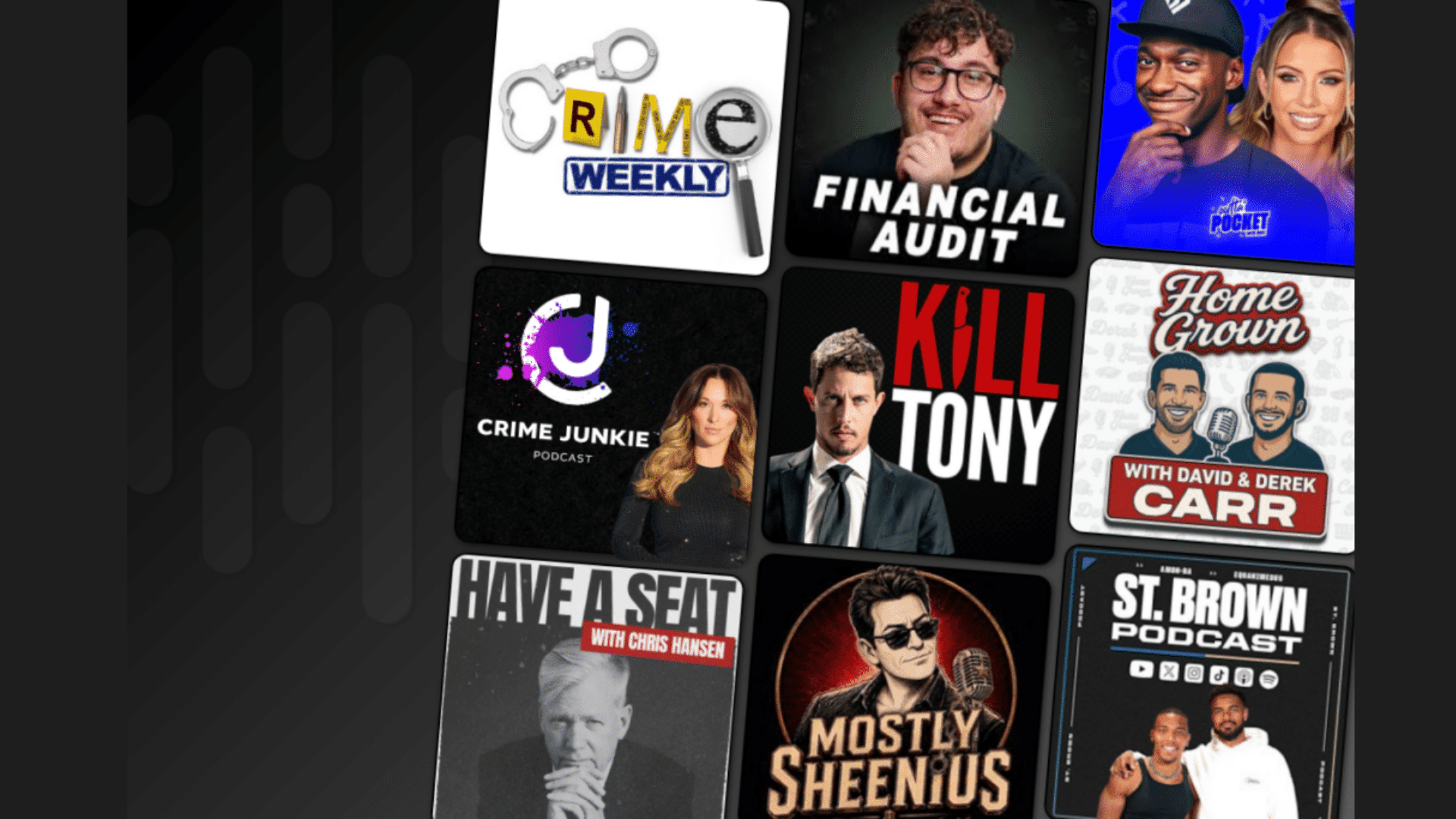
That sequencing is visible in how Red Seat has assembled its existing categories. “Crime Junkie,” hosted by Ashley Flowers, anchors true crime and consistently tops Podscribe’s monthly rankings. “Kill Tony” anchors comedy. Caleb Hammer’s “Financial Audit,” with more than 3.7 million YouTube subscribers and over 500 episodes, serves as the personal finance tent pole. Each anchors a genre around which additional creators can be signed and packaged for advertisers. “Now we have our tent pole, and we can put more creators under that and build out the genre, increasing the amount of impressions that we reach on a monthly basis,” Chris explains.
The model operates differently for earlier-stage talent. Red Seat is also building Charlie Sheen’s podcast, “Mostly Sheenius,” largely from scratch, closer to the company’s original mandate of constructing a creator business rather than acquiring an established audience.
Engagement Depth Over Audience Volume
Follower count is a secondary factor in Red Seat’s evaluation of prospective partners. The primary question is whether a creator’s audience actually responds.
“We want to work with creators that have engaged audiences first and foremost,” Chris says. “There are personalities out there that, on paper, check all the boxes, but they don’t really have an engaged audience.” He points to “TBPN” as an illustration: a network whose valuation reflects the depth of listener connection rather than raw scale.
That same standard shapes how Red Seat sells to advertisers. Because the network concentrates on fewer, larger creators rather than aggregating thousands of smaller shows, buyers purchasing across the portfolio reach an audience that is more likely to respond to brand messaging. “When they do advertise with Red Seat Ventures, they are hitting that top creator that’s reaching the most engaged audience,” Chris says, “versus doing a network buy across 3,000 shows.”
The commercial consequence of that concentration is what allowed Red Seat to debut on the Edison Ranker at number four despite a catalog far smaller than those of competing networks. Chris describes the company’s prior profile as “stealth mode,” a posture that the ranking debut has begun to change.
Fox Ownership Changes the Distribution Calculus
Red Seat’s position inside Fox Corporation opens distribution channels that independent creator networks rarely access.
“The audience that Ashley Flowers and ‘Crime Junkie’ have on Tubi is a different audience than what’s listening on Apple or Spotify or YouTube,” Chris says. Tubi’s user base, which he characterizes as young and multicultural, represents incremental reach for creators rather than overlap with existing listeners. Video-on-demand placements for “Crime Junkie,” “Kill Tony,” and “Financial Audit” are either live or in development, managed by a dedicated licensing team operating across all major platforms.
Chris also draws a structural distinction between RSV and the platforms it uses for distribution. Many of those platforms run subscription businesses that compete with creators for the same audiences, creating a misaligned incentive. “A lot of the time, they have a competing business model,” he says. RSV, sitting inside a media conglomerate that benefits from creator reach rather than monetizing it directly, does not carry that constraint. “It’s a huge advantage for us to be able to go in the room with Fox next to us in these distribution opportunities,” he notes.
Subscription Is the Revenue Layer Most Large Shows Are Skipping
Among the patterns Chris observes limiting established creators, subscription is the most consistent missed opportunity.
“If you look at the top 200 shows, the number of them that are actually doing subscription the right way is small,” he says. His critique is that most creator subscription offerings are limited to an ad-free tier, a version that leaves behind the more durable commercial asset: a direct, high-commitment relationship with a creator’s most engaged listeners. “There are ways to be more creative,” he says.
RSV provides subscription infrastructure through Supercast. Chris cites “Kill Tony’s” subscription business as a reference point the company treats as a model for other partners entering the network.
Platform Monoculture Caps Distribution
A related ceiling Chris identifies across the creator market is over-reliance on a single format, either YouTube or audio, with no investment in the other.
“We believe in the power of audio,” he says. “So let’s launch a podcast with you and let’s see if we can grow that audience.” The expansion path has become more concrete as Spotify Video and Apple HLS have created monetization surfaces for video content moving through podcast infrastructure.
A creator producing one show can now simultaneously reach audiences on YouTube, Apple HLS, Spotify Video, and Tubi, with RSV’s sales team taking all four surfaces to market as a bundled offering. “You just quadrupled your distribution just by working with us,” Chris says. That multi-platform pitch, applied across a concentrated roster of top-tier creators, is the commercial argument RSV makes to buyers and prospective partners alike.
From Stealth to the Creator Economy’s Anchor Point
Red Seat’s three-year target is a scaled version of the current model: more creators in more genres, with a stronger identity as the first call for anyone seeking to maximize audience and revenue without giving up creative control. “You’ll see us as the entry point into the Creator Economy,” Chris says.

Photo: Fenway
Credit: Veronica Benavides
He addresses one persistent misconception directly. The company’s name has no political meaning. It comes from the single red seat at Fenway Park marking where Ted Williams hit a 502-foot home run in 1946. “The mantra of the company is to swing for the fences for our clients,” Chris says. “That’s really the way that we view it.”
On the question of what the Fox relationship means for a creator’s independence, he points to Tubi as the organizational model. Fox acquired Tubi and let it operate as Tubi, an arrangement he describes as the blueprint for how Fox runs all of Tubi Media Group. “We very much still operate as a startup with the backing of Fox behind us,” he says.
For creators weighing whether a Fox-backed company can serve them as well as an independent one, Chris frames the pairing as the actual advantage. “Now we have the best of both worlds,” he concludes.
Subscribe to Our Newsletter
Check Out Our Podcast