



Tech
Inside Trendio: How Alex Perez-Tenessa Is Applying AI, Affiliate Scale To Make Video Commerce Predictable

Trendio is an AI-powered video commerce platform designed to help brands scale on TikTok Shop and YouTube Shopping. Rather than operating as a traditional influencer marketplace or creative agency, the company positions itself as an execution layer for affiliate-driven video commerce, combining creator discovery, automated outreach, content optimization, and performance tracking into a single system.
The goal, according to its founder and CEO Alex Perez-Tenessa, is to make video shopping “predictable, scalable, and profitable” for brands that want to treat it as a core acquisition channel.
Alex brings an operator’s lens to the creator economy. Before founding Trendio, he was a Partner at McKinsey, ran the Beauty & Personal Care business at CVS Health, and held senior leadership roles at Amazon, including leading the U.S. Prime Video business. That background shapes how he frames the opportunity: less about influencer culture, more about systems, economics, and repeatable outcomes.
Building Infrastructure for Video Commerce
Alex describes Trendio as “unapologetically brand-centric.” From the beginning, the company was designed to serve brands (not creators or intermediaries) by providing them with tools to run large-scale affiliate programs without manually managing thousands of individual relationships.
“At Trendio, we are a unique proposition because we’re both an agency and a technology company,” Alex says. “We focus exclusively on affiliate-type activity, particularly around video commerce.”
For Alex and his team, that distinction matters. He notes that traditional influencer marketing often relies on a small number of high-profile creators, negotiated fees, and campaign-by-campaign execution. Trendio, instead, leans into commission-based affiliate partnerships at scale, activating thousands of creators across the “tail and torso” of the creator economy rather than betting on a handful of stars.
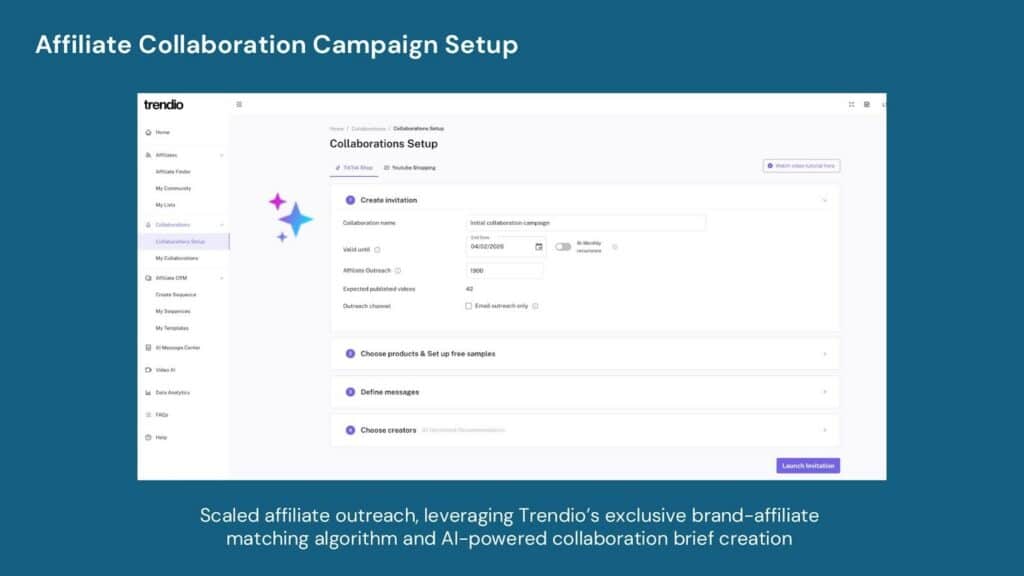
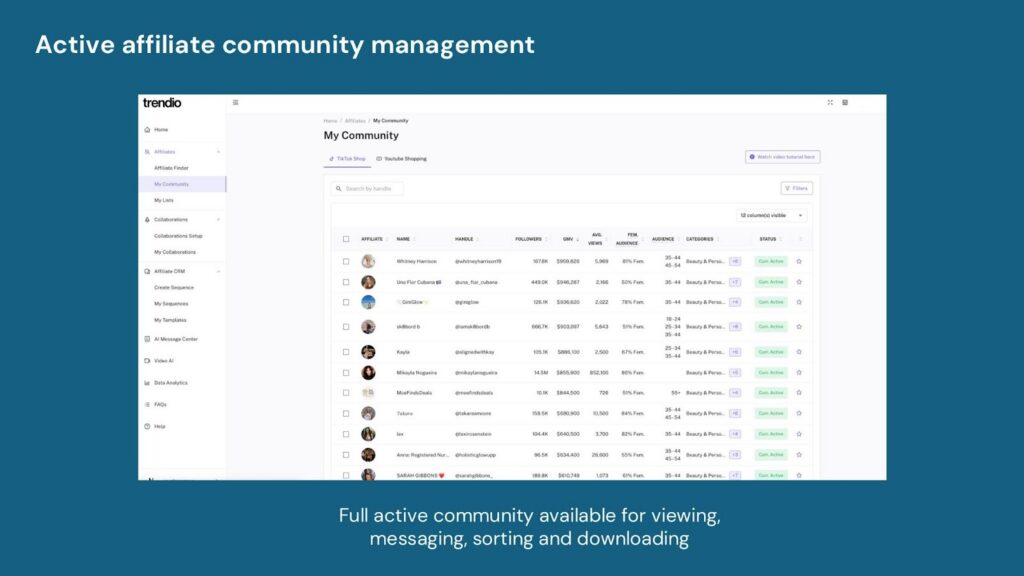
The company’s platform plugs directly into TikTok Shop through API (Application Programming Interface) integrations and layers AI-driven systems on top. Brands can onboard products, set commissions, generate creator briefs, and manage outreach in one place. From there, Trendio automates much of the operational work that typically overwhelms in-house teams.
“Our hypothesis was that this was going to be a tech play,” Alex says. “Traditional influencer approaches where you just know a few people. That’s not the formula that wins here. The formula is a combination of scale and intelligence.”
Why Scale Matters More Than Star Power
One of Alex’s strongest convictions is that creator-led commerce breaks down when brands rely on intuition or anecdotal success stories. He has seen too many teams chase “perfect” creators, only to find the results difficult to replicate.
“The anecdotes are true,” he says. “There are brands that found one or two creators, and that really drove their business. It’s just that they’re not replicable.”
Trendio’s answer is intelligent scale. According to Alex, the platform maintains a database of more than 2.5 million verified U.S.-based TikTok Shop affiliates. When a brand joins, the system narrows that universe based on category, audience demographics, price point, and commission structure. From there, AI models identify patterns among high-performing creators and proactively surface similar profiles that are statistically more likely to respond and convert.
“What we aspire to do is, on average, find more creators, faster, and better creators for our brands,” Alex explains.
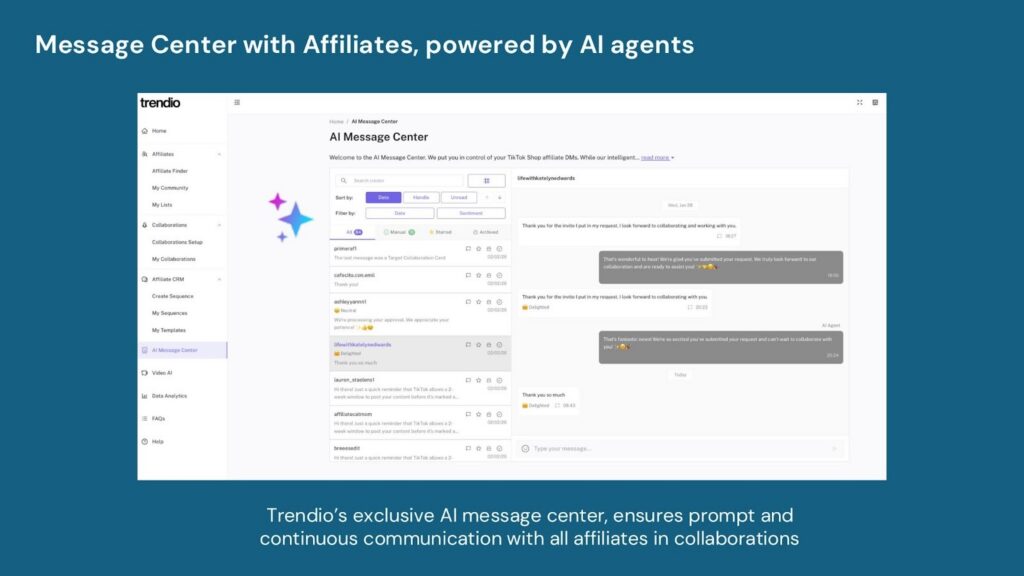
Outreach, follow-ups, sampling logistics, and content timelines are largely automated. Creators receive AI-generated briefs timed to product delivery, reminders aligned with posting windows, and instant responses to common questions through AI agents inside TikTok’s affiliate center. At the same time, Trendio flags top-performing creators for more personalized engagement once they demonstrate traction.
The result, Alex says, is a system that balances automation with human judgment, scaling what works while still allowing brands to build deeper relationships where it matters.
Treating TikTok Shop as an Acquisition Channel
One of the biggest challenges Trendio sees is how brands measure success on TikTok Shop. Many approach it as either a pure commerce channel, like Amazon, or a pure media channel, like Meta. Alex argues it’s neither – and both.
“TikTok is an acquisition channel,” he says. “You get people to discover your product there, but a lot of the lifetime value happens somewhere else.”
In practice, Alex adds, that means brands often over-optimize for short-term return on ad spend and underestimate the long-term customer value generated by TikTok-driven discovery. Some consumers buy directly on TikTok Shop; others discover a product there and later purchase on Amazon, a brand’s DTC (Direct to Consumer) site, or a retail partner.
“If you only look at it as commerce, it’s less attractive than Amazon,” he explains. “If you only look at it as media, you’re missing the transaction layer. The real value is when you look at both together.”
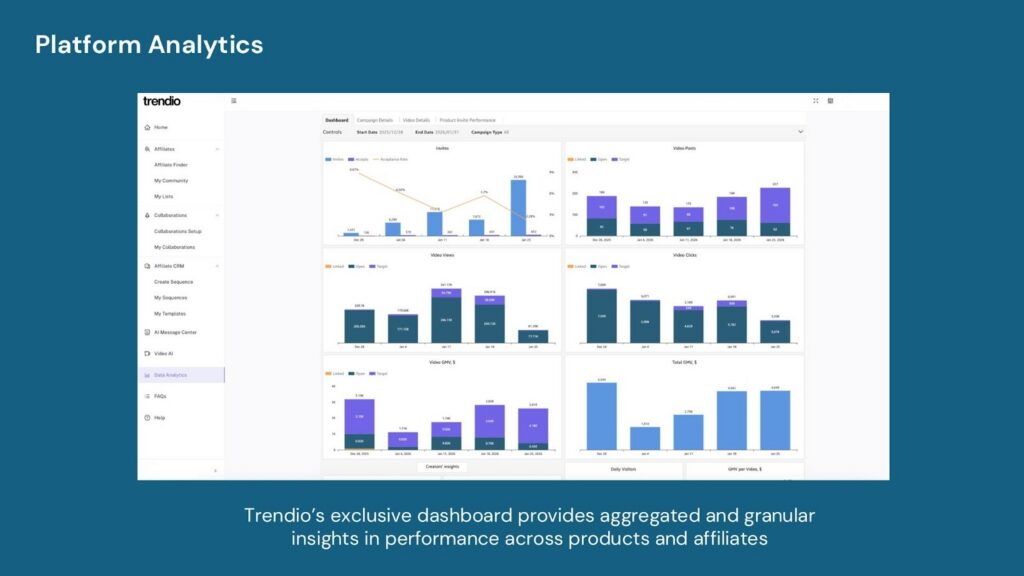
This framing shapes how Trendio advises clients. The platform helps brands model TikTok Shop as a customer acquisition engine that rewards patience, consistency, and sustained investment.
Conviction Over Experimentation
According to Alex, the brands that succeed on TikTok Shop share one trait: conviction.
“If you go into TikTok Shop just to test the waters with very limited samples and very limited investment, you are going to fail,” he says. “There’s almost no scenario where you don’t.”
Trendio has observed that results typically require months, not weeks. Early stages involve seeding content, training the algorithm, and building creator momentum. Only after that foundation is in place does the channel begin to compound.
“It’s not a straight line,” Alex says. “It’s hockey-stick-shaped because that’s how the algorithm works.”
This dynamic mirrors traditional retail expansion, he adds. Brands would never expect immediate returns from a new distribution deal with a major retailer. Video commerce, in his view, deserves the same long-term mindset.
Case Studies Without the Spotlight
While Trendio works with a range of consumer brands, Alex prefers not to name clients publicly. Instead, he points to category-level outcomes that illustrate the platform’s impact.
In one recent example, Trendio helped a beauty brand grow from zero TikTok Shop revenue to an annualized run rate of roughly $4 million within 12 weeks, equating to about $80,000 per week. In another case, a cosmetics brand increased sales from approximately $500,000 to $2 million over four months.
“What drove success was trusting intelligent scale,” Alex says. “And having real ambition.”
In both cases, he notes that brands committed sufficient inventory, creator outreach, and time to let the system mature, rather than pulling back at the first sign of uneven performance.
A Different Experience for Creators
Although Trendio is built for brands, its structure also dictates how creators participate in commerce programs. Instead of interacting primarily with agencies or talent managers, creators engage directly with brands through the platform.
“The relationship is with the brand, not with us,” Alex says. “Creators should make content because they believe in the brand, not because they’re doing us a favor.”
For creators who value long-term partnerships and consistent earning potential, that direct relationship can be appealing, according to Alex. As creators prove performance, the engagement becomes more personal, even as the broader system remains automated.
Making Video Commerce Routine
Alex’s long-term vision for Trendio is pragmatic rather than grandiose. He wants video commerce to feel operational, something brands can run with the same confidence and predictability as paid search or social ads.
“Our vision is to make running a scaled video commerce affiliate campaign as easy as running an ad on Google,” he says.
That goal reflects how Alex sees the next phase of the creator economy: less experimental, more infrastructural. As platforms like TikTok Shop and YouTube Shopping grow, the brands that win will be those that invest early, build systems, and treat creator-led commerce as a core part of their growth stack.
For Alex, the opportunity is still wide open. “Saying it’s too late now is like saying you missed Google Ads,” he says. “You haven’t.”
Image source: Trendio
Checkout Our Latest Podcast