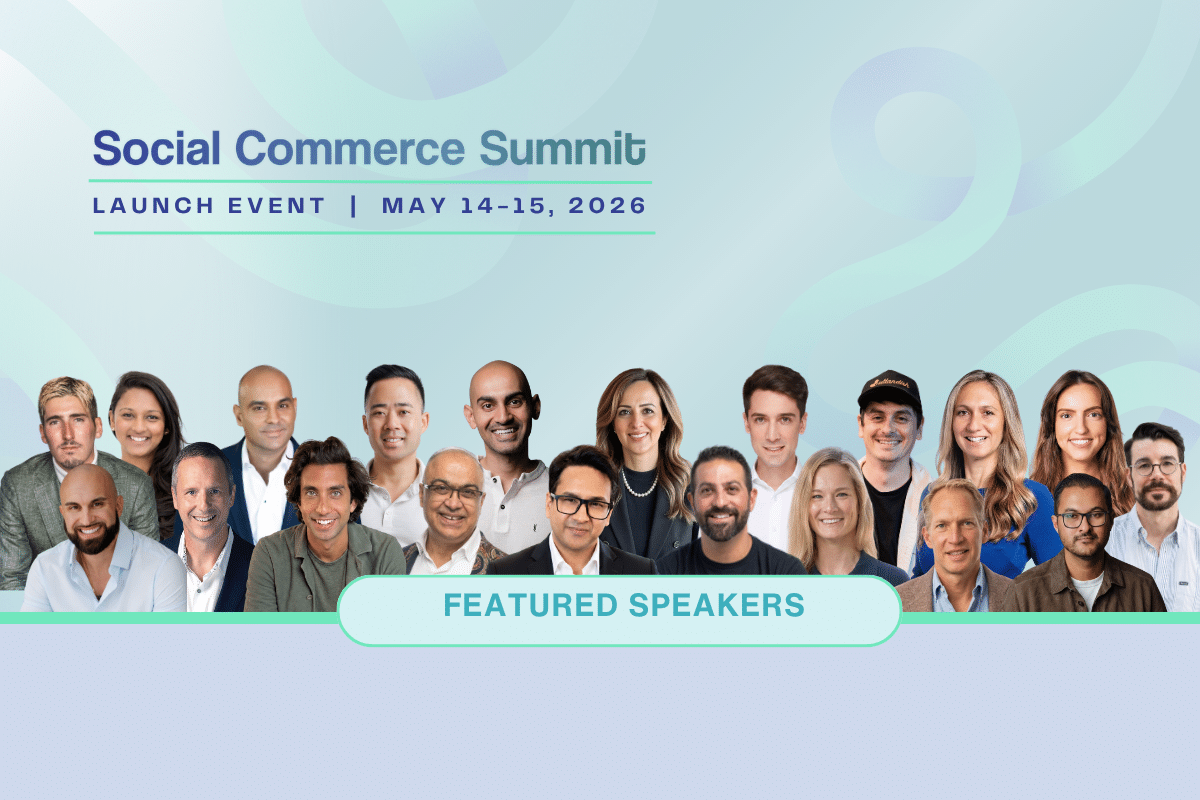
Social commerce does not have a neutral room. Major gatherings in the space are sponsored by agencies, built around platforms, or focused on a single discipline. The Social Commerce Summit, taking place May 14 and 15, 2026, at westdrift Manhattan Beach, California, is built on the premise that the gap is costing the industry.
The launch event is invitation-only, complimentary for qualified attendees, and scoped deliberately: senior operators, brand executives, platform leaders, and investors, gathered for two days of focused conversation on what is actually working across affiliate, creator commerce, TikTok Shop, live selling, and DTC. A larger event is planned for New York in September.
Kathleen Ross, the Summit’s fractional CMO, spent 15 years inside beauty, wellness, fashion, and direct-to-consumer brands before taking on the role. Her read on why the event is needed is grounded in what she watched happen to marketing organizations over the past five years: brand, performance, and growth teams pulling apart into separate functions, separate reporting lines, and separate C-suites, with nobody responsible for how they connect.
“When you sit in the CMO seat, you have to focus on all of those things,” Kathleen says, referring to affiliate, creator, influencer, organic social, and performance marketing. “And I think that it’s very difficult because some things are so siloed.”
A Fragmented Industry Starts to Reckon With Itself
The fragmentation Kathleen describes is not new, but it is getting harder to ignore. “You have a lot of companies now separating growth teams from the rest of their marketing team,” she says. “That’s happened over the past five years.”
Kathleen notes that the structural split made sense during a period when individual channels rewarded specialization. But as paid advertising on Meta grew more expensive and the customer journey migrated to social platforms, the cost of that fragmentation became harder to absorb. “As ad costs go up, you realize, ‘Oh wow, we should have invested more in brand,'” she says. “And brand still sits in social commerce.”
What has changed, she argues, is the speed at which the full purchase cycle now plays out. Discovery, consideration, and conversion can occur on a single platform, sometimes within a single session.
“Every single step of the journey can happen on social now,” Kathleen says.
Practitioner-Led, Not Platform-Sponsored
Most existing social commerce gatherings carry an institutional agenda. Affiliate summits are organized by affiliate agencies. Creator summits are run by creator agencies. Platform-specific events are, in many ways, business development opportunities for their sponsors.
Social Commerce News, the digital publication behind the Summit, was built with a journalistic orientation.
Jacob McLain, who helped develop the event concept, describes that neutrality as structural rather than aspirational. “The in-person convening of minds and interaction is so critical,” he says. “And it seemed in the social commerce space, there were a lot of creator-focused or agency-sponsored types of places for folks to get together.”
That positioning shapes everything from speaker selection to content direction. Kathleen says the team actively pushed speakers to go beyond polished case studies. “We really want to cut into the nitty-gritty of what’s working, what’s not. Tell us about your failures,” she explains. “People want to hear those things, and we want to create a safe space for that type of conversation.”
The Lineup: Platform Executives, Brand Operators, and Public Company CEOs
Thursday’s Opening Night features keynote presentations from Neil Patel and Eric Siu, co-hosts of the “Marketing School” podcast, alongside Glenn Sanford, founder of eXp Realty and Managing Director and Publisher of SUCCESS Magazine.
Friday’s main event brings platform executives into direct conversation with brand operators. Aileen Zou, Head of Global Accounts at TikTok, will address what is working on TikTok Shop. Representatives from YouTube’s Shopping Partnerships team will cover updates to YouTube’s commerce infrastructure.
Puneet Nanda, founder and CEO of GuruNanda, built one of the top TikTok Shop brands in personal care. Jay Hunter, CEO of Sprinter, is overseeing the launch of k2o by Sprinter, the company’s new beauty supplement brand. Mina Zandbar, VP of Global eCommerce and Digital Growth at Mattel, and senior contributors from Unilever and Liquid I.V. round out the brand representation.
“There are so many different learnings depending on what side of the business that you’re on,” Kathleen says.
The Friday program also includes a dedicated Financial and Investment Session spanning early-stage funding through mergers and acquisitions and exit preparation. Speakers include David Vanderveen, Board of Directors & President of Prenetics & IM8; Carl Daikeler, co-founder and CEO of publicly traded BODi; and the CFO of K18 Hair. The session is designed to give founders and operators a direct line to how investors are evaluating social commerce businesses right now.
The strategy for the launch event has been intentionally invitation-led rather than mass-market, with personal outreach to senior operators the team wants in the room. Kathleen describes it as practitioner to practitioner, with personal invitations extended to senior operators the team wanted in the room.
That approach was a deliberate choice for a first event without a track record. “If you know who some of these executives are,” she says, “it kind of attracts, in its own amazing way, the right people.”
The tight curation also serves a product function. Kathleen frames this inaugural gathering as much a feedback mechanism as a conference. “The people who are there are going to be shaping the future of how this conversation is presented,” she says.
The Multicultural Gap in Social Commerce
One of the Summit’s more pointed programming choices is a dedicated session on the U.S. Hispanic market and broader multicultural growth opportunity. Rémi Martini, co-founder and CEO of Sarelly, an influencer-created brand in Mexico, leads that conversation.
Kathleen argues the segment is both underserved and consequential. “There’s an incredible amount of opportunity to make sure that you’re understanding the different demographics that exist even in the U.S. Hispanic and Latino market,” she says. “It’s one of the core programming themes that we have.”
The point, she adds, is not to treat multicultural commerce as an add-on. The customer journey changes, the platforms shift in relevance, and the content strategies that work differ meaningfully across communities. That specificity is what makes the conversation worth having at the senior level rather than leaving it to content teams.
Building Toward a Permanent Hub for Social Commerce
The Summit’s ambition extends beyond any single gathering. Kathleen describes the goal as becoming the destination for social commerce conversation, a place practitioners return to as the category continues to define itself.
Social commerce, she notes, remains unfinished. TikTok Shop is growing but still establishing norms. Live shopping has real traction in Asia but is still finding its footing in the United States. The convergence of discovery, brand building, and conversion on a single platform is happening faster than most organizations have adapted their structures to accommodate.
“We want to be able to inspire and to facilitate that conversation as far and wide as we can to the right people,” Kathleen says. “To really be a part of how people find success within their social commerce business.”
The Social Commerce Summit takes place May 14 and 15, 2026, at westdrift Manhattan Beach, California. Attendance is complimentary for qualified applicants. Apply at socommsummit.com.
Nii A. Ahene is the founder and managing director of Net Influencer, a website dedicated to offering insights into the influencer marketing industry. Together with its newsletter, Influencer Weekly, Net Influencer provides news, commentary, and analysis of the events shaping the creator and influencer marketing space. Through interviews with startups, influencers, brands, and platforms, Nii and his team explore how influencer marketing is being effectively used to benefit businesses and personal brands alike.











Social commerce does not have a neutral room. Major gatherings in the space are sponsored by agencies, built around platforms, or focused on a single discipline. The Social Commerce Summit, taking place May 14 and 15, 2026, at westdrift Manhattan Beach, California, is built on the premise that the gap is costing the industry.
The launch event is invitation-only, complimentary for qualified attendees, and scoped deliberately: senior operators, brand executives, platform leaders, and investors, gathered for two days of focused conversation on what is actually working across affiliate, creator commerce, TikTok Shop, live selling, and DTC. A larger event is planned for New York in September.
Kathleen Ross, the Summit’s fractional CMO, spent 15 years inside beauty, wellness, fashion, and direct-to-consumer brands before taking on the role. Her read on why the event is needed is grounded in what she watched happen to marketing organizations over the past five years: brand, performance, and growth teams pulling apart into separate functions, separate reporting lines, and separate C-suites, with nobody responsible for how they connect.
“When you sit in the CMO seat, you have to focus on all of those things,” Kathleen says, referring to affiliate, creator, influencer, organic social, and performance marketing. “And I think that it’s very difficult because some things are so siloed.”
A Fragmented Industry Starts to Reckon With Itself
The fragmentation Kathleen describes is not new, but it is getting harder to ignore. “You have a lot of companies now separating growth teams from the rest of their marketing team,” she says. “That’s happened over the past five years.”
Kathleen notes that the structural split made sense during a period when individual channels rewarded specialization. But as paid advertising on Meta grew more expensive and the customer journey migrated to social platforms, the cost of that fragmentation became harder to absorb. “As ad costs go up, you realize, ‘Oh wow, we should have invested more in brand,'” she says. “And brand still sits in social commerce.”
What has changed, she argues, is the speed at which the full purchase cycle now plays out. Discovery, consideration, and conversion can occur on a single platform, sometimes within a single session.
“Every single step of the journey can happen on social now,” Kathleen says.
Practitioner-Led, Not Platform-Sponsored
Most existing social commerce gatherings carry an institutional agenda. Affiliate summits are organized by affiliate agencies. Creator summits are run by creator agencies. Platform-specific events are, in many ways, business development opportunities for their sponsors.
Social Commerce News, the digital publication behind the Summit, was built with a journalistic orientation.
Jacob McLain, who helped develop the event concept, describes that neutrality as structural rather than aspirational. “The in-person convening of minds and interaction is so critical,” he says. “And it seemed in the social commerce space, there were a lot of creator-focused or agency-sponsored types of places for folks to get together.”
That positioning shapes everything from speaker selection to content direction. Kathleen says the team actively pushed speakers to go beyond polished case studies. “We really want to cut into the nitty-gritty of what’s working, what’s not. Tell us about your failures,” she explains. “People want to hear those things, and we want to create a safe space for that type of conversation.”
The Lineup: Platform Executives, Brand Operators, and Public Company CEOs
Thursday’s Opening Night features keynote presentations from Neil Patel and Eric Siu, co-hosts of the “Marketing School” podcast, alongside Glenn Sanford, founder of eXp Realty and Managing Director and Publisher of SUCCESS Magazine.
Friday’s main event brings platform executives into direct conversation with brand operators. Aileen Zou, Head of Global Accounts at TikTok, will address what is working on TikTok Shop. Representatives from YouTube’s Shopping Partnerships team will cover updates to YouTube’s commerce infrastructure.
Puneet Nanda, founder and CEO of GuruNanda, built one of the top TikTok Shop brands in personal care. Jay Hunter, CEO of Sprinter, is overseeing the launch of k2o by Sprinter, the company’s new beauty supplement brand. Mina Zandbar, VP of Global eCommerce and Digital Growth at Mattel, and senior contributors from Unilever and Liquid I.V. round out the brand representation.
“There are so many different learnings depending on what side of the business that you’re on,” Kathleen says.
The Friday program also includes a dedicated Financial and Investment Session spanning early-stage funding through mergers and acquisitions and exit preparation. Speakers include David Vanderveen, Board of Directors & President of Prenetics & IM8; Carl Daikeler, co-founder and CEO of publicly traded BODi; and the CFO of K18 Hair. The session is designed to give founders and operators a direct line to how investors are evaluating social commerce businesses right now.
Going Organic to Build a Credible Room
The strategy for the launch event has been intentionally invitation-led rather than mass-market, with personal outreach to senior operators the team wants in the room. Kathleen describes it as practitioner to practitioner, with personal invitations extended to senior operators the team wanted in the room.
That approach was a deliberate choice for a first event without a track record. “If you know who some of these executives are,” she says, “it kind of attracts, in its own amazing way, the right people.”
The tight curation also serves a product function. Kathleen frames this inaugural gathering as much a feedback mechanism as a conference. “The people who are there are going to be shaping the future of how this conversation is presented,” she says.
The Multicultural Gap in Social Commerce
One of the Summit’s more pointed programming choices is a dedicated session on the U.S. Hispanic market and broader multicultural growth opportunity. Rémi Martini, co-founder and CEO of Sarelly, an influencer-created brand in Mexico, leads that conversation.
Kathleen argues the segment is both underserved and consequential. “There’s an incredible amount of opportunity to make sure that you’re understanding the different demographics that exist even in the U.S. Hispanic and Latino market,” she says. “It’s one of the core programming themes that we have.”
The point, she adds, is not to treat multicultural commerce as an add-on. The customer journey changes, the platforms shift in relevance, and the content strategies that work differ meaningfully across communities. That specificity is what makes the conversation worth having at the senior level rather than leaving it to content teams.
Building Toward a Permanent Hub for Social Commerce
The Summit’s ambition extends beyond any single gathering. Kathleen describes the goal as becoming the destination for social commerce conversation, a place practitioners return to as the category continues to define itself.
Social commerce, she notes, remains unfinished. TikTok Shop is growing but still establishing norms. Live shopping has real traction in Asia but is still finding its footing in the United States. The convergence of discovery, brand building, and conversion on a single platform is happening faster than most organizations have adapted their structures to accommodate.
“We want to be able to inspire and to facilitate that conversation as far and wide as we can to the right people,” Kathleen says. “To really be a part of how people find success within their social commerce business.”
The Social Commerce Summit takes place May 14 and 15, 2026, at westdrift Manhattan Beach, California. Attendance is complimentary for qualified applicants. Apply at socommsummit.com.
Subscribe to Our Newsletter
Check Out Our Podcast