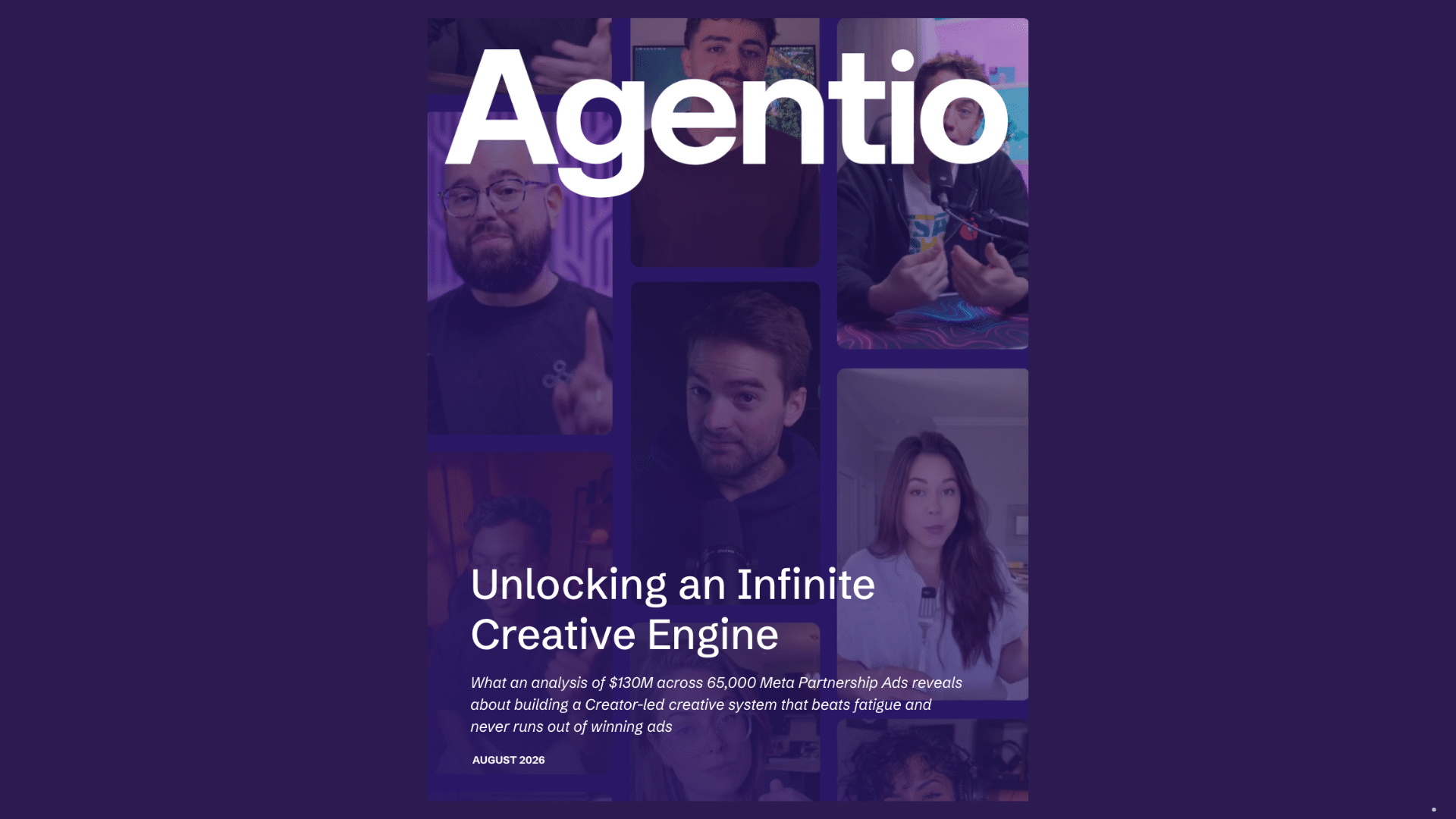
Meta Partnership Ads delivered a 19% higher click-through rate, a 10% higher conversion rate, and a 5% lower cost per acquisition than traditional licensed UGC run from brand accounts, despite carrying a 19% higher CPM, according to a new report from Agentio that analyzed $130 million in spend across 65,000 ads from 137 brands.
The report, titled “Unlocking an Infinite Creative Engine,” also found a median hit rate of about one in five across the brands in its testing sample, that winning ads fatigue after an average of 36 days, and that brands can extend the life of fatigued Meta winners by redeploying them on YouTube Shorts through Google’s Creator Partnerships Boost format.
The gap between Partnership Ads and licensed UGC was widest in Search placements, where Partnership Ads posted a 45% higher CTR, a 143% higher CVR, and a 63% lower CPA. Explore placements showed a 129% CTR advantage alongside a 57% lower CPM. Story placements were the exception: Partnership Ads there carried a 25% higher CPA despite an 11% CTR lift.
Agentio attributes the overall gap to what it calls a “dual signal”: Partnership Ads optimize against both the creator’s follower graph and engagement history and the brand’s pixel, while licensed UGC runs on the brand’s signal alone. The report cites Meta CEO Mark Zuckerberg’s Q1 2026 earnings call, where he said brands “increasingly turning to Creators to promote their products” helped more than double the Partnership Ads revenue run rate year over year, to $10 billion.
Most Brands Land a 20% Hit Rate, and Cutting Tests Early Costs Winners
Across a locked population of 8,696 purchase-optimized ads from 56 brands over the trailing 12 months, the median hit rate, winners divided by ads tested, was 20.4%. Most brands fell between 10% and 20%; only four of the 56 brands in the sample topped 40%.
Agentio’s data indicates that judging tests too early misclassifies winners as losers. At $100 of cumulative spend, 45% of ads that would eventually qualify as winners still looked like losers. That share dropped to 26% at $1,000 of spend. The report recommends brands set a spend floor of roughly $1,000 per ad before making a kill call.
The report also found that where a test ad launches affects its odds. In ad sets of six to 15 active ads, the single top-spending ad captured a median 53% of the ad set’s budget, rising to 97% for the top five ads. An “incumbent ad,” defined as one holding at least 1.5 times its fair share of spend for three or more consecutive days, reduced a new test’s chances of reaching fair share of spend from 31% to 25%. Agentio recommends launching new tests into ad sets with no incumbent present.
Winners Fatigue in About Five Weeks
The report found that winning ads begin to fatigue after an average of 36 days of active spend. Ads kept running past that point saw CPA rise by an average of 1.8 times (a median of 1.4 times), with a quarter of ads deteriorating past 2x and one in 10 past 3x.
To maintain a portfolio of winning ads, Agentio calculates that each concurrently running winning slot requires roughly four new test ads per month, based on a 20% hit rate and a monthly replacement rate derived from the 36-day fatigue window. By that math, a brand spending $1 million or more monthly on Meta Partnership Ads would need to test roughly 81 new ads a month to sustain 20 concurrent winners.
A Second Life on YouTube Shorts
Rather than retiring fatigued winners, Agentio recommends redeploying them through Google’s Creator Partnerships Boost, which runs a creator’s YouTube video as an ad from the creator’s own channel in a co-branded format on Shorts. The report cites GWI data showing 34% of U.S. YouTube Shorts users are not active on TikTok or Instagram Reels, meaning a third of that inventory has not yet seen a given Meta creative. Among Agentio brands that redeployed Meta winners this way, CPMs on YouTube’s Creator Partnerships Boost ran 30% lower than on Meta Partnership Ads for the same creative, a gap the report attributes to limited advertiser adoption of the format so far.
Image source: Agentio The full report is available here
Dragomir is a Serbian freelance blog writer and translator. He is passionate about covering insightful stories and exploring topics such as influencer marketing, the creator economy, technology, business, and cyber fraud.











Meta Partnership Ads delivered a 19% higher click-through rate, a 10% higher conversion rate, and a 5% lower cost per acquisition than traditional licensed UGC run from brand accounts, despite carrying a 19% higher CPM, according to a new report from Agentio that analyzed $130 million in spend across 65,000 ads from 137 brands.
The report, titled “Unlocking an Infinite Creative Engine,” also found a median hit rate of about one in five across the brands in its testing sample, that winning ads fatigue after an average of 36 days, and that brands can extend the life of fatigued Meta winners by redeploying them on YouTube Shorts through Google’s Creator Partnerships Boost format.
The gap between Partnership Ads and licensed UGC was widest in Search placements, where Partnership Ads posted a 45% higher CTR, a 143% higher CVR, and a 63% lower CPA. Explore placements showed a 129% CTR advantage alongside a 57% lower CPM. Story placements were the exception: Partnership Ads there carried a 25% higher CPA despite an 11% CTR lift.
Agentio attributes the overall gap to what it calls a “dual signal”: Partnership Ads optimize against both the creator’s follower graph and engagement history and the brand’s pixel, while licensed UGC runs on the brand’s signal alone. The report cites Meta CEO Mark Zuckerberg’s Q1 2026 earnings call, where he said brands “increasingly turning to Creators to promote their products” helped more than double the Partnership Ads revenue run rate year over year, to $10 billion.
Most Brands Land a 20% Hit Rate, and Cutting Tests Early Costs Winners
Across a locked population of 8,696 purchase-optimized ads from 56 brands over the trailing 12 months, the median hit rate, winners divided by ads tested, was 20.4%. Most brands fell between 10% and 20%; only four of the 56 brands in the sample topped 40%.
Agentio’s data indicates that judging tests too early misclassifies winners as losers. At $100 of cumulative spend, 45% of ads that would eventually qualify as winners still looked like losers. That share dropped to 26% at $1,000 of spend. The report recommends brands set a spend floor of roughly $1,000 per ad before making a kill call.
The report also found that where a test ad launches affects its odds. In ad sets of six to 15 active ads, the single top-spending ad captured a median 53% of the ad set’s budget, rising to 97% for the top five ads. An “incumbent ad,” defined as one holding at least 1.5 times its fair share of spend for three or more consecutive days, reduced a new test’s chances of reaching fair share of spend from 31% to 25%. Agentio recommends launching new tests into ad sets with no incumbent present.
Winners Fatigue in About Five Weeks
The report found that winning ads begin to fatigue after an average of 36 days of active spend. Ads kept running past that point saw CPA rise by an average of 1.8 times (a median of 1.4 times), with a quarter of ads deteriorating past 2x and one in 10 past 3x.
To maintain a portfolio of winning ads, Agentio calculates that each concurrently running winning slot requires roughly four new test ads per month, based on a 20% hit rate and a monthly replacement rate derived from the 36-day fatigue window. By that math, a brand spending $1 million or more monthly on Meta Partnership Ads would need to test roughly 81 new ads a month to sustain 20 concurrent winners.
A Second Life on YouTube Shorts
Rather than retiring fatigued winners, Agentio recommends redeploying them through Google’s Creator Partnerships Boost, which runs a creator’s YouTube video as an ad from the creator’s own channel in a co-branded format on Shorts. The report cites GWI data showing 34% of U.S. YouTube Shorts users are not active on TikTok or Instagram Reels, meaning a third of that inventory has not yet seen a given Meta creative. Among Agentio brands that redeployed Meta winners this way, CPMs on YouTube’s Creator Partnerships Boost ran 30% lower than on Meta Partnership Ads for the same creative, a gap the report attributes to limited advertiser adoption of the format so far.
Image source: Agentio
The full report is available here
Subscribe to Our Newsletter
Check Out Our Podcast