







Tech
How Logically AI Is Turning Narrative Intelligence Into A Decision Layer For The Creator Economy

Logically AI is a UK-based decision intelligence company that helps government agencies, enterprises, and brand-facing organizations make sense of complex information environments shaped by social media, news, and internal data. Founded in 2017 by Lyric Jain, Logically began as a consumer-focused fact-checking platform before becoming an enterprise intelligence system designed to help organizations detect, interpret, and respond to narrative risk at scale.
Today, Logically positions itself not as a moderation tool or monitoring dashboard, but as a simulation-driven decision layer that allows stakeholders to understand not only what is happening online, but why it matters and what is likely to happen next. For creator-led brands and marketing teams operating in volatile information environments, Lyric believes that distinction is increasingly critical.
“We’re a decision intelligence platform,” he explains. “We hoover up a bunch of information from open spaces online – social media, news, blogs – but also from organizations internally. Then we detect signals, cluster them into narratives, and simulate what different responses are likely to do.”
From Consumer Fact-Checking to Enterprise Decision Intelligence
Logically’s original thesis was rooted in verification. Lyric began working with artificial intelligence academically in 2016, before large language models entered the mainstream, driven by an interest in how misinformation spreads and causes real-world harm.
“I like to think I got into AI before it was cool,” he says. “But I was also motivated by personal experiences around misinformation and harmful narratives, particularly around health.”
That motivation initially led Logically to be developed as a consumer-facing product. The company launched a direct-to-consumer app designed to help users assess the credibility of information they encountered online, attracting several hundred thousand users around major election events. Engagement, however, proved easier to generate than revenue.
“People’s appetite to pay for media was already challenging,” Lyric says. “Back in 2017 and 2018, that demand was even further depressed.”
Those constraints drove Logically’s first major shift toward governments, social platforms, and large organizations dealing with misinformation, influence campaigns, and narrative risk at scale. The company built teams of intelligence analysts and fact-checkers who supported partners directly and trained its models with human-in-the-loop oversight.
For several years, that institutional demand grew alongside rising investments in trust and safety. Between 2016 and 2023, content moderation budgets expanded steadily. By 2024 and 2025, those priorities reversed.
“At some platforms, trust and safety budgets were cut by more than half,” Lyric says. “That changed the ecosystem.”
At the same time, the economics of influence shifted. Lyric notes that generative AI reduced the cost of producing and amplifying narratives, enabling coordinated campaigns to be run at scale and cost-effectively.
“Anyone could create these campaigns for as little as $1,000 and have a significant impact on a company’s brand or stock price,” he says. “We started seeing pump-and-dump schemes and coordinated attacks against publicly listed companies.”
As platforms pulled back and narrative risk became easier to manufacture, enterprises (including brand-facing and creator-adjacent organizations) became the new center of gravity. Communications leaders and risk teams were no longer dealing with isolated incidents, but with sustained, multi-channel narrative pressure affecting reputation, revenue, and market confidence.
That convergence reshaped Logically’s focus. Rather than operating primarily as a verification or moderation tool, the company evolved into a decision intelligence platform designed to help organizations understand what is happening, why it matters, and what is likely to happen next.
What Logically Actually Does In Practice
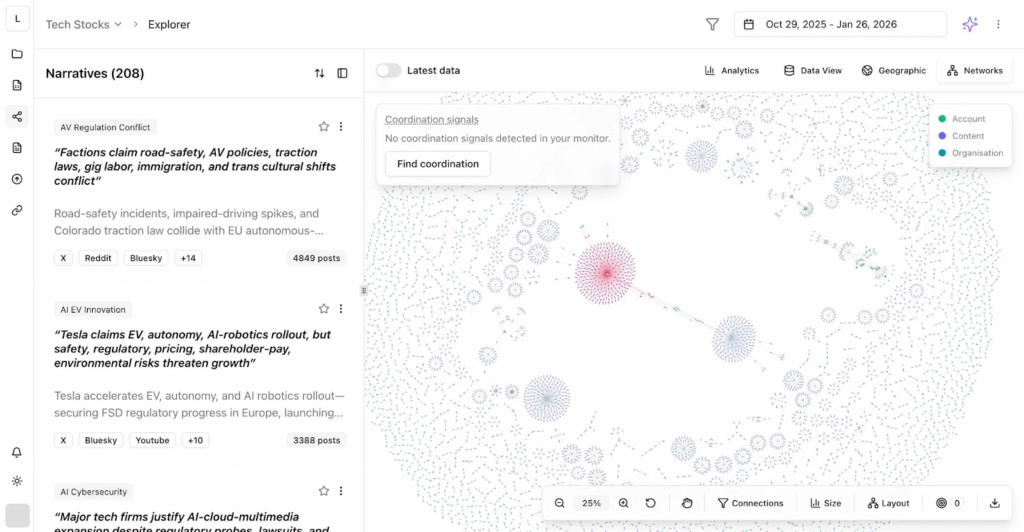
Logically’s platform ingests large volumes of online and internal data, detects signals of risk or opportunity, and organizes them into narratives. Lyric notes that these narratives may be organic (genuine consumer outrage, for example) or synthetic, such as coordinated bot activity designed to amplify pressure.
In one case Lyric describes, a publicly listed cybersecurity company experienced a major outage. Within 24 hours, more than two million negative messages appeared online.
“What we ended up doing was distilling those two million messages into about 200,000 that were assessed as harmful,” he says. “Then, we distilled those down into 37 narratives and instances of coordinated or authentic behavior.”
Some narratives reflected real customer frustration. Others involved synthetic amplification designed to depress the company’s stock price. “Each of those narratives needed to be dealt with differently,” Lyric says. “You don’t want to overreact to bots, but you do want to be transparent with customers.”
The outcome, he adds, was not just a better crisis response, but a long-term shift in how the company approached narrative resilience.
Decision Intelligence, Not Just Detection
Lyric believes Logically’s emphasis on decision support distinguishes it from purely automated monitoring or moderation tools.
“Truthiness is important, but it’s just one dimension,” he says. “Our customers are looking at the information environment holistically.”
Rather than flagging individual claims, the platform explains how narratives form, where pressure is building, and which interventions are likely to produce what outcomes. Users can simulate responses across communication strategies and influencer outreach to assess likely outcomes based on historical patterns and behavioral signals.
“We’re not claiming to have built a future-predicting machine,” Lyric says. “But we can simulate thousands of possibilities and probabilistically indicate which outcomes are more likely.”
Products Built Around How Decisions Actually Get Made
Logically offers two core product surfaces: Logically Intelligence and PRISMα.
Logically Intelligence is a purpose-built dashboard designed for specialist users: analysts, communications teams, and risk professionals who work with the platform daily.
PRISMα takes a different approach.
“People are a bit sick of another dashboard tool,” Lyric says. “PRISMα allows our agents to integrate directly into workflows like Slack or Gmail.”
He adds that the agents can also be deployed within secure environments for customers with strict privacy requirements.
“It was really about adding value to customers we were already working with,” Lyric explains. “Making intelligence accessible without requiring people to be trained specialists.”
Where Organizations Still Fall Short
According to Lyric, the biggest failure mode in information integrity is not a lack of data, but bias.
He points out that organizations tend to either underestimate risk and respond too late, or overreact to situations that do not warrant escalation. Both outcomes, he argues, can damage trust, particularly in creator-driven environments where audiences are highly reactive.
“What we’re trying to do is bring it back to the data,” Lyric says. “What does it simulate? What’s the confidence level? And here’s the audit trail.”
That transparency, he says, allows teams to move away from instinct-driven responses toward repeatable, evidence-based decision-making.
Building a Sense-Making Layer
Lyric sees the next phase of the information ecosystem as increasingly noisy, shaped by both human and AI-generated content with competing intents.
“How does an entire organization build a single source of sense-making?” he asks. “That’s the gap we’re trying to serve.”
In the near term, Logically’s focus is on expanding PRISMα to more customers. Long-term, Lyric envisions Logically becoming a core narrative and simulation layer embedded across organizational decision-making workflows, from communications and risk to strategy and planning.
“There’s nothing that technically limits this capability to one use case,” he says. “Any decision-making workload can benefit from it.”
For creator economy professionals tackling fragmented platforms, volatile audiences, and increasingly weaponized narratives, that proposition is less about moderation and more about clarity.
As Lyric puts it: “The outcome is people making better decisions on the basis of better information.”