






Technology
Caloroga Media’s New AI Studio Turns One Prompt Into Editable Podcasts and Videos

Caloroga Media has produced about 60 podcasts with two founders and a stable of AI voices. The company is now selling the production system behind that output. Linnet, a browser-based studio that opened to the public in beta on November 2, builds a full rough cut from a single prompt and leaves every piece of it editable on a multitrack timeline.
“We’re trying to take a really high ground on the use of AI, its content, its creation, and set a standard for doing it right,” says co-founder Mark Francis, who worked as a producer at New York’s WNEW-FM and later as Senior Director of Talk Production at SiriusXM.
Doing it right, in his account, means a professional-grade tool that a first-time creator can still operate. Mark and co-founder John McDermott, a former SiriusXM and Cadence13 executive, started Caloroga in New York in 2023, and Linnet grew out of the network’s own workflow. Mark expects users to range from a solo video blogger to a podcast company whose team uses it as a design tool. “I built it as a professional, but with a very intuitive design,” he says.

Early AI Audio Tools Missed What Producers Need
The professional half of that design came from Mark’s assessment of the first wave of AI voice platforms. A few years ago, about half a dozen companies launched tools that let users type a script, have AI voice it, and drop the result onto a timeline for light editing. Mark, who produces in Pro Tools, found them limited. “They were built by coders, not by broadcasters,” he argues.
He figured a team and a couple of million dollars could build something better, but nobody wanted to fund it. About a year ago, he turned to vibe coding on Replit, which Mark describes as the ability to write code without knowing code. He expected a couple of months of work. It took a year and a couple thousand hours. “Vibe coding is all made to sound like anyone can do it. But if you really want to do something big and good, it still takes time,” he notes. Mark counts the result as a million dollars of investor money saved.
The workstation is modeled on the software producers already use, with 24 audio tracks plus video and graphics tracks, fades, audio separation and volume automation. Mark built multitrack mixing into the core so users are not limited to a program that outputs a single track. Including those standard studio controls is how Linnet shows it was designed by someone who edits for a living. They are also where its AI output lands.
‘God Mode’ Drafts the Episode and Leaves the Edit to Users
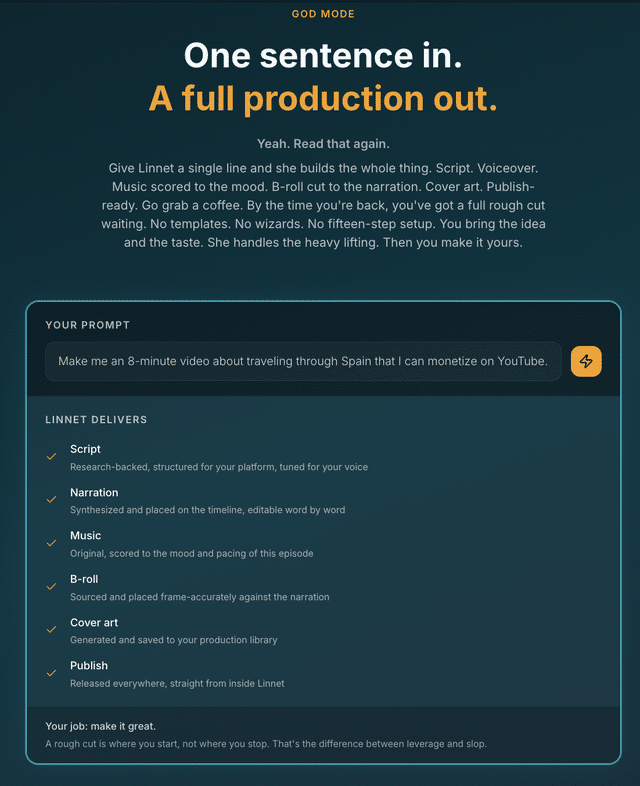
Linnet’s AI layer is a feature called “God Mode.” In Mark’s example, a user asks for a two-minute video about a dog-walking service. Linnet sends the prompt to Claude for a script, then pulls a music bed from Jamendo, a voice from ElevenLabs, stock footage from Pexels and podcast artwork from Ideogram, and lays everything out on the timeline.
That final step is the line Mark draws between Linnet and generators that return a finished file with no editing control. “This puts it out on a timeline where you can now edit it, make it better, swap in your own footage, swap in your voiceover if you want,” he explains. With an API key from Podigee, Transistor, or Buzzsprout (hosts that currently allow API access for video), “God Mode” can also have a show published within 10 minutes, according to Mark.
He acknowledges that someone could use the feature to make slop. “It’s up to the user to use their own responsibility and their own talent to create what they feel is good product,” he says. He argues the output still holds up because its elements come from legitimate services, and says a company that recently drew press for what he calls its “AI slop manufacturing machine” sharpened Caloroga’s focus. In his framing, “God Mode” is a demonstration. “Here’s the layout, here’s the elements, here’s the way to do it. Go make better.”
Linnet’s anti-slop position therefore rests on editing control and the user’s judgment. The firm limits Mark sets are legal ones.
Linnet Draws Its Hard Lines at Legal Exposure
The first is endorsement. An AI voice should never deliver a personal testimonial, according to Mark, a rule he carries over from broadcasting. “If you didn’t try a product, you were never allowed to say, ‘I tried this mattress, and it was great,’” he says, citing FCC standards.
Licensing is the second. Mark tested a competing audio-to-video service that, in a story about Kim Kardashian, placed her photo in the generated video. When he checked how it handled image rights, he found its terms put the legal onus on the user. Linnet, by his account, pays for the rights to the assets it uses, watermarks its output and follows recently introduced EU rules. “It took a lot of time and lawyers to get it right, but it sets us apart from those companies that are popping up like a dime a dozen,” Mark says.
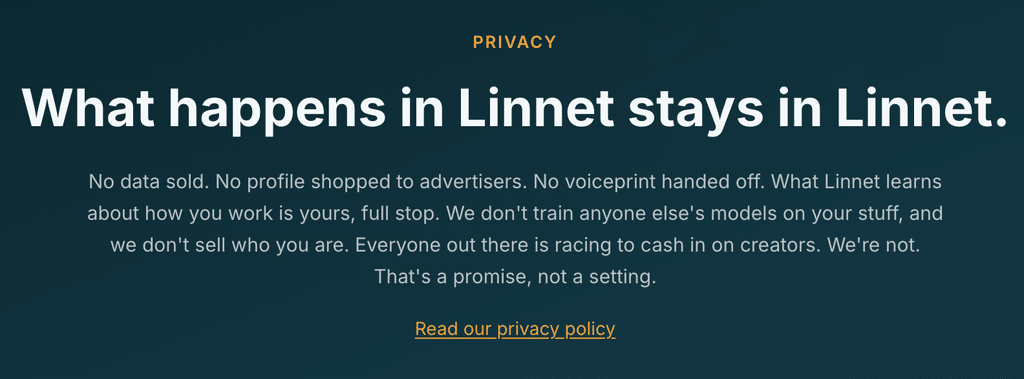
Data handling follows the same logic. Linnet’s built-in assistant, which offers four levels of help from Co-Pilot down to none, learns how each user works, and Mark says that information stays with the company. “We don’t train on user content, and we don’t permit the providers we use to train on it either,” he notes. Linnet offers preset voices only, with no voice cloning.
Those protections ship inside a single subscription, the other half of Mark’s pitch.
One Subscription Aims to Replace a Stack of AI Services
That subscription bundles services Mark says typically run $20 to $30 a month each, including transcription, visualizers similar to Headliner and Descript-style editing by text. “Now you’ve got $300 worth of services in this media workstation for $16 a month,” he says. According to the company, the “Starter” tier begins at $16 a month, and the “Creator” tier costs $35, with the latter free through the end of November.
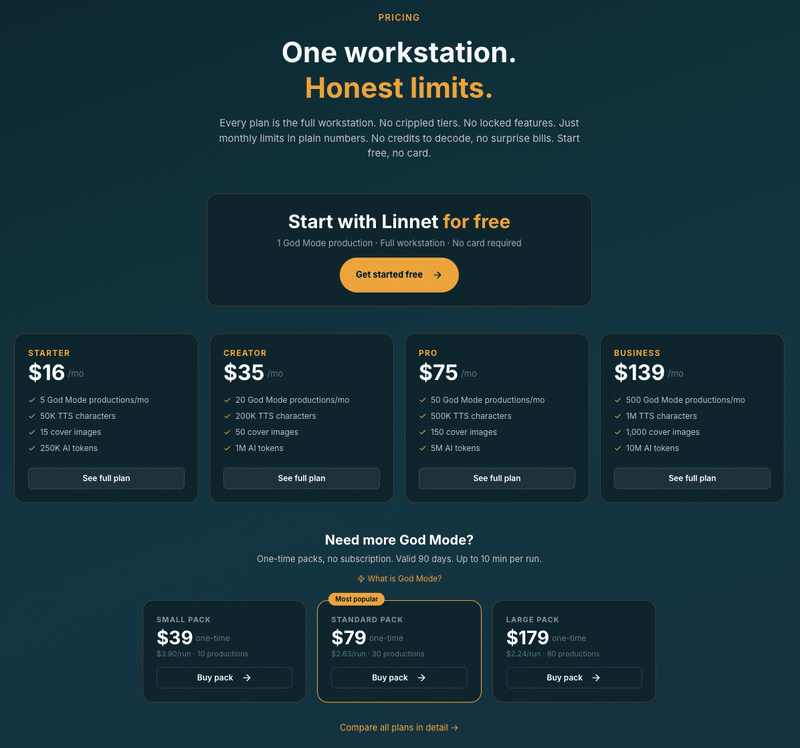
Users who already pay for ElevenLabs, Claude, or OpenAI can bring their own API keys and bill that usage to their existing accounts. “If you have something and you’re paying for it, you can use that key with us,” Mark says.
Cost also shapes Caloroga’s approach to video as podcasting turns more video-centric. Mark objects to the expectation that every show needs it. “Video is expensive, and it’s time-consuming, and it needs resources, and it needs people,” he argues. Caloroga knows it needs video to reach YouTube audiences, so it is adding it slowly and with AI.
The company built Linnet in a modular structure so services can be swapped as they age, unlike tools from a couple of years ago that are now “sitting there dead in the water.” Mark’s one regret is speed. “I would have had this product out a year ago when everybody was still in its infancy and jumped on a market that is now getting saturated,” he says.
Profitability Is the Benchmark for Small Media Companies
Mark’s forecast for one- and two-person media companies over the next couple of years comes down to two words: “Be profitable.” He highlights Caloroga as evidence. A few years ago it was “two guys with two voices and two script-writing skills,” he says, and today about a dozen of its shows run on a daily or weekly basis.
Linnet will stay in beta for a while, and Mark says the free access exists partly so users can find bugs in software he built without being a coder. Early feedback has been positive, he shares, though the company has not yet started charging. His next priority is folding in new AI tools as they arrive, with the stated aim of making creators profitable too.
That aim comes with a condition for anyone treating content as more than a hobby. “If you’re in it for a business, you’re going to have to adapt and learn how to utilize these tools to be competitive,” Mark says.
Subscribe to Our Newsletter
Check Out Our Podcast