







Tech
Basa’s Adam Schlossman: Creator Marketing’s Biggest Problem Isn’t Discovery, It’s What Comes After

Adam Schlossman believes Influencer Marketing has matured into a core media channel, but the operational infrastructure supporting it has not. The average creator deal, from initial outreach to signed contract, still requires between 60 and 80 messages exchanged across email, WhatsApp, and spreadsheets, the same workflow brands and agencies would have used three decades ago.
As the co-founder and CEO of Basa, Adam has spent the past two years building the platform while traveling full-time and has found the same infrastructure gap everywhere, across regions, cultures, platforms, and company sizes. Launched in January 2026, Basa targets brands and agencies executing high-volume creator partnerships, providing a centralized system for outreach, negotiation, contracting, and deal data, all without replacing the client’s own contracts or processes.
“The problem is that the technology in the space is not focused on that pain point,” Adam says. “The infrastructure gap is: after I’ve sourced the talent, what do I do next? It’s all happening manually.”
Adam’s path to founding Basa runs through music management, sports media, and an extended immersion in AI. He spent nearly a decade managing Delta Rae, a major label band on Warner Bros. Records, before joining Religion of Sports, the sports media company co-founded by Tom Brady, Michael Strahan, and Gotham Chopra, as its third employee and executive producer. After leaving Religion of Sports in 2023, he spent nine months studying AI full-time before concluding that building was a more sustainable path.
Adam concluded that if he wanted to stay ahead of how AI would reshape work, he needed to be building rather than waiting. “The riskiest thing I could do was to try to get another relatively normal job,” he says. “I thought those jobs were not really going to exist.”
Discovery Is Solved, The Messy Middle Is Not
According to Adam, Influencer Marketing platforms have invested heavily in two areas: discovery and sourcing on the front end, and analytics and measurement on the back end. What sits between them, the negotiation, contracting, and legal review that turns a shortlist into a signed deal, remains almost entirely manual.
“A lot of places say they are end-to-end solutions,” Adam says. “But the people who are using these end-to-end solutions are still doing all of this manual work.”
The current workflow is familiar to anyone who has run a creator campaign. An outreach message is sent; rates are collected and entered into a spreadsheet; the spreadsheet is circulated for internal approval; deal terms are re-entered into a contract template; the contract is redlined across multiple parties; and then signed.
Adam points out that the operational effort behind a creator deal does not scale with its value. According to him, a $500 partnership can require the same 60 to 80 messages as a $5,000 one, because the outreach, negotiation, approvals, and contracts all follow the same workflow.
“Now, if you’re doing 300 deals at $500, it takes just as much time as doing one $5,000 deal,” he says.
The shift toward high-volume creator strategies makes that dynamic harder to ignore. A campaign built around hundreds of smaller partnerships could mean thousands of back-and-forth exchanges across email, messaging apps, and spreadsheets. At the 60-to-80-message range Adam describes, a 300-creator campaign could generate roughly 18,000 to 24,000 messages before every deal is signed.
He frames the problem as the distance between intention and execution. “There’s intention, there’s the execution of doing the work, and in the middle, there’s this section where you’re just spending time trying to figure out how to do the thing. The longer you spend on that middle part, no one’s getting any value from it.”
As Creator Deal Volume Rises, the Old Workflow Breaks
The shift toward higher-volume influencer strategies, nano creators, micro-influencers, UGC, and affiliate marketing has exposed the limits of a deal-making infrastructure not designed for scale.
Legal teams built for large contracts are now expected to review hundreds of small ones. “Even if it’s one basic red line, it takes three weeks because it’s not a high priority for them,” Adam says.
That delay compounds across a campaign. A manager waiting on legal approval loses time, flexibility, and sometimes the creator. Adam’s view is that the root cause is structural. “The problem is not people’s understanding of the problem. It’s that the infrastructure to handle that strategy and handle that growth has not kept up.”
Adam believes AI will accelerate the pressure. Lower production costs mean more content, which means more deals. “AI is going to slash production budgets, it’s going to slash production timelines, it’s going to lower the barrier of entry for high-volume, high-velocity content creation,” he says. “And what’s going to happen? An explosion in the volume again.” More content also means the value of any individual piece declines, which pushes brands to commission still more, tightening the cycle.
Brands are recognizing the problem more slowly than agencies, according to Adam. Many brands have historically outsourced creator campaign execution, meaning the operational friction sits inside agency teams rather than within the brand organization itself.
As a result, when brands begin bringing influencer operations in-house, it can take time for the scale of the challenge to become clear. Adam says it often takes around nine months for teams to fully experience the workflow bottlenecks involved in negotiating and contracting hundreds of creator deals.
“If you’re the leader of a team and you come from the broadcast world, you’re not going to know about the infrastructure problems because you haven’t experienced them,” he says. “But now the legal team’s getting involved, the CEO is saying we need to cut 20 to 30% of our budget. Then there’s a big learning curve.”
Adam emphasizes that the delay is less about awareness than exposure. “It’s no one’s fault,” he says. “It’s such a narrow problem that you really have to feel it directly before the urgency becomes clear.”
Basa Captures the Deal Before It Becomes a Contract
Basa’s platform begins where most influencer tools stop. A brand or agency creates a campaign workspace and configures what the creator sees when they receive an outreach link, sent via email or WhatsApp from within the platform or manually. The creator fills in their rates and deliverables directly in the platform. No signup required on their end.
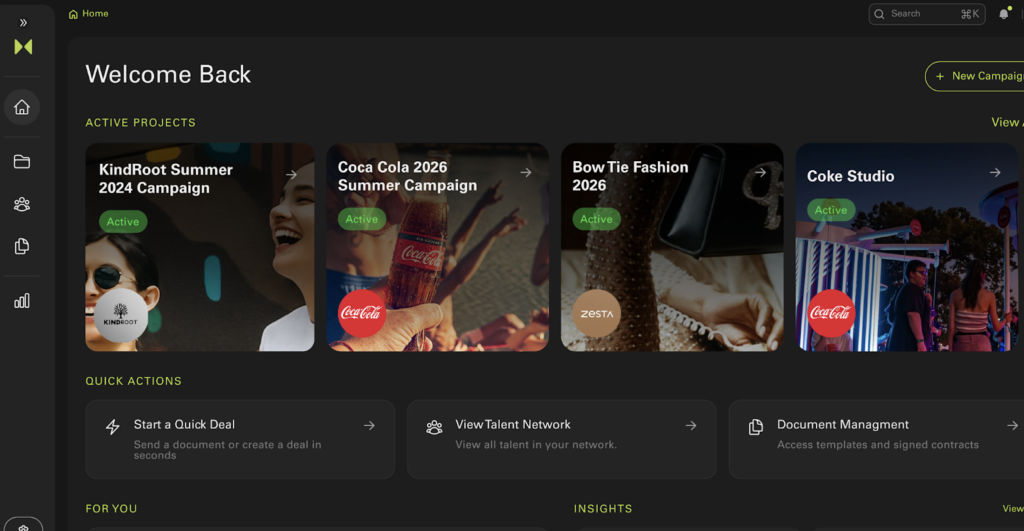
The buyer reviews submissions and accepts, declines, or counters them. Negotiation happens inside the system, with the full history visible to both sides. “If you’re doing 300 deals, someone will respond to you, and you’re like, ‘What did I even offer last time?’ Here you have the entire history of the deal,” Adam says.
Once terms are agreed, the contract stage uses the client’s own legal documents. “There’s no chance a corporate lawyer is using a contract that’s not theirs,” Adam says. Clients upload their existing agreements, including regional variants for different markets, and legal teams redline directly in the platform. The entire deal record, rates, deliverables, negotiation history, and signed contract stay in one place and can be exported at any time.
The platform charges brands and agencies on a flat-license basis rather than per seat, and does not charge creators. “We want the entire organization on there,” Adam says. “It’s a collaboration between marketing, influencer, finance, legal, and data.”

Two Critical Data Points Most Analytics Platforms Don’t Have
Most performance measurement in Influencer Marketing draws on social APIs (Application Programming Interface) to track engagement and reach. Adam notes that what is almost never captured in structured form is what a brand paid and what exactly it paid for, because that information lives in contracts.
“We were surprised to find that two of the many data points missing from a lot of the analytics out there are ‘what did I pay’ and ‘what did I pay for,'” he says. “Because those are in the contract.”
Without connecting payment data to performance data, measuring return on investment in any rigorous sense is difficult, Adam adds. “Unless you have a team manually entering that every time, how do you determine ROI on a campaign unless you know how it’s connected to what you paid and the deliverables you paid for?”
Basa is building a historical data import feature so clients can onboard existing campaign records at launch rather than waiting a year for the platform to accumulate deal history. The company is also working on cross-office data sharing, enabling a global agency to access negotiation records from other regional teams before opening a new deal with a creator they have worked with before. Adam points to a large agency as an example: different offices likely worked with the same creators, but that institutional knowledge currently lives in individual inboxes.
Why Basa Isn’t Using AI… Yet
For a company whose founding premise was shaped by nine months of AI study, the absence of AI features inside Basa is conspicuous. Adam’s reasoning is practical rather than philosophical: contracts require 100% accuracy.
“Corporations are not going to accept 99%,” he says. “The technology is not there for that.” More fundamentally, negotiation itself involves human behavior that cannot be reduced to automation. “Have you ever negotiated with an 18-year-old? You can’t automate that process.”
His distinction is between automating human behavior and automating everything around it. “Everything around human behavior is getting faster and automated. And so what that requires is for humans to be able to make good decisions, faster,” Adam says. “How do we give people the confidence to make good decisions at the speed of AI without outsourcing the decision to AI?”
The platform’s goal is compression, not replacement. Reducing the weeks-long timeline of a standard deal to something that more closely matches the speed at which the underlying decision could actually be made.
Adam’s framing puts the friction in sharp relief: “We’re going back and forth on exclusivity rights for four weeks. I’m not saying exclusivity rights aren’t important. I’m just saying that decision doesn’t need to take that long to make.”
A January Launch, Global Clients, and the Problem That Hasn’t Been Solved
Basa officially launched its product in January with a team of six. Adam’s first clients are predominantly international, reflecting what he observed during a year of traveling across Latin America and the Middle East: the operational pain points surrounding creator deal-making appear largely identical across regions, cultures, company sizes, and communication platforms.
According to Adam, the early international traction is not due to the problem being larger outside the U.S. Instead, smaller organizations often move more quickly when adopting new infrastructure. At the same time, Basa is in active conversations with major U.S.-based global agencies and brands, where interest has accelerated as teams encounter the same operational challenges at scale.
The company’s near-term focus is on building trust rather than feature breadth. “The cost of our platform is not ever the problem. It’s the perceived cost of change,” Adam says. “How do we solve today’s problem to build the trust to be someone who can solve tomorrow’s problem?”
The question matters because Adam believes the gap Basa is targeting will only widen. More creators, more volume, more legal exposure, and more pressure to cut costs will push brands and agencies toward infrastructure that currently does not exist in a usable form.
“When anyone can build anything in two seconds, it becomes: do you understand my problem, do you understand where things are going, can you help us mitigate the risk of this change?” Adam says.
“Everything is trust.”
Subscribe to Our Newsletter
Check Out Our Podcast