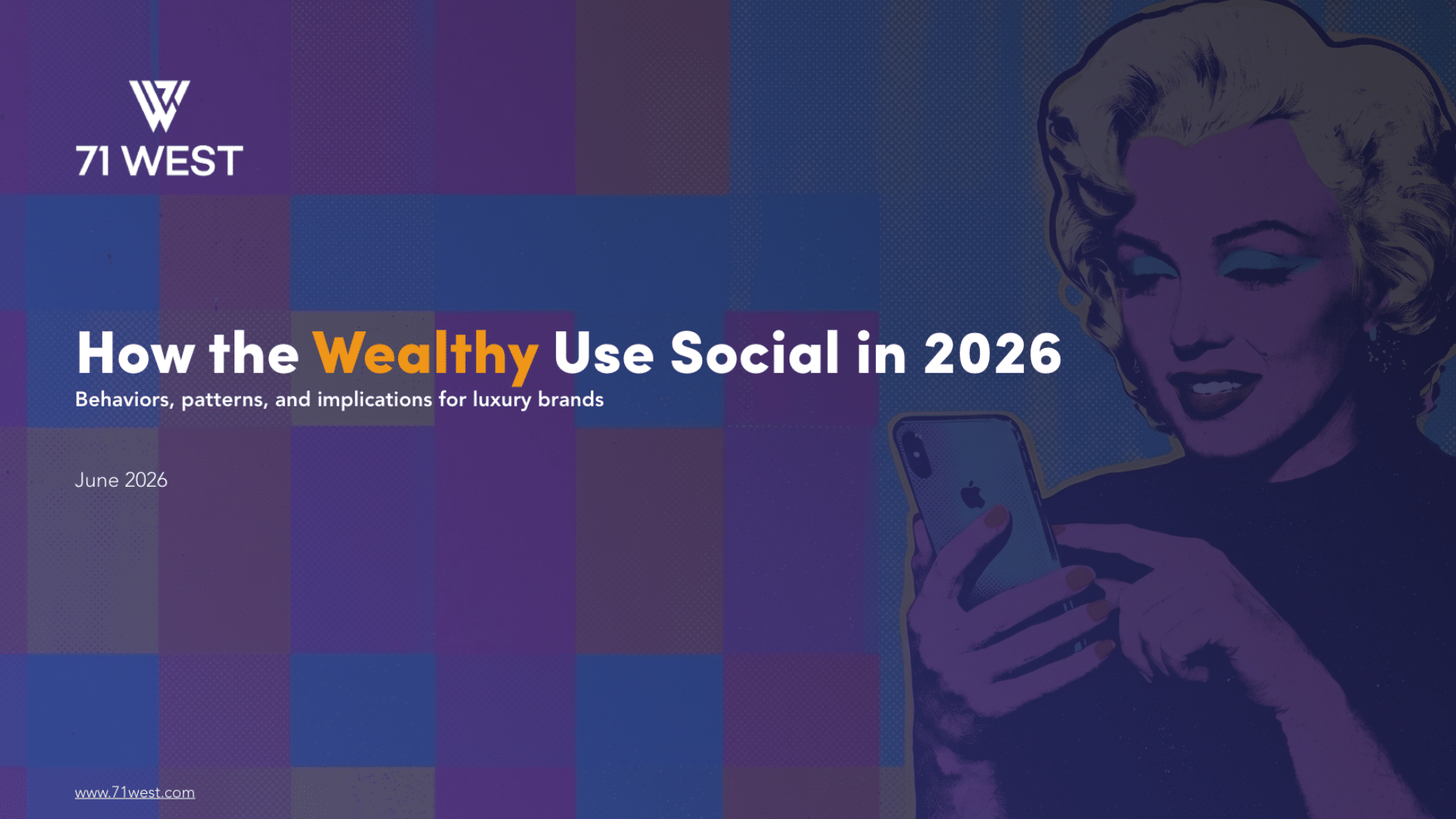
Affluent consumers respond to peer recommendations and expert credibility rather than follower counts, according to a June 2026 report from 71 West titled “How the Wealthy Use Social in 2026.” The report cites LUUX Media research showing 85% of ultra-high-net-worth individuals (UHNWIs) are influenced by peer recommendations in luxury purchase decisions. It says creator content works with this group at the “niche, credibility-driven end of the spectrum.”
The report draws on four studies that define wealth differently: Altiant (minimum $1 million in investable assets), BCG and Altagamma (at least €50,000 in annual luxury spend), Morning Consult ($200,000 or more in household income), and Ipsos (top 20% of household incomes plus senior business leaders).
Who Carries Influence
71 West says the 85% figure describes trust within closed networks, not broadcast influence from celebrity creators. The report says subject matter experts, respected figures within a specific cultural or professional world, and creators whose audiences closely mirror the affluent consumer’s own identity and values carry real influence with this group. It frames the question for luxury brands as whether a creator has genuine authority in the world the customer lives in, not how many followers the creator has.
The report says this group’s highest-trust conversations increasingly happen in private settings, including WhatsApp groups among family offices, private professional threads, and invitation-only communities. LUUX Media reports 89% of UHNWIs use WhatsApp multiple times a day. 71 West says these spaces remain largely invisible to standard social analytics.
Public platforms still play a role in discovery. Savanta research cited in the report found that about 80% of UK millionaires are open to hearing about luxury categories on social media. 71 West says discovery and validation are splitting, with public platforms sparking awareness and private peer networks shaping confidence.
A Trust Problem
The report cites Harvard Business Review in placing Influencer Marketing at $24 billion, and says most of that scale is not driven by affluent consumers. Research cited by Harvard Business Review found 88% of consumers say authenticity matters in influencer content. Nearly half believe most influencers are fake, and over a third think influencers misrepresent the products they endorse. 71 West says the mass influencer model runs against the grain for an audience that places heavy weight on peer validation.
Metrics Capture Little
Among luxury consumers, 17% regularly share their luxury purchases on social media, the report states. Among affluent consumers active on social, 42% follow a brand, 19% have ever purchased through social, and 14% have ever sent a brand a private message. Likes, comments, shares, and DM volume reflect a small and unrepresentative slice of how this audience engages.
The report says social still shapes purchases. LUUX Media found 69% of UHNWIs have been directly influenced by social media to make a luxury purchase, though 71 West says the path to conversion runs through multiple touchpoints before reaching anything trackable. It also says 38% of U.S. luxury consumers report dissatisfaction with how brands communicate with them.
Younger Affluent Consumers
The report says younger affluent consumers are significantly more likely to treat digital creators as carrying the same cultural authority as traditional celebrities. Among affluent consumers, 6 in 10 of those under 40 follow a brand on social media, versus 4 in 10 of those over 40. 71 West calls social a primary discovery environment for the younger cohort.
TikTok reaches 17% of high-net-worth individuals outside China, compared with 37% of adults broadly. The report cites BCG’s projection that Gen Z’s share of global luxury spending will grow from 4% in 2019 to 25% by 2030, and says TikTok is Gen Z’s primary discovery platform.
Platform Roles by Region
In China, the report describes Xiaohongshu as the dominant trust and discovery environment, particularly among affluent women, and says its 2025 pivot toward interest-based community suits the more low-key mood among Chinese high-net-worth individuals. It says Weixin serves relationship management and Douyin drives scale. In the Middle East, Instagram and Snapchat dominate, and conspicuous sharing is more culturally accepted than among Western or Chinese high-net-worth individuals, 71 West says.
Dragomir is a Serbian freelance blog writer and translator. He is passionate about covering insightful stories and exploring topics such as influencer marketing, the creator economy, technology, business, and cyber fraud.













Affluent consumers respond to peer recommendations and expert credibility rather than follower counts, according to a June 2026 report from 71 West titled “How the Wealthy Use Social in 2026.” The report cites LUUX Media research showing 85% of ultra-high-net-worth individuals (UHNWIs) are influenced by peer recommendations in luxury purchase decisions. It says creator content works with this group at the “niche, credibility-driven end of the spectrum.”
The report draws on four studies that define wealth differently: Altiant (minimum $1 million in investable assets), BCG and Altagamma (at least €50,000 in annual luxury spend), Morning Consult ($200,000 or more in household income), and Ipsos (top 20% of household incomes plus senior business leaders).
Who Carries Influence
71 West says the 85% figure describes trust within closed networks, not broadcast influence from celebrity creators. The report says subject matter experts, respected figures within a specific cultural or professional world, and creators whose audiences closely mirror the affluent consumer’s own identity and values carry real influence with this group. It frames the question for luxury brands as whether a creator has genuine authority in the world the customer lives in, not how many followers the creator has.
The report says this group’s highest-trust conversations increasingly happen in private settings, including WhatsApp groups among family offices, private professional threads, and invitation-only communities. LUUX Media reports 89% of UHNWIs use WhatsApp multiple times a day. 71 West says these spaces remain largely invisible to standard social analytics.
Public platforms still play a role in discovery. Savanta research cited in the report found that about 80% of UK millionaires are open to hearing about luxury categories on social media. 71 West says discovery and validation are splitting, with public platforms sparking awareness and private peer networks shaping confidence.
A Trust Problem
The report cites Harvard Business Review in placing Influencer Marketing at $24 billion, and says most of that scale is not driven by affluent consumers. Research cited by Harvard Business Review found 88% of consumers say authenticity matters in influencer content. Nearly half believe most influencers are fake, and over a third think influencers misrepresent the products they endorse. 71 West says the mass influencer model runs against the grain for an audience that places heavy weight on peer validation.
Metrics Capture Little
Among luxury consumers, 17% regularly share their luxury purchases on social media, the report states. Among affluent consumers active on social, 42% follow a brand, 19% have ever purchased through social, and 14% have ever sent a brand a private message. Likes, comments, shares, and DM volume reflect a small and unrepresentative slice of how this audience engages.
The report says social still shapes purchases. LUUX Media found 69% of UHNWIs have been directly influenced by social media to make a luxury purchase, though 71 West says the path to conversion runs through multiple touchpoints before reaching anything trackable. It also says 38% of U.S. luxury consumers report dissatisfaction with how brands communicate with them.
Younger Affluent Consumers
The report says younger affluent consumers are significantly more likely to treat digital creators as carrying the same cultural authority as traditional celebrities. Among affluent consumers, 6 in 10 of those under 40 follow a brand on social media, versus 4 in 10 of those over 40. 71 West calls social a primary discovery environment for the younger cohort.
TikTok reaches 17% of high-net-worth individuals outside China, compared with 37% of adults broadly. The report cites BCG’s projection that Gen Z’s share of global luxury spending will grow from 4% in 2019 to 25% by 2030, and says TikTok is Gen Z’s primary discovery platform.
Platform Roles by Region
In China, the report describes Xiaohongshu as the dominant trust and discovery environment, particularly among affluent women, and says its 2025 pivot toward interest-based community suits the more low-key mood among Chinese high-net-worth individuals. It says Weixin serves relationship management and Douyin drives scale. In the Middle East, Instagram and Snapchat dominate, and conspicuous sharing is more culturally accepted than among Western or Chinese high-net-worth individuals, 71 West says.
The full report can be found here
Subscribe to Our Newsletter
Check Out Our Podcast