






Tech
Extreme Reach Extends Its Celebrity Ad Payroll Platform to Creators

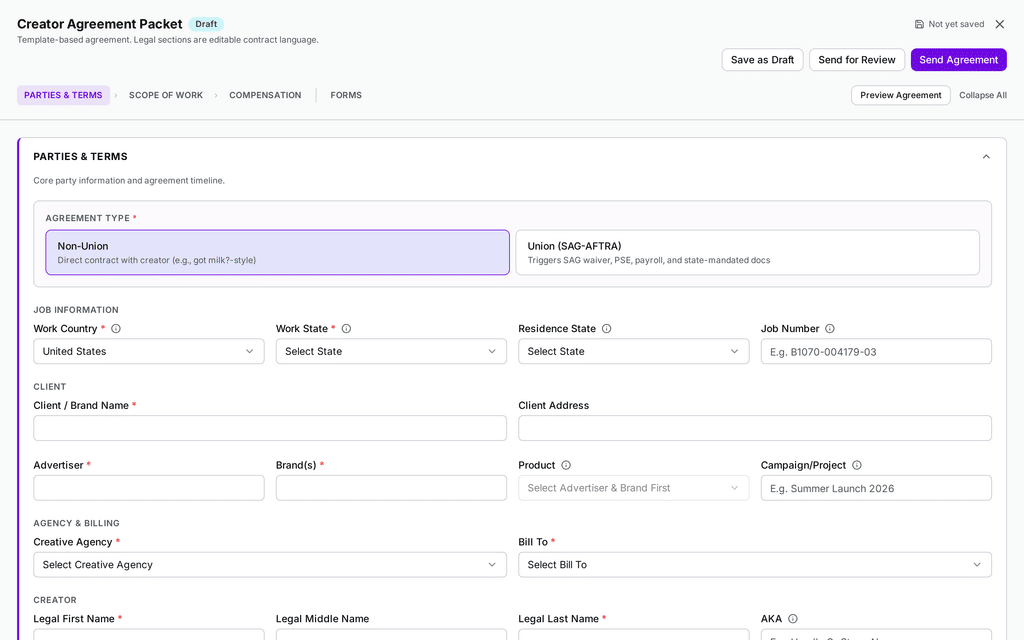
Extreme Reach (XR) is taking the payroll platform it uses for celebrities in advertising and extending it to creators, some of whom still get paid through Venmo and Cash App from agencies and brands. The company launched “XR Pay for Creators” on October 22, a platform that puts onboarding, tax documents, payments, and usage rights into one place for brands and agencies.
The launch follows a broader industry shift toward creators and influencers as a core part of marketing strategies. It also builds on a belief held by Frank DeVito, President and Chief Operating Officer of XR Pay. “We believe creators are the next celebrities in advertising,” he says, speaking from XR’s Burbank, California office.
Celebrity payroll is where XR built its standing with advertisers. “We’re like the ADP for celebrities and advertising,” says Graham McKenna, XR’s Chief Marketing Officer. XR processes roughly $1.3 billion to $1.5 billion in celebrity payments a year, estimated at 80% of talent payments in advertising, according to the company.
Dubbed “XR Pay for Creators,” it gives brands and agencies a way to onboard, manage, and pay creator talent for their campaigns. It also gives them a mobile app to track and manage all their campaigns and pay. “Given that we’re the trusted source with the brands and agencies, we wanted to provide a tool and a platform for brands and creators,” Frank says.
Graham traces the need for XR’s solution back to how the creator industry first took shape.
Discovery Platforms Came First, and Payments Never Caught Up
Creator advertising spending in the U.S. reached $37 billion in 2025, and 48% of brands now consider creators a “must buy” in their marketing mix, according to IAB research. The financial systems behind that growth have not kept pace, with brands and agencies juggling four or five platforms and tools.
Graham says the first creator platforms were built to answer a different question, which was identifying who a brand should work with, meaning who has the audience that fits its customer base and values and could potentially bolster their brand and campaigns. “The payments part was a little bit of an afterthought, so they would hire different vendors to handle it,” he says.
At many companies, responsibility for creator payments is spread across departments, according to XR’s conversations with clients. Graham says accounts payable teams at some large companies aren’t involved at all, leaving marketers to manage creator payments. Frank adds brands often have to chase down multiple departments to find out where a creator’s payment stands and when they’ll actually get paid.

Creators Need to Track Usage Rights the Way Celebrity Talent Does
With a celebrity ad campaign running across streaming and linear TV, talent contracts often set where the ad can air, in which countries, for how long, and what the brand can do with the content, Graham says. Brands that break those terms often face steep penalties. He calls rights tracking a crucial standard practice in traditional advertising.
However, as traditional linear TV ads are increasingly repurposed for streaming and social media, it’s becoming harder to track where they can run and who needs to get paid. Graham says creators now need to ask similar questions about their own work. He says they should know how long a brand can use their content, on which platforms, and what rights they keep. Social is more challenging because it is global by nature, he notes.
For brands, Graham says the test is whether each creator payment is tied to the rights it covers, including duration, territories, and platforms. “That’s another big thing that people need to be concerned about as they think about evolving their creator programs,” he says.
One Workflow Covers All Sizes Of Payment Processing
In the new “XR Pay for Creators” solution, a creator’s agreements and deliverables sit next to payment status. iOS and Android apps let creators accept offers, track deliverables, and see which payments are paid, pending, or late.
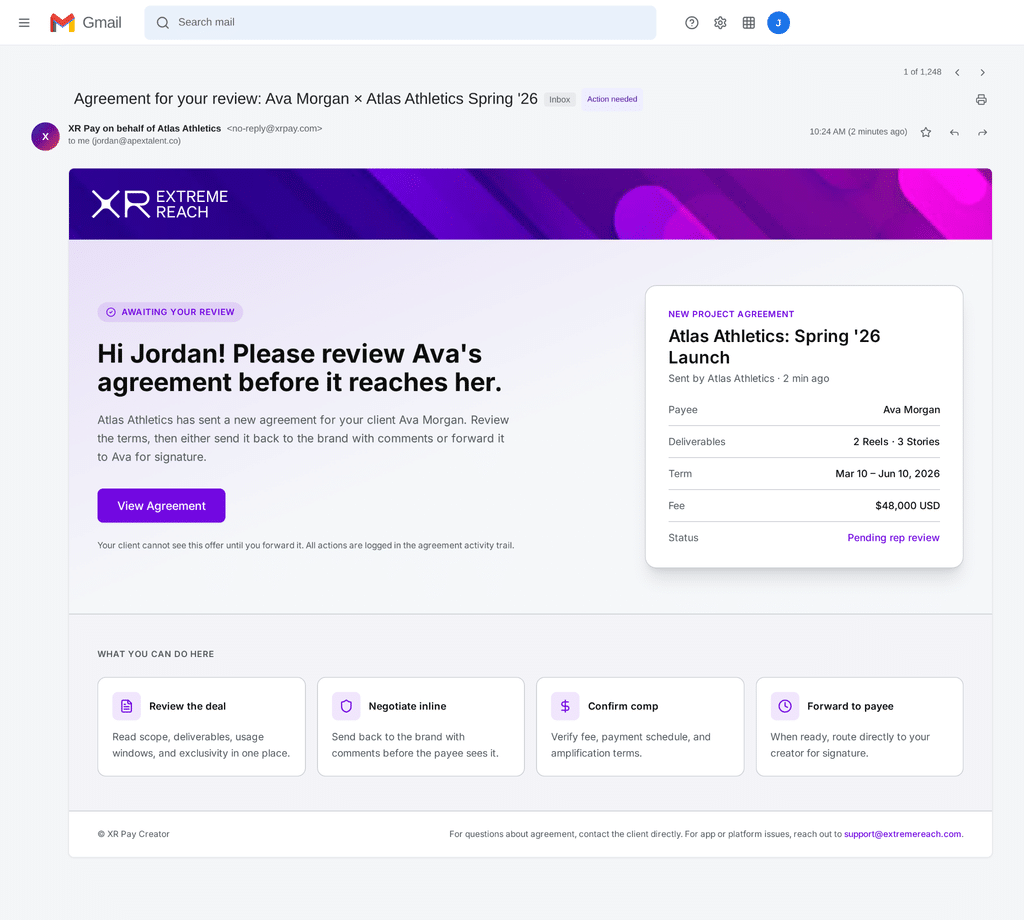
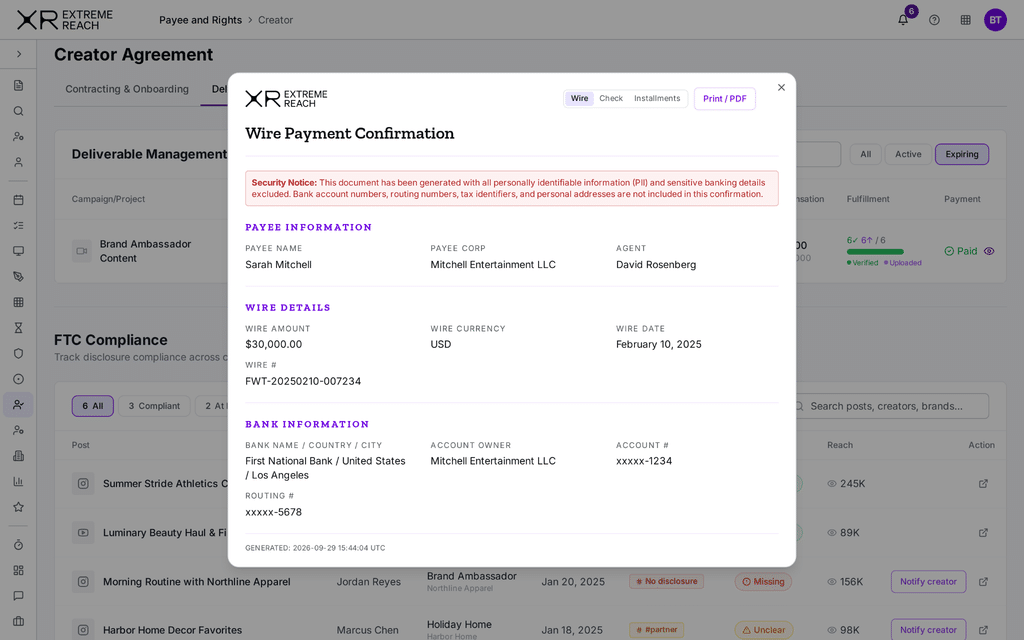
Creators can receive payments by wire transfer or paper check, with bank account linking available through Plaid. On the client side, a dashboard shows payment history, pending payments, and future guarantees that XR programs for the client. Creators also submit proof that content was delivered, which then appears for the client.
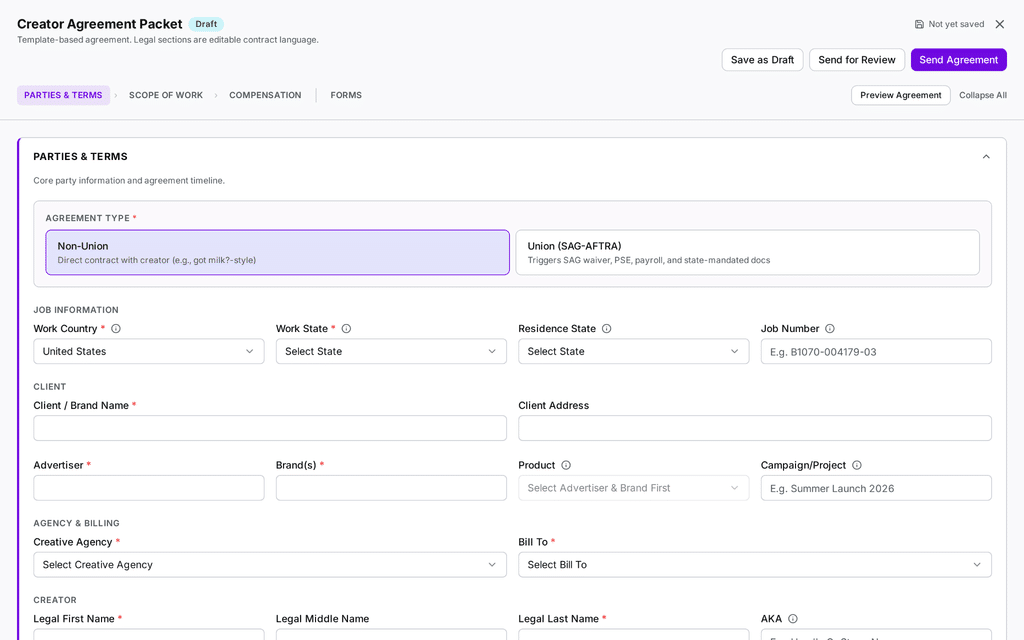
Frank says regardless of the amount of payments, all follow the same path of submission, approval, and processing. “The system is intended to be consistent regardless of size of campaign or payments due,” he says. What changes is the classification. As Graham explains, a brand can mark a job as a union or non-union shoot, and XR pays it appropriately.
Earnings Data Could Open New Conversations Between Creators and Brands
XR’s creator dashboard shows where a creator’s earnings come from. Frank sees another potential benefit in the creator’s earnings data, helping them better understand their business and potentially opening the door to new opportunities with brands.
XR leaves those conversations to creators, brands, and agencies. However, Graham says the added structure can make a big difference, especially for creators who are dealing with large agencies and brands for the first time and navigating complicated contracts and tax forms. As deals grow from $200 to $100,000, so does the complexity. “The more you get paid, the more complicated it becomes,” he says.
Frank says the platform is meant to organize creators’ work without limiting it. “The goal is to not remove any creativity,” he says. XR plans to collect more feedback from creators as usage grows, he adds, and to act on it in real time.
XR Expects Creator Work With Major Brands to Keep Growing
Graham says celebrity payments in advertising have reached an all-time high, despite growing attention around AI-generated performers and digital replicas. XR works with the unions on both forms of AI talent, but demand for real-life talent remains strongest. “The real people are actually making more money than they’ve ever made,” he says.
Creators are now competing for the same advertising dollars as Hollywood celebrities, and Graham predicts double-digit growth with creators working with major brands over the next five years. He points to the rise in athlete endorsements as a sign of what’s ahead. “We’ve seen it with athletes in the last five years just completely taking off,” he says. Frank expects similar growth, pointing to his own increasing online purchases driven by creator recommendations.
Graham says creator pay appears to be heading toward standard rates and protections, with more creators graduating into roles covered by SAG-AFTRA agreements as their deals grow. Actors, crew, and directors each have unions, he notes, and it will be interesting to see whether creators get their own or an expanded SAG-AFTRA role. “It would only make sense that we’re starting to go down that route,” Graham says.
Subscribe to Our Newsletter
Check Out Our Podcast