


Strategy
Creators Are Entering Hollywood and UTA Is Advising Brands to Build Relationships Early

Some time ago, a client came to Liz Fassl after years of influencer work built on one-off posts. Brands were spotting creators gaining steam, paying them for a post and then walking away. Liz, a Vice President in UTA’s Advisory Practice, counts that habit among the bigger mistakes brands make with creators, and she now steers clients toward open briefs and longer partnerships.
That advice lands as even Hollywood starts recognizing creators. “SubwayTakes,” an interview series filmed on New York City subway cars, earned an Emmy nomination; the Golden Globes added a podcast category that “Good Hang with Amy Poehler” won first, and the Critics Choice Association has opened submissions for its first Creator Awards.
“The line has never been more blurry between traditional creators and what I think people would call celebrities,” Liz says.
Against that backdrop, her advice for brands is to stay close to a creator over time. “Have a longer-term partnership with a creator so that you can go along with them and be in those authentic moments with them,” she says. She makes that argument from UTA Advisory, where her team works with brands trying to reach Gen Z and Gen Alpha. The former, she says, follows creators “breathlessly.”
That work draws on UTA’s access to entertainment information. Liz, who is based in Chicago, says the agency holds information on every film and TV show in production, so clients can be first to place a product or partner with a celebrity “that we know is going to be really hot six months or a year from now.” She came up at Ogilvy and dentsu before joining the Gen Z consultancy JUV Consulting, which UTA later acquired.
Natasha Vaquer makes a similar case from another part of the agency. As Co-Head of Brand Partnerships for UTA Creators, she oversees partnerships for more than 900 creators. “Brands need to be intentional about what they want to achieve and ensure their budgets reflect those goals,” she says.
Brands Building Relationships Early Matters
Liz points to “Dancing with the Stars,” where she says each week’s contestants, creators included, gain more followers. “Creators are able to charge more based on followers and exposure,” she says. Brands that have not been tracking those creators end up paying more, she adds.
Her advice is to “find talent and then really understand what they have going on within the next year,” including the creator’s hopes, dreams, and ambitions. If a creator is heading out on tour or launching a retail line, Liz says, the brand should be with them on that path and “integrate your product really authentically in it.”
Liz says it is “really important for brands to try to get in early with talent and establish relationships with them.” The aim is to “ride that wave of popularity with the creator.” Timing is where UTA positions itself. Liz says an agency like UTA can tell clients “much beforehand” when a creator is about to have a big moment.
Natasha ties that early planning to budget, which she says includes “allocating sufficient resources for paid media, content usage rights, and exclusivity, all of which come at a premium and should be factored into the planning process early on.”
Open Briefs Outperform Briefs With a Thousand Requirements
The open brief is UTA’s alternative to the one-off post. The agency gives talent a product and asks about the moments coming up in the next six months to a year, the same horizon Liz tells brands to understand about a creator. “What are the moments in which you can authentically use this product?” Liz says.
For a personal care product such as a body wash, she says, the moments might be the ones a creator is getting ready for and wants to feel their best. Clothing works the same way, she adds.
She says open-brief content performs “so much better than a brief that has a thousand requirements,” in which a creator talks straight to camera and recites product facts. “They want to feel that they are close and connected with that creator and the creator happens to be using this cool product,” Liz says.
Picking Creators From the Client’s Objectives, Then Reading the Comments
UTA’s advisory arm is talent agnostic, Liz says, and she calls the idea that it works only with UTA talent “a misnomer.” Casting starts with questions to the client about objectives, past successes and pitfalls, then picks creators “no matter where they’re repped.”
UTA then reviews engagement rate and follower count, and checks whether creators reply to commenters and build community on their pages. Many clients are focusing on engagement rate over impressions and views, Liz says. “If you like the content enough to comment, like, share, save, we’ve done our job,” she says.
If the campaign objective is widespread awareness, she says, a larger following may fit, but she would never advise looking at follower count alone.
UTA often finds success with mid-tier creators (roughly 500,000 to 1 million followers), whose audiences comment heavily. “I would put that up against high follower count any day,” Liz says.
On a recent apparel campaign, a creator wore the brand’s clothes in a required video, then wore them again in a separate video. Viewers asked where the pants and shirt came from, and she tagged the brand in the comments. “That is a brand having relevancy within a creator’s world,” Liz says.
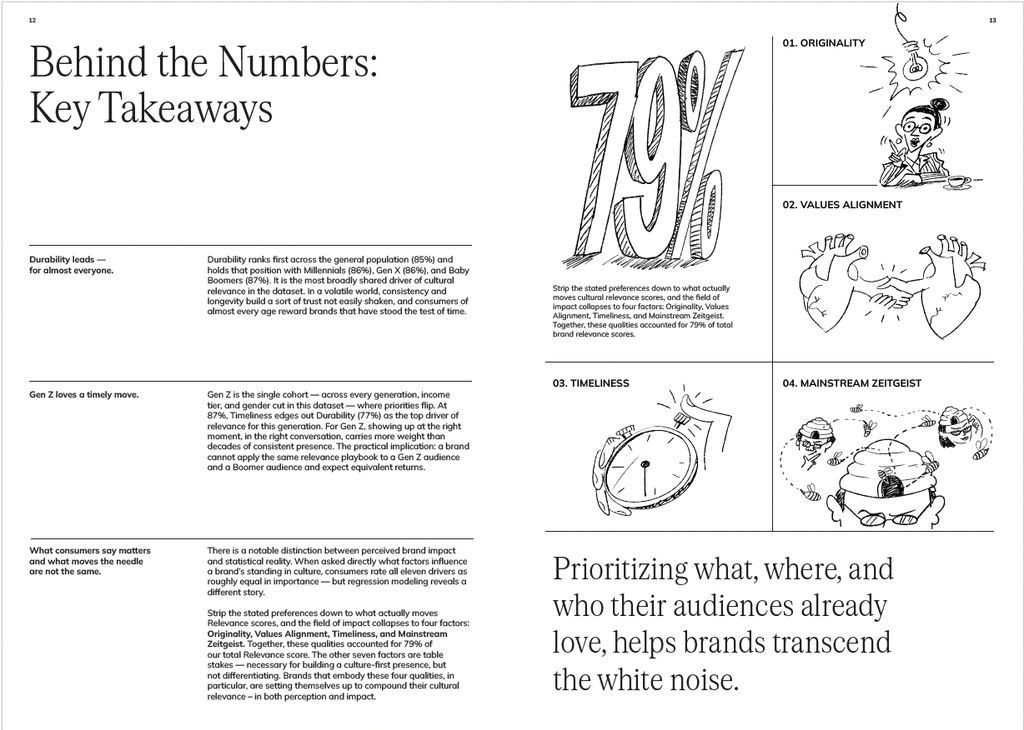
Image: The “Behind the Numbers” graphic from UTA’s Culture Index
Source: UTA
Relevance and Reach Serve Different Goals
Natasha also separates relevance from reach. “Many creators with large followings have spent years building their audiences, but cultural relevance isn’t necessarily defined by audience size,” she says.
The first decision is whether a brand wants a creator who can spark a trend or one who drives mass awareness, she says. “The most effective partnerships recognize that true influence isn’t always measured by reach, but by a creator’s ability to shape conversations, drive behavior, and connect authentically with an audience,” Natasha notes.
Finding Success in Produced Series With a Light Product Touch
Amazon partnered with creator Owen Thiele on “Girl Room,” a series in which he redesigns messy bedrooms for girls who want a makeover, Liz says. She describes it as “a home makeover show but more for the TikTok era” and says Amazon, one of UTA’s clients, is “a very light touch within the entire video” in a series she calls “wildly entertaining.”
Liz says branded entertainment, meaning digital series and long-form pieces that are sometimes more highly produced, is “where brands are having a lot of success.” She frames the shift as one from interruption to value. Traditional advertising worked on an interruptive model with a commercial cutting into a show or a banner ad interrupting a web page. “How can you as a brand add value?” she asks.
This is reinforced through UTA’s Culture Index data, which evaluated 10,000 global brands across 44 industries and ranked each based on their performance across 49 distinct categories of data. It found that traditional advertising is losing sway, ranking 5th in terms of the highest-impact tactics for driving brand relevance behind sports and entertainment partnerships, talent partnerships, media platform presence, and brand collaborations.
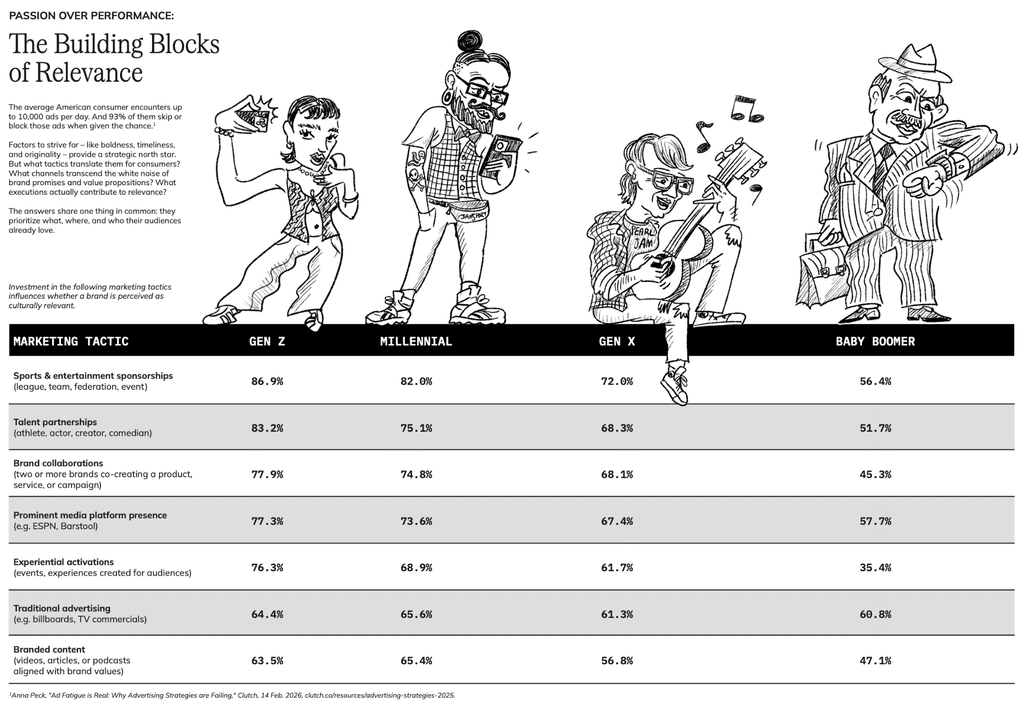
Image: The “Building Blocks of Relevance” chart from UTA’s Culture Index
Source: UTA
According to Natasha, long-form content is gaining momentum, so brands need a more strategic view of short-form versus long-form storytelling. “Each format serves a different purpose, and understanding how to leverage both will become an increasingly important part of the conversation,” she says.
Creators Arrive in Hollywood With Audiences Already Built
Creators who move into film and television bring their followers with them, Liz says, and the production benefits. “They don’t need to build fans. They already have them,” she says. On the other side of that move, Hollywood gets “all of those authentic fans and really interesting people that are kind of uniquely themselves,” she says.
Brands, in turn, should not lean on one creator, Natasha notes. “Rather than relying on a single creator or approach, brands should build a thoughtful mix of partnerships that collectively drive awareness, cultural relevance, engagement, and measurable business results,” she says.
Liz expects the line between creators and entertainment to stay blurred and creators to keep adding touchpoints. UTA’s role, she says, is helping brands take part in that expansion without interrupting viewers.
“We are really going to hopefully get some of the community that rallies around these creators to also rally around our brands,” Liz says.
Subscribe to Our Newsletter
Check Out Our Podcast