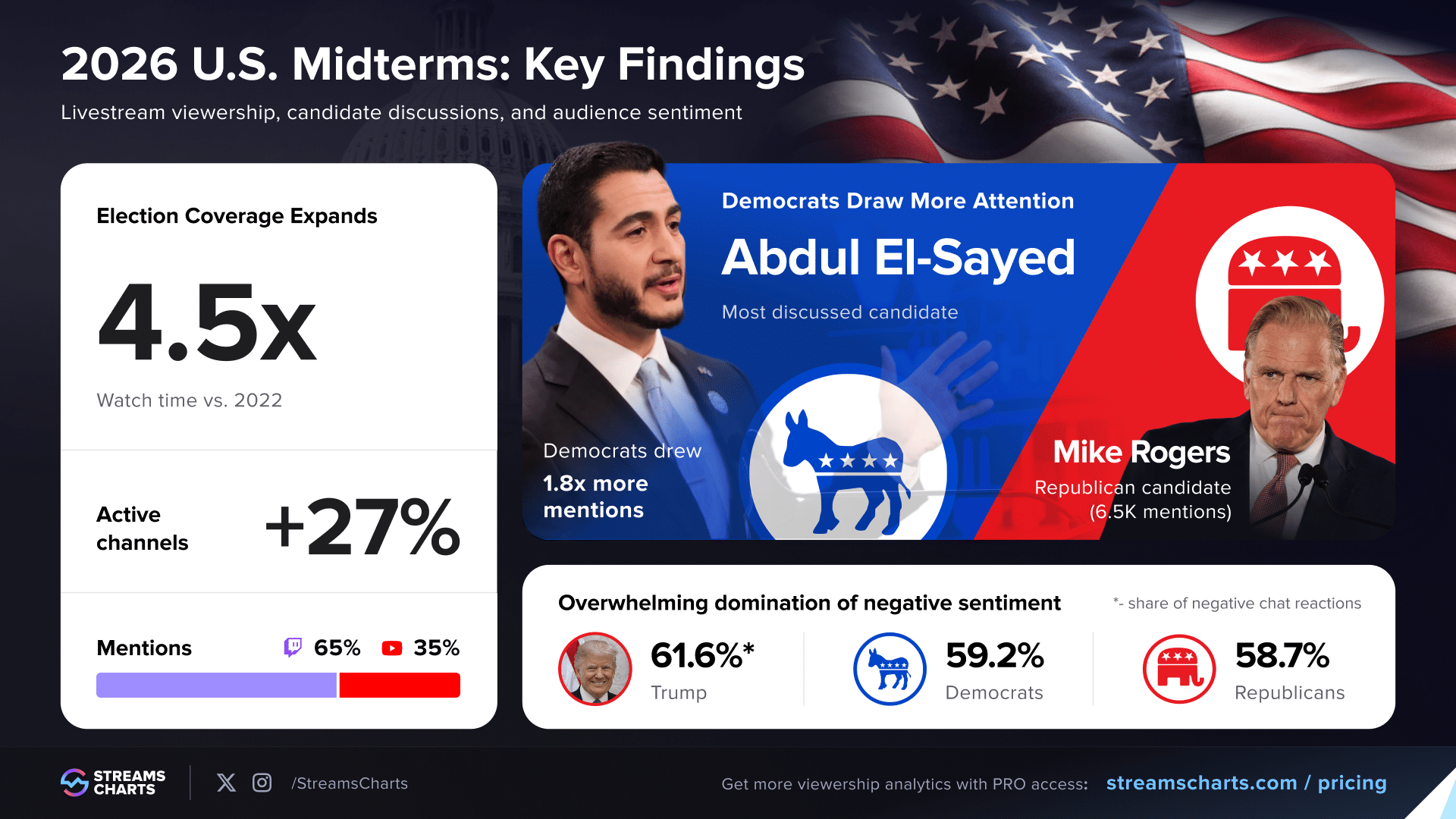
Election-related livestreams on Twitch, YouTube, Kick and Rumble generated 10.27 million hours watched in the 30 days before Election Day (Nov. 3), and broadcasts with “midterm” in the title drew 4.5 times as much watch time as in 2022, according to a report from Streams Charts. About 60% of relevant chat messages about Democrats, Republicans, and President Donald Trump were negative.
Streams Charts analyzed election-related broadcasts and political discussions from October 4 to November 2. The study covered more than 2,500 channels and hundreds of thousands of political mentions in livestream chats.
Viewership Compared with 2022
For the election-cycle comparison, Streams Charts looked at broadcasts on Twitch and YouTube that explicitly mentioned “midterm” in their titles, over equivalent 30-day windows ending on the eve of each election. The 2026 cycle produced 8.70 million hours watched across 1,840 channels, compared with 1.92 million hours across 827 channels in 2022.
The report notes that platform availability and data collection differed between the two cycles, but says the additional platforms accounted for only a small share of the 2026 audience. The increase in watch time remained almost identical after removing Hasan “HasanAbi” Piker from both periods.
Viewing accelerated toward the end of the window. November 2 was the busiest day, with nearly one million hours watched and 637 channels broadcasting election-related content. The final three days accounted for nearly one-fifth of all election-related watch time. The biggest spikes coincided with the Michigan Senate debates, early voting developments, and rallies involving prominent political figures. Excluding HasanAbi, average daily watch time tripled between the opening and closing seven-day periods.
A Concentrated Audience
Viewing was concentrated in a small number of channels. The ten largest generated more than two-thirds of total watch time. HasanAbi alone accounted for nearly 45%, with 4.60 million hours watched, and several dips in daily viewership occurred on days when he was inactive or spent little time covering the midterms.
The largest single live audience belonged to Candace Owens, who reached more than 70,000 concurrent viewers during one election-related broadcast, the highest peak among all channels. She ranked lower in total watch time.
Twitch and YouTube contributed almost equal watch time. Twitch’s audience centered on a smaller group of personalities, while YouTube featured a broader mix of political commentators, independent creators and news organizations. Among news channels, Fox News produced the most election-related watch time of any American news broadcaster. India’s CNN-News18 led overall, attracting more watch time than any U.S. outlet.
Michigan Senate Race Led Mentions
Two candidates in the Michigan Senate race topped the ranking of mentions across Twitch, YouTube and Kick chats: Democrat Abdul El-Sayed, with 7,649 mentions, and Republican Mike Rogers. Ilhan Omar ranked third. Democratic candidates overall were mentioned 1.8 times as often as Republicans.
The two Michigan candidates were discussed in very different terms. Of messages about El-Sayed, 57% were positive and 16% negative. For Rogers, 10% were positive and 55% negative. Rogers recorded his largest daily surge immediately after the first televised debate on October 8, and discussion of El-Sayed peaked on the eve of the election. The second debate took place October 21.
Streams Charts described El-Sayed as more the exception than the rule, writing that being talked about more did not necessarily mean receiving a warmer reception.
Negative Sentiment Across Parties
Negative reactions accounted for 59.2% of mentions about Democrats, 58.7% about Republicans and 61.6% about Trump. Criticism did not follow a simple partisan divide: Democrats drew negative reactions in both left-leaning and right-leaning communities, while sentiment toward Republicans and Trump varied considerably by platform.
Republicans drew positive responses in 35% of relevant chat messages on YouTube, compared with about 2% on Twitch.
Discussion of the elections themselves also skewed negative, with negative messages outnumbering positive ones. Neutral discussion was the largest category. Some viewers raised concerns about the integrity of the electoral process, citing supposed fraud, manipulated ballots, or voting machines. Those concerns accounted for about a third of the negative opinions about the elections.
Image source: Streams Charts The full report is availablehere
Dragomir is a Serbian freelance blog writer and translator. He is passionate about covering insightful stories and exploring topics such as influencer marketing, the creator economy, technology, business, and cyber fraud.
















Election-related livestreams on Twitch, YouTube, Kick and Rumble generated 10.27 million hours watched in the 30 days before Election Day (Nov. 3), and broadcasts with “midterm” in the title drew 4.5 times as much watch time as in 2022, according to a report from Streams Charts. About 60% of relevant chat messages about Democrats, Republicans, and President Donald Trump were negative.
Streams Charts analyzed election-related broadcasts and political discussions from October 4 to November 2. The study covered more than 2,500 channels and hundreds of thousands of political mentions in livestream chats.
Viewership Compared with 2022
For the election-cycle comparison, Streams Charts looked at broadcasts on Twitch and YouTube that explicitly mentioned “midterm” in their titles, over equivalent 30-day windows ending on the eve of each election. The 2026 cycle produced 8.70 million hours watched across 1,840 channels, compared with 1.92 million hours across 827 channels in 2022.
The report notes that platform availability and data collection differed between the two cycles, but says the additional platforms accounted for only a small share of the 2026 audience. The increase in watch time remained almost identical after removing Hasan “HasanAbi” Piker from both periods.
Viewing accelerated toward the end of the window. November 2 was the busiest day, with nearly one million hours watched and 637 channels broadcasting election-related content. The final three days accounted for nearly one-fifth of all election-related watch time. The biggest spikes coincided with the Michigan Senate debates, early voting developments, and rallies involving prominent political figures. Excluding HasanAbi, average daily watch time tripled between the opening and closing seven-day periods.
A Concentrated Audience
Viewing was concentrated in a small number of channels. The ten largest generated more than two-thirds of total watch time. HasanAbi alone accounted for nearly 45%, with 4.60 million hours watched, and several dips in daily viewership occurred on days when he was inactive or spent little time covering the midterms.
The largest single live audience belonged to Candace Owens, who reached more than 70,000 concurrent viewers during one election-related broadcast, the highest peak among all channels. She ranked lower in total watch time.
Twitch and YouTube contributed almost equal watch time. Twitch’s audience centered on a smaller group of personalities, while YouTube featured a broader mix of political commentators, independent creators and news organizations. Among news channels, Fox News produced the most election-related watch time of any American news broadcaster. India’s CNN-News18 led overall, attracting more watch time than any U.S. outlet.
Michigan Senate Race Led Mentions
Two candidates in the Michigan Senate race topped the ranking of mentions across Twitch, YouTube and Kick chats: Democrat Abdul El-Sayed, with 7,649 mentions, and Republican Mike Rogers. Ilhan Omar ranked third. Democratic candidates overall were mentioned 1.8 times as often as Republicans.
The two Michigan candidates were discussed in very different terms. Of messages about El-Sayed, 57% were positive and 16% negative. For Rogers, 10% were positive and 55% negative. Rogers recorded his largest daily surge immediately after the first televised debate on October 8, and discussion of El-Sayed peaked on the eve of the election. The second debate took place October 21.
Streams Charts described El-Sayed as more the exception than the rule, writing that being talked about more did not necessarily mean receiving a warmer reception.
Negative Sentiment Across Parties
Negative reactions accounted for 59.2% of mentions about Democrats, 58.7% about Republicans and 61.6% about Trump. Criticism did not follow a simple partisan divide: Democrats drew negative reactions in both left-leaning and right-leaning communities, while sentiment toward Republicans and Trump varied considerably by platform.
Republicans drew positive responses in 35% of relevant chat messages on YouTube, compared with about 2% on Twitch.
Discussion of the elections themselves also skewed negative, with negative messages outnumbering positive ones. Neutral discussion was the largest category. Some viewers raised concerns about the integrity of the electoral process, citing supposed fraud, manipulated ballots, or voting machines. Those concerns accounted for about a third of the negative opinions about the elections.
Image source: Streams Charts
The full report is available here
Subscribe to Our Newsletter
Check Out Our Podcast