







Technology
Women’s Sports Index Launches to Bring Benchmarks to a $3B Category

Mondo Metrics and Deep Blue Sports + Entertainment launched the Women’s Sports Index in June, a real-time benchmarking platform tracking social performance across professional women’s sports globally. The companies built it on a specific bet: the engagement data tells a story about this category that current brand investment has not yet priced in.
Nick Cicero, founder and CEO of Mondo Metrics, built his career constructing analytics infrastructure for emerging social formats. Delmondo, which he founded in 2014, was the first third-party analytics platform for Snapchat and Instagram Stories; he sold it to Conviva in 2018 and spent four years there scaling it across enterprise clients before launching Mondo in New York in late 2024.
The Women’s Sports Index, powered by Mondo’s MondoTrends platform, tracks more than 20,000 social handles across professional women’s sports teams, leagues, and athletes in North America and Europe, designed for brands, agencies, and rights holders looking to make and defend women’s sports investments with standardized data rather than anecdote.
“Women’s sports are totally undervalued in terms of the engagement value that they deliver to their fans and to their partners on social on a per-post basis relative to men’s sports,” Nick says. Women’s sports built its audience without the television infrastructure that drove men’s leagues for decades, growing instead on social platforms where athletes defined their own identities and cultivated fans directly. Nick argues that this created an engagement depth that current sponsorship pricing has not yet fully reflected. Global women’s sports revenues are projected to surpass $3 billion in 2026, up from $2.4 billion the prior year, according to Deloitte data.
Men’s Leagues Didn’t Need Athletes as Platforms. Women’s Sports Did.
The men’s sports model was built on television. Decades of cable programming, round-the-clock highlights, and analyst shows created a cultural infrastructure that extended far beyond game broadcasts. Women’s sports had no comparable machine.
“Women’s sports is so interesting because they didn’t have the cable TV machine to grow in popularity,” Nick says. “They still don’t have anywhere near the same level of coverage men’s sports does.”
What that absence produced, he argues, is a different kind of fandom. Without cable infrastructure to fill in the cultural context, women’s athletes and leagues built their presences directly on social, 24 hours a day, defining their personalities and stories there first. “Social media has become so much more important to defining the individuality of these women athletes,” Nick says. He points to WNBA player Sophie Cunningham appearing at a UFC event as the kind of organic cultural crossover that emerges when athletes have built their own platforms from scratch.
Nick’s read is that men’s leagues are now scrambling to develop social-native strategies that women’s sports built by necessity. Women’s sports, he argues, have the opportunity to “build that access and collaboration in from the start, rather than retrofitting it after the fact” as men’s leagues had to. The engagement patterns being built on social tell a story that brand investment decisions have not yet fully incorporated, and that is the story the Index is designed to surface.
The Renewal Conversation Without Data
Nick is concrete about what the measurement problem looks like inside a budget meeting. “For years, if you were a marketer defending a women’s sports partnership internally, you were stuck making an anecdotal case,” he says. “You’d point to a great photo, a viral moment, maybe a screenshot of good comments. That’s not defensible in a budget conversation.”

The Women’s Sports Index addresses that at three stages. Before a partnership, brands can research which athletes, teams, and leagues have the audience composition and content patterns that align with their goals. During a campaign, the platform tracks how often and how effectively a brand appears in a partner’s content. After the campaign, results are benchmarked against the full market, so a marketer can show not just what happened but how it compared to everything else in the category.
Nick and Deep Blue cite GEICO’s partnership with Dallas Wings player Azzi Fudd and the team as an example of what that accountability can surface. The partnership announcement became GEICO’s highest social engagement day of the year, according to Deep Blue. “That’s the kind of stat that turns a renewal conversation from ‘we liked working together’ into ‘this outperformed every other marketing moment we ran this year,'” Nick says.
Scoring Overperformance, Not Volume
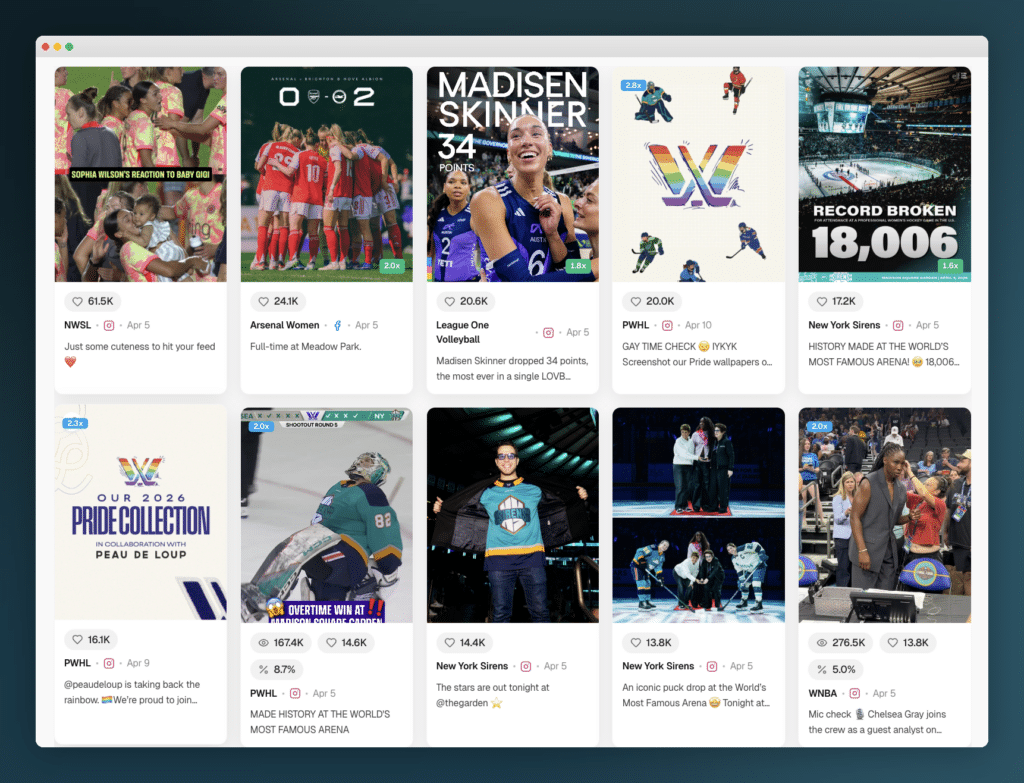
The Women’s Sports Index ingests every public post published by professional women’s sports teams, leagues, and athletes across Facebook, Instagram, TikTok, YouTube, and X, then scores each piece of content against the median performance for a given account, sport, or segment of the market.

Nick describes a post featuring WNBA player A’ja Wilson and NBA player Bam Adebayo that, according to his reading of the platform, generated 13 times the engagement of the WNBA’s recent average. The signal is the point: athlete relationship narratives are a content category that brands and teams can build campaigns around, not an isolated viral moment.
Early data cited by the companies identified several overperforming content categories. Celebrity sightings at women’s sports events, including appearances by Aubrey Plaza and Teyana Taylor at WNBA games, generated a 3.3x engagement lift and 405,000 engagements per post. Rookie arrival and draft content delivered a 2.0x lift and 1.7 million views per post.
“The number one trend that we see right now in the last 28 days is the celebrity sightings at WNBA games are far overperforming relative to all of the other women’s sports content,” Nick says.
What the Data Can Point To and What It Cannot
Nick draws a line between where data ends and judgment begins. “Data can tell you what happened,” he says. “It can tell you an athlete’s engagement is outperforming her follower count, or that a series is performing well. Data cannot and should not make the content for you.”
His framework is about allocating creative resources precisely, not automating creative decisions. Picking a sponsorship partner on gut feel is a guessing problem. Measuring whether a campaign outperformed category benchmarks is also a guessing problem, until the benchmarks exist. “The data’s job is to remove the guesswork from the parts of the decision that shouldn’t require guessing,” Nick says, “so the judgment and creativity that’s left gets spent where it actually belongs, on the execution.”
Nick acknowledges the analytics market is crowded. His argument is that most tools show clients their own performance without providing surrounding context, and that knowing whether a result was strong requires knowing what everything else in the category produced. That context is what the Index is built to supply.
The Undervaluation Thesis Has a Long Run Ahead of It
Nick points to long-form consumption as one underappreciated signal. “We have women’s shows that people will sit and watch for 35, 40, 50 minutes long average watch time on a podcast on a television around women’s sports,” he says. The Women’s Sports Index will initially be available to Deep Blue and Mondo clients, with select market insights released publicly on a recurring basis.
For Nick, the parallel to his earlier work is explicit. He built Delmondo before most organizations had decided they needed dedicated analytics for Snapchat or Instagram Stories. The case being made now is structurally similar.
“The fans of women’s sports are just as engaged, if not more engaged, than the fans of men’s sports,” he says. “And far more efficient in the way that they’re reaching their fans.”
Image source: womensportsindex.com
Subscribe to Our Newsletter
Check Out Our Podcast