






Technology
Why Linqia Built Marco AI And What It Signals For Influencer Marketing

As influencer marketing has expanded beyond social feeds into paid media, commerce, and full-funnel measurement, the operational complexity behind creator programs has grown just as quickly.
For Daniel Schotland, Chief Operating Officer at influencer marketing agency Linqia, the widening gap between ambition and execution ultimately led the company to launch Marco AI.
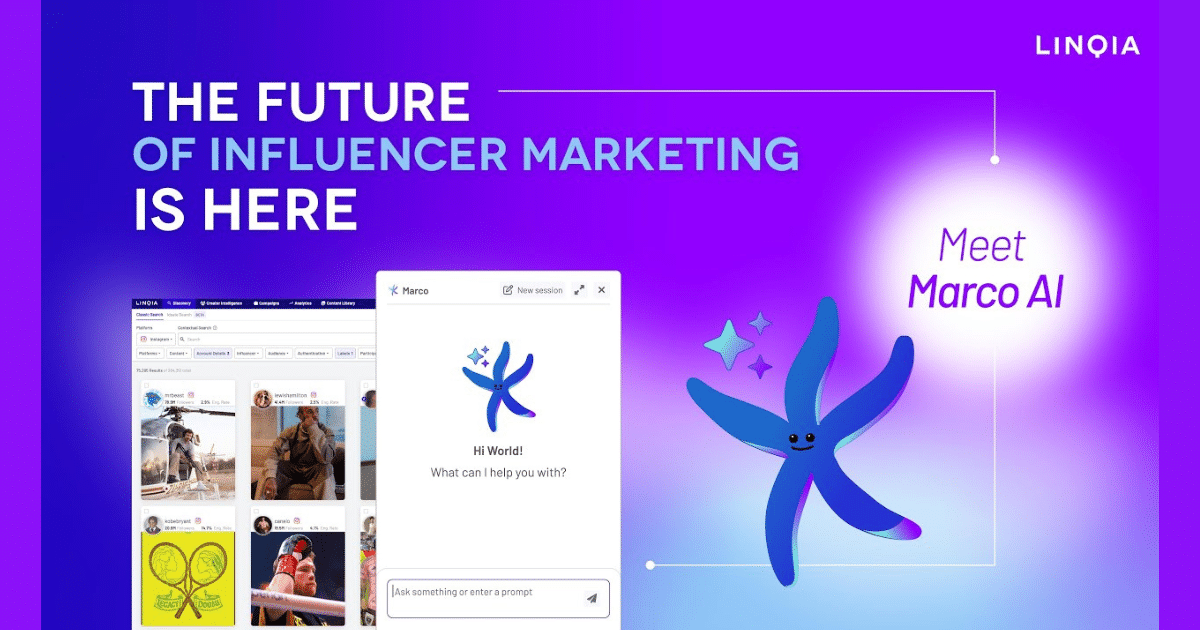
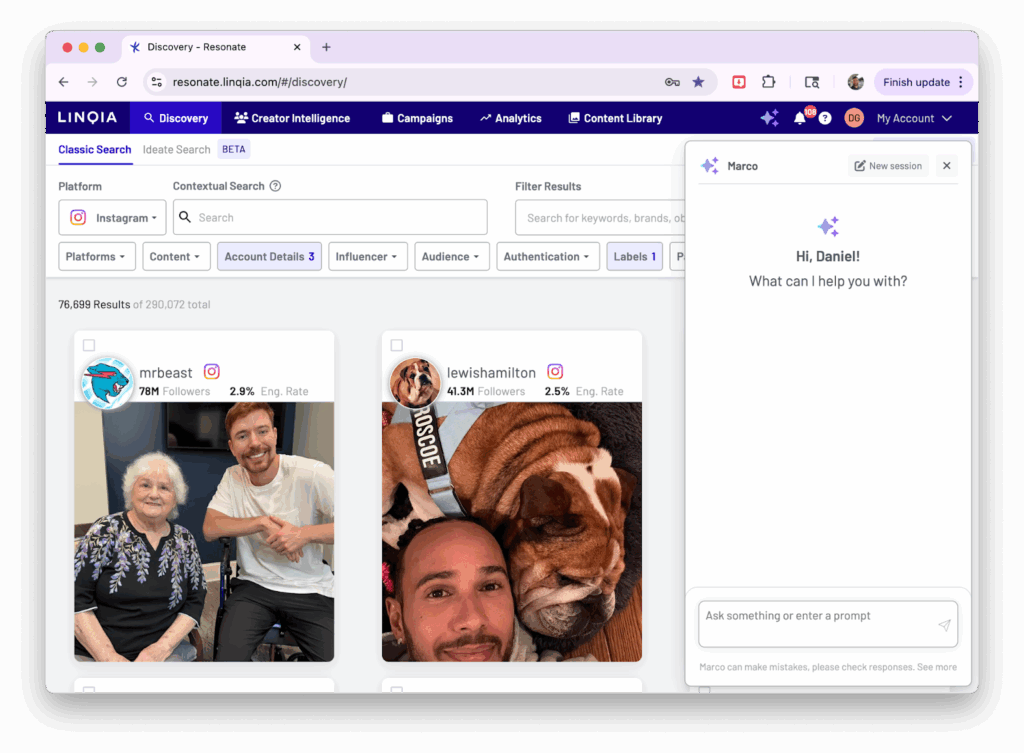
Marco AI is a conversational assistant embedded directly into Linqia’s Resonate platform, designed to help brands plan, execute, and analyze influencer marketing through natural-language prompts. Rather than acting as a standalone feature, Marco is positioned as a decision-making layer that abstracts away dashboards, workflows, and manual analysis in favor of intent-driven interaction.
“Think of Marco as your trusted influencer marketing expert advisor,” Daniel says. “Not just to navigate the platform, but to really understand the what and why behind performance, and most importantly, how to find creators and create content that is likely to perform best.”
Since joining Linqia in 2017, Daniel has helped guide the San Francisco Bay Area-based company’s transition from campaign execution toward a more performance-driven, system-based approach to creator marketing. Marco AI, he says, is a direct response to how the category has matured and where it is heading next.
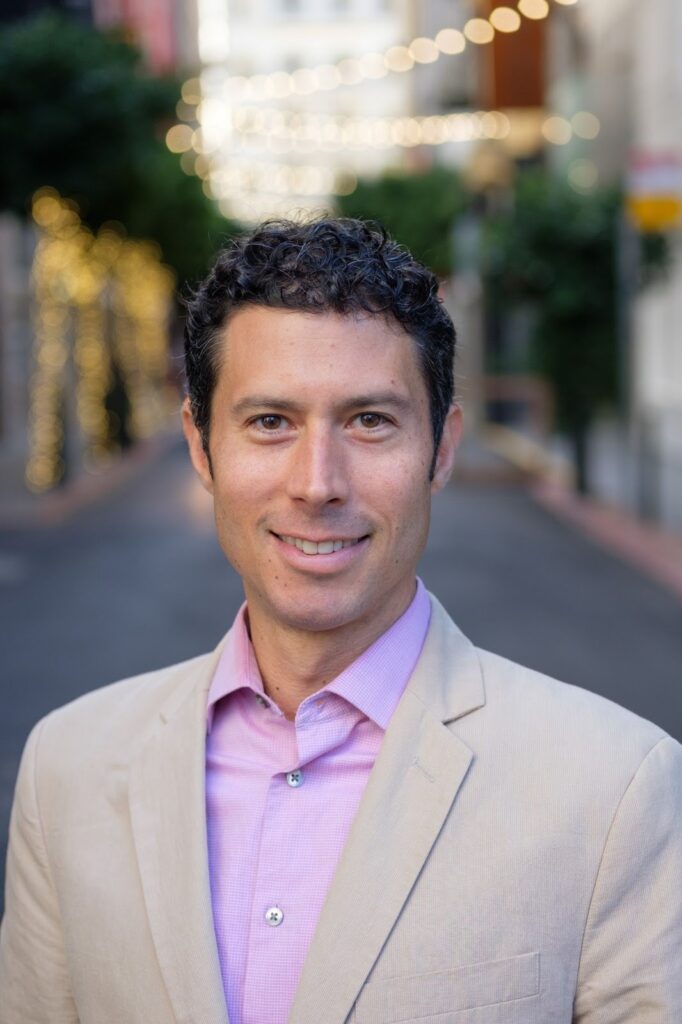
Daniel Schotland
Why Influencer Marketing Needed a Copilot
According to Daniel, brands are no longer struggling to justify influencer marketing. Instead, they are struggling to operationalize it at scale.
“As budgets continue to increase, determining what drives the best result for your business and how to effectively measure it continues to be a challenge,” he says.
Influencer marketing today spans creator discovery, briefing, content production, paid amplification, commerce integration, and performance analysis across channels, including social, online video, connected TV, retail media, and product pages. As Daniel notes, each function often lives in a different workflow or tool, creating friction for marketers trying to make decisions quickly.
“Our platform has always been capable of doing these things,” he says. “But you’d go to a different part of the platform to do each one of them.”
Marco was designed to collapse that complexity. Instead of navigating interfaces, users describe an objective, such as launching a product, finding creators in a specific vertical, or understanding campaign performance, and Marco surfaces insights, recommendations, or actions in response.
“All they need to do is say, ‘Here’s what I’m looking to accomplish,’” Daniel says. “And Marco takes care of the rest.”
What Marco AI Actually Does
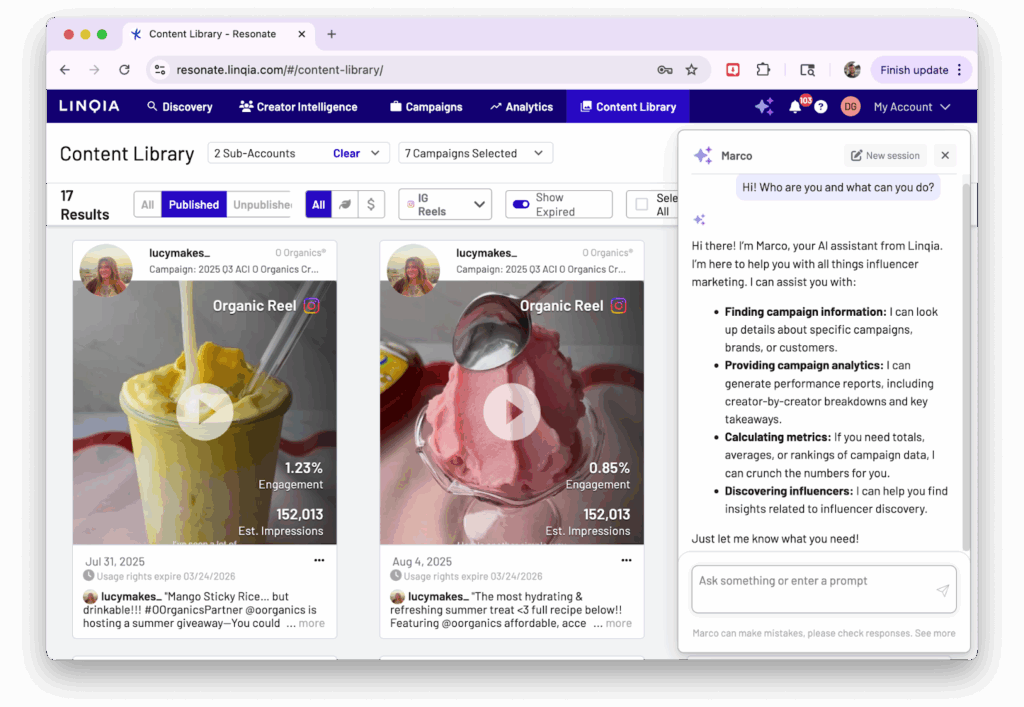
Marco AI’s operation within the Resonate platform spans the full lifecycle of an influencer campaign. Marketers can use it to identify creators, generate campaign briefs, benchmark performance, analyze results, and summarize learnings, all through conversational prompts.
At the discovery stage, Marco can surface creators based on vertical, historical performance, or similarity to past top performers. For briefings, it can generate content guidelines from a high-level campaign objective description, refining tone and structure based on what has historically driven performance.
“Through natural language, you can now literally describe what you want,” Daniel says. “As that trusted advisor, Marco helps you get there.”
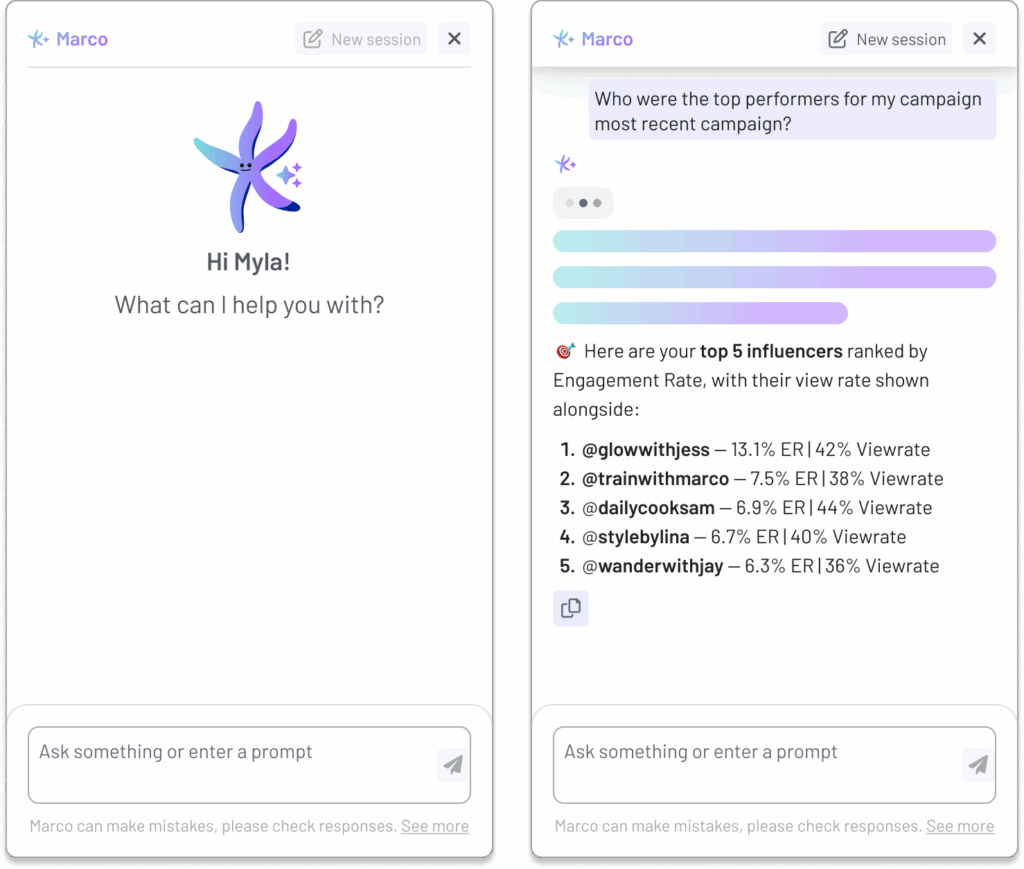
Once campaigns are live, Marco shifts into analysis mode. It can compare performance across campaigns, creators, formats, and time periods, while benchmarking results against industry and vertical norms.
“You can ask Marco anything you want,” Daniel says. “It can analyze anything that’s currently happening, or that has happened.”
Early testing showed that Marco reduced the time from brief creation to client review by up to 25%, according to Linqia, while improving collaboration across teams.
Why AI Became the Interface, Not Just an Add-On
Daniel is clear that Marco wasn’t built simply because AI became fashionable in marketing software. Instead, he frames it as a more fundamental rethink of how platforms surface functionality.
“When you’re developing software, you think about all the different use cases marketers have, and then you build features to support those,” he says. “What AI provides right now is the ability to abstract all of that.”
Rather than pre-defining workflows, Marco interprets user intent and determines which data sources, benchmarks, or tools are required to deliver an answer or outcome. In some cases, that means generating insights that marketers may not have explicitly requested.
“Marco can understand your intention,” Daniel says. “It understands how to navigate all the data that it’s been given access to to provide answers and recommendations.”
That abstraction, he argues, allows Linqia to support a broader range of marketer needs without constantly adding bespoke features. “It felt like a much better, more efficient, more effective way to allow brands to partner with creators to drive business results,” he says.
How Marco Is Built Under the Hood
While Marco presents as a single conversational interface, Daniel says it relies on multiple large language models (LLMs) working together behind the scenes. Each model is optimized for a different type of task.
“Some LLMs are better at analyzing data and providing summaries,” he says. “Some are better at looking at contextual relevance and clustering. Some are better at summarizing or polishing content.”
For example, a prompt asking how a campaign performed relative to past efforts draws on a model designed for data analysis, while a prompt requesting a campaign brief uses a different model optimized for language generation.
“We built it in a way that we can interchange and optimize which LLMs we use depending upon what the actual function is,” Daniel says, adding that this modular approach allows Linqia to improve Marco’s outputs continuously and adjust models as new capabilities emerge.
Surfacing Insights Humans Rarely Catch
One of Marco’s most practical benefits, according to Daniel, is its ability to identify patterns across massive volumes of performance data – something he notes human teams struggle to do consistently.
Marco evaluates how a campaign performs against multiple benchmarks simultaneously: a brand’s historical performance, an influencer’s typical engagement, vertical averages, and broader industry norms.
“What Marco does is look across all of those different angles,” Daniel says. “And then it looks at the content itself.”
By analyzing elements such as video length, narrative structure, visual cues, and calls to action, Marco can identify common characteristics among top-performing posts. “This is all stuff that’s very hard for humans to do, because it’s a ton of different data points,” Daniel says. “Marco will say, ‘The posts that performed well had these similarities.’”
How Marco Impacts Creators
At launch, Marco is primarily brand-facing. But Daniel says its outputs already indirectly affect creators, particularly through better briefs.
“One of the things we find is that when left to humans, briefs can be a little too verbose,” he says. “Marco can help streamline that.”
Looking ahead, Linqia plans to extend Marco to the creator side of its platform. “As creators are producing content, it could make recommendations,” Daniel says. “For this style of content, maybe you should do this instead of that.”
He points to examples such as timing a call to action earlier in a video or adjusting the narrative structure to improve engagement.
Automation at a Scale Influencer Marketing Has Lacked
Beyond analytics and briefs, Daniel sees Marco as foundational to automating influencer marketing to a level the industry has not yet reached, particularly for trend tracking.
“Identifying trends, figuring out how to insert a brand into that trend, finding the right creators, writing the brief, executing – that’s a tremendous amount of time and effort to do manually,” he says.
Marco is being built with agentic capabilities that enable it not only to analyze, but also to take action, moving from trend detection to creator outreach to campaign execution. “Marco has an agentic backend,” Daniel says. “These are little AI agents that can actually take action, not just provide information.”
While human oversight remains optional, the goal is to make large-scale influencer activation possible without proportional increases in headcount.
Why AI Doesn’t Replace Creators
As AI becomes more embedded in influencer marketing, Daniel acknowledges concerns about its impact on creators, but remains firm that human creativity remains central.
“The ability to get true resonance with an audience – that’s a uniquely human trait,” he says. “I see AI as an enabler.”
For Daniel, Marco’s role is to remove friction from planning, execution, and measurement, freeing marketers and creators to focus on strategy and storytelling. “I see AI taking what can be very painful, time-consuming, difficult, and making it seamless, automated, and much more impactful,” he says.
The exec envisions a future in which influencer platforms rely less on traditional interfaces.
“I envision a world where there isn’t even a front end,” Daniel says. “It’s almost like a ChatGPT-style interface where you just have a conversation with Marco and Marco gives you what you need.”
Image credits: Linqia
Subscribe to Our Newsletter
Check Out Our Podcast