


Technology
‘Unbland Yourself’: Chris Do On Standing Out In The Creator Economy


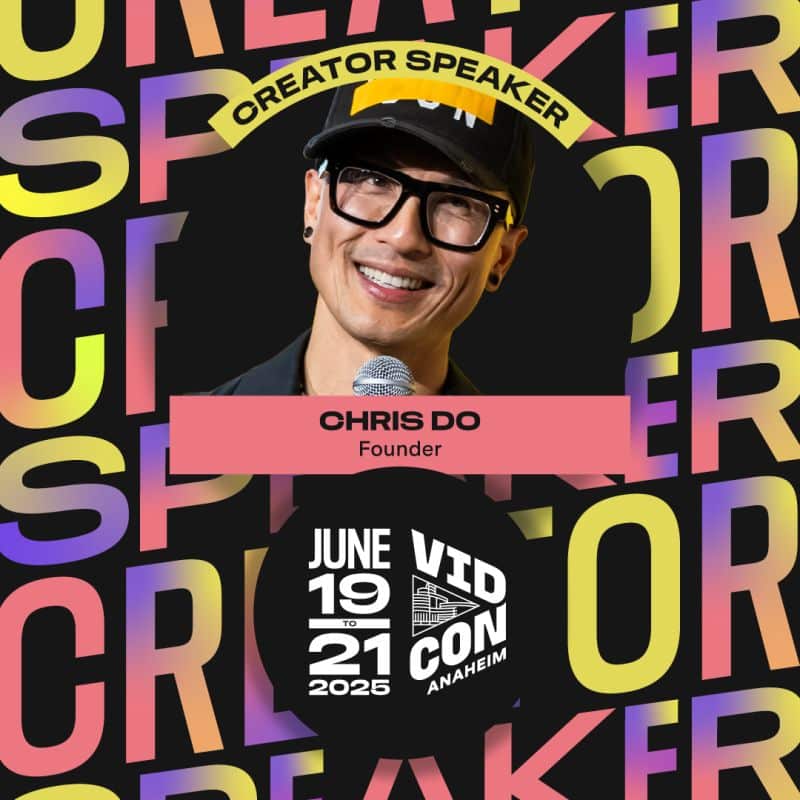
Chris Do believes the creator economy has a “blanding” problem. The founder and CEO of The Futur is on a mission to help creators differentiate themselves in a saturated digital environment—a message he delivered during his panel at VidCon 2025.
The traditionally trained graphic designer-turned-educator has built a business teaching creatives the business skills they need to monetize their passions. His VidCon keynote, titled “Unbland Yourself,” offered a contrarian approach to personal branding that challenges conventional wisdom.
“If you are doing what everyone else is doing, we don’t call that branding, we call that blanding,” Chris explains. “And that’s what most people are doing. They’re just washing away everything that makes sense, that is unique, interesting, and weird in particular.”
Founded in 2016, The Futur has grown from a YouTube channel into an education platform with a team of eight people working remotely to help creatives transform their passions into sustainable businesses. Their mission: teach 1 billion people how to make a living doing what they love.
VidCon 2025: Where Creators and Industry Converge
Chris’s experience at VidCon 2025 encapsulates what makes the event distinctive in the creator economy. Unlike the professional conferences he typically attends, VidCon bridges multiple worlds—fans, creators, and industry professionals.
“VidCon is very unique in that there are a bunch of creators there, and there are a lot of fans there. So we have a mix of industry peers and fans,” Chris explains, adding that this dynamic creates an energy different from other industry gatherings, with VidCon’s three-floor structure separating fans, peers, and industry professionals.
The security measures surprised even Chris: “They have to actually protect you from the fans. We’re staying at the Anaheim Hotel, and there’s tight security. I’m like, ‘Who are we? I’m not that special to need this kind of FBI-level security detail.’”
For his 45-minute keynote on “Unbland Yourself,” Chris prepared 347 slides—though he only made it through about 147 of them. His goal was to provide “thought-provoking ideas to stimulate them to start thinking about personal branding differently,” a topic that’s gaining increasing traction in the creator economy.
Learning and Connecting at VidCon
When Chris finished his presentation, he encountered an unexpected question from attendees: “Who are you?”
“I realized something,” he reflects. “I am used to going to a place where people who attended know who I am and know who the speakers are, because it costs money to be there.” The panel title—”Unbland Yourself”—had drawn people in, but nowhere in his presentation had he introduced himself. “That was a note to self: when you’re doing a talk, make sure you tell people just a little bit about who you are.”
Despite this oversight, audience response was enthusiastic. “People were saying it was the best panel or the best talk they’d seen. I made the trip worth it for them and reframed things for them that they hadn’t thought about before,” Chris shares.
VidCon also provided opportunities to reconnect with fellow creators experiencing their own paths in the creator economy. Chris attended part of attorney Tyler Chou’s session, witnessing firsthand how quickly things can change in this field. “Two years ago, I was just strolling around. I’m not speaking. I’m not attending VidCon. And Tyler comes up to me and says, ‘Chris, I’m a fan. Can I take a picture with you?'” Within 18 months, Tyler had “totally blown up” in the creator space.
This networking aspect makes VidCon particularly valuable. “I like it because you never know who you’re gonna run into,” Chris says. “It’s like a reunion for some of us that I’ve known for years. It feels like a homecoming party or dance, and we all know each other in one way.”
From Client Services to Creator Education
A traditionally trained graphic designer, Chris spent 23 years in the production space, servicing the advertising industry through his company, Blind, Inc., working with clients such as Microsoft, Sony, Nike, and Starbucks.
The shift toward education began in 2014 when a former classmate suggested he start an education company and build awareness through YouTube. “I was very reluctant to do it,” Chris recalls. “But he was a very generous human being. He made it super safe and easy for me to say yes to.”
The dissolution of a business partnership in 2016 became a catalyst for a full commitment to content creation. “I caught the creator bug,” Chris says. “I’m like, I’m ready to do this. I love doing this. Actually, I love doing this more than focusing on my business.”
By December 2018, Chris achieved what he calls his “freedom date,” the point at which The Futur fully transitioned away from client work. “It’s been a blissful seven years since then,” he reflects.
The Business of Teaching Creative Business
The Futur’s business model is designed to teach the business skills that creative professionals often lack. “It isn’t hard to do something that you love,” Chris explains. “The part is how to make a living doing what you love. And that requires soft skills: pricing, negotiation, sales and marketing, and building up your brand.”
The Futur monetizes its content through YouTube (with 2.7 million followers), courses, workshops, global speaking engagements, and AI-powered tools. This varied approach has enabled Chris to build a sustainable business centered on knowledge sharing, rather than relying on brand deals or sponsorships, like many creators.
His team has even developed “DoBot,” a virtual teaching assistant that extends The Futur’s reach. “I’ve already made a digital version of myself,” Chris explains. “DoBot answers your questions 24/7. DoBot has infinite patience. DoBot will sit there and talk to you for as long as you want and help you through the problem.” The AI assistant demonstrates how The Futur is utilizing technology to scale personal guidance.
Recent workshop attendance suggests growing interest in personal branding education. “I recently got back from Singapore, and we did multi-day workshops. The personal branding one had 20 or 30% more people signing up for it in a faster amount of time than the sales workshop,” Chris notes. “So it’s hot. People want to know.”
Being Genuine in an AI-Driven World
At VidCon and in his upcoming Vancouver talk on branding in the age of AI, Chris is addressing how creators can maintain their distinctiveness as AI becomes more prevalent.
“I think the future of branding is going to lean into more of a human-centric approach where we move away from the glossy veneer of appearing perfect and sanitizing for public consumption, because the robots are already doing that,” Chris observes.
His philosophy differs noticeably from conventional wisdom on personal branding. “I’m a contrarian in my space. I’m the anti-Chris, if you will. I like that opposite of where people are,” he says. “A lot of people think personal branding is about marketing and sales and getting conversions. They believe it’s an outward expression intended to achieve a certain result. I tell people, for me, personal branding is a journey inward, not outward.”
This introspective approach was central to his presentation at VidCon. “It’s about discovering who you are. It’s important that you know who you are before you start telling people this is what you stand for,” Chris emphasizes.
A Message for the Creator Economy
As Chris looks ahead to a busy schedule of speaking engagements—from Las Vegas to Vancouver, Dubai, Japan, and Vietnam—his message to creators remains consistent: embrace your uniqueness, develop business acumen, and build a sustainable model around your genuine self.
“I want to let people know, it’s your time, baby. It is your time. It’s the rise of the creator. It’s the rise of individual expression. And the world needs more of you in it,” he says passionately.
His observations from VidCon and throughout his career have convinced him that the creator economy’s continued growth depends on individuals finding sustainable business models around their unique gifts.
As he prepares for future speaking opportunities, including the potential return to VidCon with expanded programming, Chris remains focused on his core mission. “I’d love to come back in a bigger capacity. I enjoyed my time there, and I just want to do more.”
Chris grounds his work in a thoughtful perspective. “There’s a quote from Picasso,” he shares. “‘The meaning of life is to find your gift; the purpose of life is to give it away.’ The creators have already begun to figure out what their gift is. And now they’re in the process of giving it away.”
Subscribe to Our Newsletter
Check Out Our Podcast