Consumer mobile app brands allocate the largest share of social budgets to the platform, while DTC and omnichannel advertisers see impact build over weeks, not days.
Marketing measurement firm Haus has published new research examining how TikTok advertising generates returns across different business types, finding that the platform’s incremental impact on purchases tends to emerge gradually and, in some cases, persists beyond the conclusion of ad campaigns.
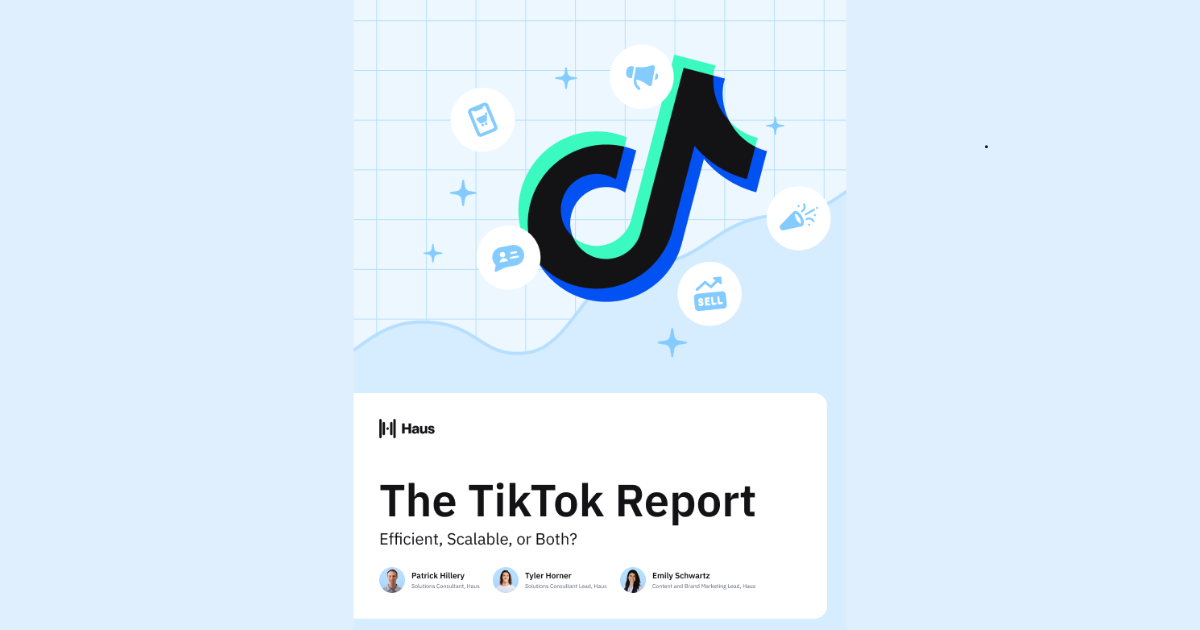
The report, titled “The TikTok Report: Efficient, Scalable, or Both?”, draws on geo-based incrementality experiments conducted across Haus’s client base. The research examined TikTok’s role within broader media mixes, analyzing how the platform performs across consumer mobile apps, direct-to-consumer (DTC) e-commerce brands, services businesses, and marketplace operators.
Budget Allocation Varies Sharply by Business Type
Across the business segments studied, consumer mobile app brands devote the largest share of their combined search and social budgets to TikTok, averaging 19% of that spending on the platform. DTC and e-commerce brands follow at 7%, while services companies allocate 4%, and marketplace brands allocate 3%.
The report does not characterize these allocations as optimal or suboptimal but presents them as a baseline for understanding how different categories have weighted TikTok within their media investments.
Impact Builds in the Second Half of Campaigns
One of the report’s central findings concerns the timing of TikTok’s measurable effect on consumer behavior. Using cumulative lift graphs drawn from anonymized client experiments, Haus found that the first half of a given campaign period frequently showed negligible differences between exposed and unexposed consumer groups. Measurable impact began emerging in the second half of the campaign window.
One case study in the report, identified as an omnichannel brand, ran an incrementality experiment from September 12 through October 1. The cumulative lift data shows minimal movement through the first two weeks of the treatment period, with lift accelerating in the final stretch. Notably, the upward trajectory continued into the post-treatment window (October 2 through October 8) and extended further into a subsequent promotional period.
A second case study features a DTC company that sells products priced at $400 or more through its own website and Amazon, identified in the report as a Long Consideration Cycle Brand. That brand ran a month-long experiment from August 2 through September 1 without a post-treatment observation window. The data showed modest movement throughout most of the campaign, followed by a sharp acceleration in the final three days, which coincided with a promotional period.
The report states that “almost all of the impact from the media was measured” during those final days.
Demand-Building Before Promotional Windows
The Long Consideration Cycle Brand example illustrates a pattern the report identifies as relevant for advertisers with higher-priced products or longer purchase consideration timelines. In that experiment, TikTok advertising appeared to warm up audiences and build demand during the treatment period, with the conversion of that demand concentrated at the promotional moment rather than distributed evenly across the campaign.
The report presents this dynamic as a factor brand marketers may need to account for when evaluating TikTok’s contribution to sales outcomes, particularly if their measurement windows do not extend through or beyond promotional events.
Persistent Post-Campaign Effects
The omnichannel brand experiment adds a separate dimension to the timing discussion. In that case, lift did not dissipate when paid media stopped running. Instead, the data shows continued upward movement in the week following the campaign’s end, including during a promotional period that fell outside the original treatment window.
The report frames this as evidence that TikTok advertising can generate residual effects that extend beyond the active campaign, a characteristic that standard last-click or short-window attribution models may not fully capture.
Methodology
Haus conducts its experiments using geo-based randomization, dividing markets into treatment and control groups to isolate the incremental effect of advertising from organic demand. The cumulative lift metric used in the report aggregates daily differences between those groups over time, providing a running view of how ad impact accumulates across a campaign.
The anonymized nature of the client data in the report means specific advertiser names, spend levels, and exact lift percentages are not disclosed beyond what appears in the charts.
Image source: Haus The full report is available here
Dragomir is a Serbian freelance blog writer and translator. He is passionate about covering insightful stories and exploring topics such as influencer marketing, the creator economy, technology, business, and cyber fraud.



















Consumer mobile app brands allocate the largest share of social budgets to the platform, while DTC and omnichannel advertisers see impact build over weeks, not days.
Marketing measurement firm Haus has published new research examining how TikTok advertising generates returns across different business types, finding that the platform’s incremental impact on purchases tends to emerge gradually and, in some cases, persists beyond the conclusion of ad campaigns.
The report, titled “The TikTok Report: Efficient, Scalable, or Both?”, draws on geo-based incrementality experiments conducted across Haus’s client base. The research examined TikTok’s role within broader media mixes, analyzing how the platform performs across consumer mobile apps, direct-to-consumer (DTC) e-commerce brands, services businesses, and marketplace operators.
Budget Allocation Varies Sharply by Business Type
Across the business segments studied, consumer mobile app brands devote the largest share of their combined search and social budgets to TikTok, averaging 19% of that spending on the platform. DTC and e-commerce brands follow at 7%, while services companies allocate 4%, and marketplace brands allocate 3%.
The report does not characterize these allocations as optimal or suboptimal but presents them as a baseline for understanding how different categories have weighted TikTok within their media investments.
Impact Builds in the Second Half of Campaigns
One of the report’s central findings concerns the timing of TikTok’s measurable effect on consumer behavior. Using cumulative lift graphs drawn from anonymized client experiments, Haus found that the first half of a given campaign period frequently showed negligible differences between exposed and unexposed consumer groups. Measurable impact began emerging in the second half of the campaign window.
One case study in the report, identified as an omnichannel brand, ran an incrementality experiment from September 12 through October 1. The cumulative lift data shows minimal movement through the first two weeks of the treatment period, with lift accelerating in the final stretch. Notably, the upward trajectory continued into the post-treatment window (October 2 through October 8) and extended further into a subsequent promotional period.
A second case study features a DTC company that sells products priced at $400 or more through its own website and Amazon, identified in the report as a Long Consideration Cycle Brand. That brand ran a month-long experiment from August 2 through September 1 without a post-treatment observation window. The data showed modest movement throughout most of the campaign, followed by a sharp acceleration in the final three days, which coincided with a promotional period.
The report states that “almost all of the impact from the media was measured” during those final days.
Demand-Building Before Promotional Windows
The Long Consideration Cycle Brand example illustrates a pattern the report identifies as relevant for advertisers with higher-priced products or longer purchase consideration timelines. In that experiment, TikTok advertising appeared to warm up audiences and build demand during the treatment period, with the conversion of that demand concentrated at the promotional moment rather than distributed evenly across the campaign.
The report presents this dynamic as a factor brand marketers may need to account for when evaluating TikTok’s contribution to sales outcomes, particularly if their measurement windows do not extend through or beyond promotional events.
Persistent Post-Campaign Effects
The omnichannel brand experiment adds a separate dimension to the timing discussion. In that case, lift did not dissipate when paid media stopped running. Instead, the data shows continued upward movement in the week following the campaign’s end, including during a promotional period that fell outside the original treatment window.
The report frames this as evidence that TikTok advertising can generate residual effects that extend beyond the active campaign, a characteristic that standard last-click or short-window attribution models may not fully capture.
Methodology
Haus conducts its experiments using geo-based randomization, dividing markets into treatment and control groups to isolate the incremental effect of advertising from organic demand. The cumulative lift metric used in the report aggregates daily differences between those groups over time, providing a running view of how ad impact accumulates across a campaign.
The anonymized nature of the client data in the report means specific advertiser names, spend levels, and exact lift percentages are not disclosed beyond what appears in the charts.
Image source: Haus
The full report is available here
Subscribe to Our Newsletter
Check Out Our Podcast