





Strategy
The Conference That Taught Marketers Social Media Is Now Teaching Them to Fear It Less

Social Media Marketing World, the annual conference that has spent more than a decade teaching small business marketers how to navigate social platforms, is moving to Anaheim and reconfiguring its curriculum around artificial intelligence. The shift reflects a broader reality in the market it serves: the platforms themselves matter less than what marketers do with them.
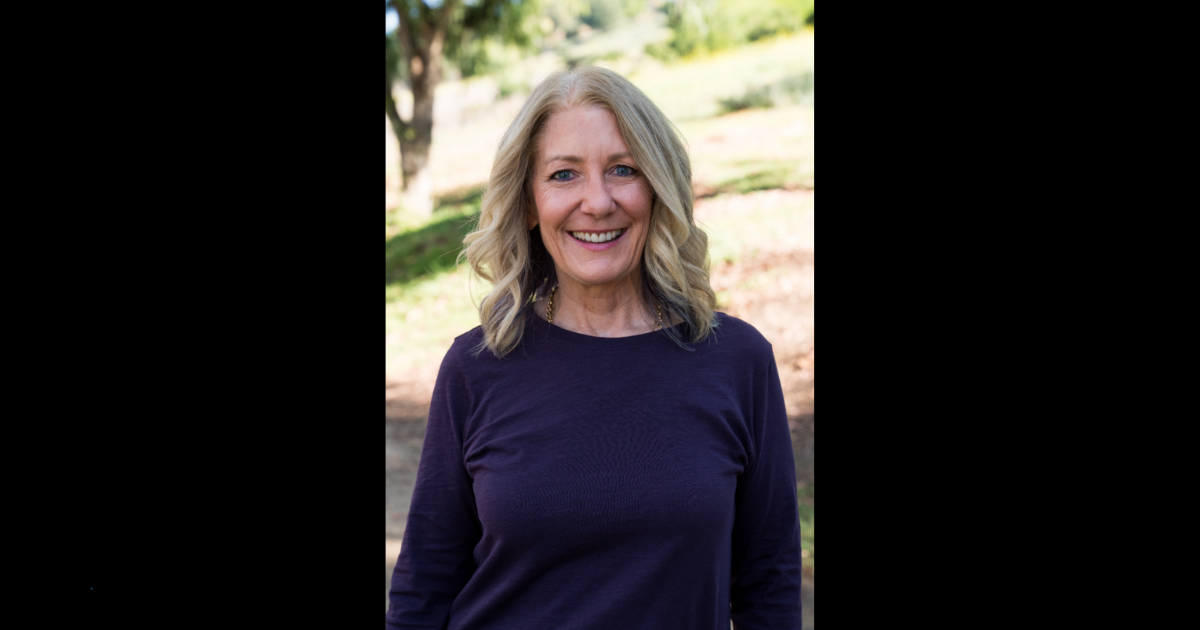
Emily Crume, Director of Strategy at online media company Social Media Examiner, has been with the organization since its first conference in April 2013, brought on to monetize the event’s media touchpoints and sell sponsorships. Thirteen years and multiple platform generations later, she describes her work as brokering relationships between marketers and the tools they need to compete.
“Whether you’re a small business marketer or part of a marketing team or you work for an agency or you’re an independent creator, these marketers struggle to keep up because so much comes at them,” she says. “We help them sift through a lot of, not hype necessarily, but we really get down to strategic objectives.”
Founded by CEO Michael Stelzner in 2013, Social Media Examiner’s annual conference draws attendees from more than 60 countries, with an average participant having 8-10 years of marketing experience.
The 2026 edition runs April 28-30 at the Anaheim Convention Center and includes a new embedded event, AI Business World, reflecting the organization’s expansion into AI as a dedicated content category.
From Platform Tracks to Medium-First Curriculum
At its peak, Social Media Marketing World organized its sessions by platform. Attendees could spend a day in the Instagram track or the YouTube track and leave with a specific playbook for each. That model has been retired.
“Now, it’s really less about some of these individual platforms and more about the medium,” Emily explains. “We have a paid track, an organic track, and content marketing, because those are ubiquitous. You could pay for ads on any of these platforms.”
The shift is a response to what Emily and her team hear from their annual research. The Social Media Examiner industry report, now in its 18th year, surveys readers and listeners on which platforms and mediums they prioritize. According to the research, video consistently ranks among the most important outputs, but which platform carries that video has become secondary to the mechanics of production and distribution.
The 2026 agenda includes a session on Reddit, which Emily points to as a marker of where attention is moving. She frames it in terms of what the industry is calling AEO or AIO, the optimization of content for large language models rather than traditional search engines.
“Reddit’s become a really interesting place where conversations are happening, and this is where people are talking about your brand or your business or topics,” she says. “It’s no longer SEO. You’re fine-tuning the content online for these large language models and artificial intelligence to find your information.”

AI Anxiety and the Move Toward Agentic Workflows
The most visible structural change at this year’s event is the launch of AI Business World as a separately ticketed event within the conference. The embedded format lets Social Media Examiner serve attendees who want AI-specific education without reorganizing the broader curriculum around a single technology category.
Emily describes a tension she sees frequently in the market. Social media managers who initially feared AI would eliminate their roles are increasingly learning to use it as a production multiplier. “Smart social media managers are figuring out ways to deploy AI inside of their job to become more critical to their own organization because they can do more things,” she says.
She draws a parallel to internet adoption in the late 1990s. “We didn’t know what a browser was in 2000,” she notes. “It’s just like that. It’s another tool.” The comparison reflects her view that adoption anxiety dissipates quickly once use cases become concrete.
What Social Media Examiner calls the “agentic shift” refers to the movement from AI as a chatbot or search layer to AI as a deployed agent operating autonomously on a user’s behalf. “People are looking for ways to become deeply known by the AI that they’re working with and then using that and deploying as an agent to go out and do things for you,” Emily explains. “It could be scheduling content, it could be doing research, it could be doing a lot of things for you.”
The company has built its own example: a chatbot called “Scout Bot,” trained on event FAQ data and updated continuously, that handles attendee questions on the conference website.

Why Anaheim?
Social Media Marketing World has been held in San Diego since its first edition. The move to Anaheim represents the first venue change in the conference’s history, and Emily frames it primarily as a capacity decision driven by anticipated growth.
“We are a global event where people come from 60+ countries,” she says. “We’re looking to grow.” Anaheim offers five accessible airports and more affordable hotel inventory than San Diego, lowering the logistical and financial barrier for international attendees. Emily acknowledges that proximity to Disneyland was also a factor. “Who doesn’t want to be near Disneyland? It checked the box in their favor.”
The growth ambition extends specifically to AI Business World. Emily believes AI in marketing will continue expanding as a content category, and building a separately ticketed track gives the organization flexibility to scale it independently without crowding the core social media curriculum.
The Vetting System That Keeps the Panels Off Stage
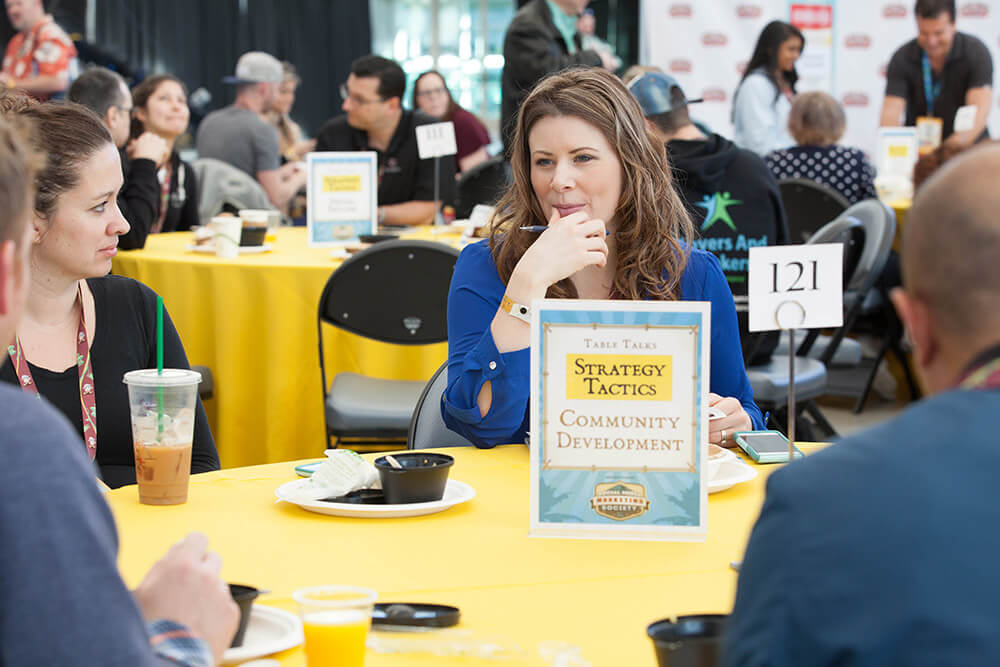
Social Media Marketing World operates an invitation-only speaker model. Emily contrasts it directly with open-pitch conferences. “It’s not clap for credit like some of these famous festivals in Austin, Texas, where anybody could potentially speak if you get enough of your friends to vote for you,” she says.
All speakers must first appear on either the “Social Media Marketing Podcast” or the “AI Explored Podcast.” The podcast interview functions as both a credential check and a pre-event audience development mechanism.
“When I get a random pitch from somebody that says, ‘Hey, my CEO wants to keynote your event,’ I always say, ‘Have you ever been to an event? You might want to come first because this isn’t a personal brand-building opportunity,’” Emily says.
The organization provides speaker coaching for newer voices who have built expertise but have limited stage experience. That program produced at least one speaker this year who attended the event as a volunteer a decade ago, photographed herself on the stage, and publicly stated her goal of returning to present. Loren Bartley, who will speak on AI at the 2026 event, is that speaker.

A Community That Outlasts the Conference Week
The commercial case for Social Media Marketing World rests partly on what Emily describes as attendee transformation, but the retention data is more concrete. Repeat sponsorships from companies like tech company Zoho, which has returned nine times, and Metricool, which has returned six times, point to measurable returns for brand partners. “To have that and to know that they’re achieving their own business objectives because of our working together, that lights me up,” Emily says.
Emily notes that attendee loyalty follows a similar pattern. Groups coordinate session schedules across team members and compare notes afterward. The event has also produced relationships with longer arcs. “We’ve had marriages, we’ve had babies as a result of Social Media Marketing World connections,” she says.
The social infrastructure has expanded alongside the conference itself. A networking session specifically for introverts runs alongside more traditional mixer formats. A volunteer program exchanges event access for support roles, and tiered payment plans lower the cost barrier for marketers who cannot pay the full ticket price.
The Next Chapter: AI, More Markets, Fewer Platform Obsessions
For Emily, the conference’s transition from platform-specific curriculum to medium-first instruction and now AI-first education is less a strategic pivot than an honest tracking of where marketer needs have moved. “Mediums and technologies will change, but outcomes won’t,” she says. “Marketing is based on business outcomes. What are you looking to achieve?”
The move to Anaheim and the launch of AI Business World are the most visible signals of where Social Media Marketing World is directing its next phase. The event may still sell tickets in part on the strength of specific platform sessions, but it increasingly teaches a curriculum that assumes the platforms are interchangeable. The mechanics of paid media, organic reach, and content production apply across all of them.
“Every year I show up, and I look around, and I think, ‘I cannot believe I work at this amazing company that just does such a great job of bringing people together and making them feel like they’re really part of something,’” Emily concludes.
For more information about Social Media Marketing World, follow this link.
Subscribe to Our Newsletter
Check Out Our Podcast