



Tech
Stamp’s Lucy Magri-Overend on Building a Certification System That Puts Creators in Control of Their Credibility

Lucy Magri-Overend spent years watching the Creator Economy accumulate infrastructure on one side of the ledger while leaving the other largely empty. Tools to measure reach, track engagement, and optimize ad spend proliferated. Tools built to support creators themselves, equipping them to navigate compliance, avoid unintended harm, and signal their credibility to the market, did not. In March 2025, she joined Stamp as co-founder to fix that.
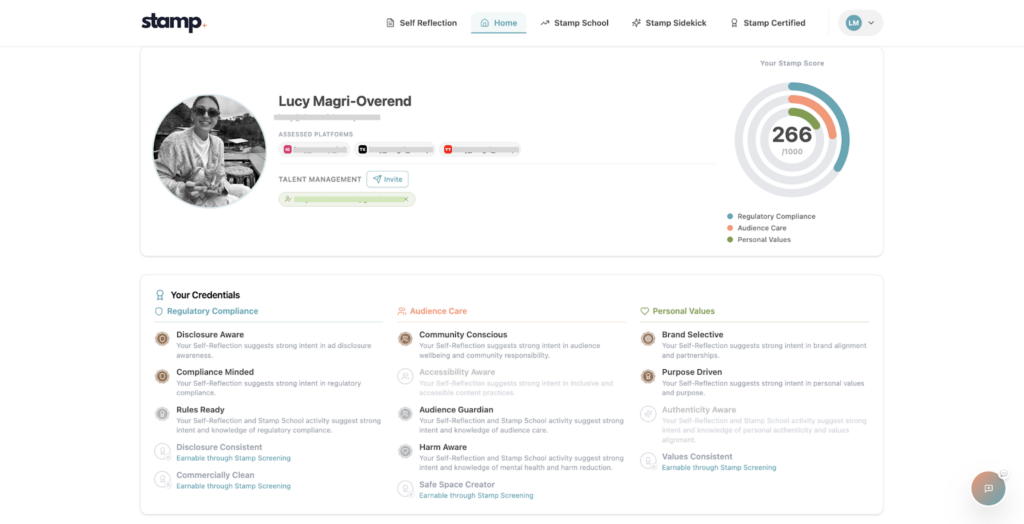
Stamp, founded in London in November 2024 by Murphy Hopkins-Hubbard, is positioning itself as an ethical certification for the Creator Economy. The platform certifies creators across three pillars: regulatory compliance, audience care, and upholding of personal values. Currently in beta, the company works with both creators seeking certification and brands or agencies running creator longlists who want a credibility signal before committing to partnerships.
“We really care about being on the side of creators,” Lucy says. “There are a lot of tools that have been spun up to support the advertiser side. Creators, who are the lifeblood of the value that everyone else is receiving, have not been duly supported.”
The Industry Has Been Optimizing for the Wrong Signal
The Creator Economy built its measurement infrastructure around comparability: reach, engagement, and demographic data. What it left unaddressed, according to Lucy, was the quality dimension that makes Influencer Marketing structurally different from a display ad.
“We don’t go and stand in Times Square going, ‘I don’t trust the relationship between the Nike ad and that billboard,'” she says. “Influencer Marketing has this unique component whereby the brand outcome is massively affected by the perception of the relationship. That’s just not been at the forefront of the conversation. It’s been more quantitative.”
Stamp is built on the premise that the qualitative and quantitative are two different things, and that only one of them has been measured.
Three Pillars, One Threshold
Stamp’s certification model draws on three sequential data sources, each measuring something the others cannot.
The first is the Stamp Self-Reflection, a structured 30 to 45-minute assessment that captures a creator’s stated values, working boundaries, regulatory awareness, and approach to audience care. The answers given personalize the outputs of Stamp Sidekick, the platform’s creator tooling, and inform Stamp’s determinations on the Personal Values pillar. While very few questions are scored, a handful help establish a baseline score that reflects intent.
The second is Stamp School, a bite-sized learning management system covering disclosure rules, regulatory risk, and ethical brand partnership standards. Each module contains a mini-quiz, and success in those quizzes is taken as a signal of demonstrated creator knowledge.
Neither completing Stamp Self-Reflection nor the Stamp School modules is sufficient. “Full marks across both would still fall well short of the certification threshold,” Lucy explains.
Stamp Self-Reflection measures intent, and Stamp School measures knowledge. The certification determination rests primarily on the third layer, Stamp Screening, which measures behavior: an AI-assisted analysis of a creator’s full social presence, including historical content and ongoing monitoring across all formats. A minimum three-month evaluation period is required before certification can be awarded, and the mark is reassessed monthly.
Each pillar must clear its own threshold independently. “A creator who excels in value alignment but has persistent disclosure issues would not be certified,” Lucy says. “And vice versa.” Certification is also revocable. A creator who falls below standard for three consecutive months loses the mark, and specific guidance is provided on how to recover it.
What Creators Actually Get: Stamp Sidekick
Alongside the certification pathway, Stamp offers creators a suite of practical tools under Stamp Sidekick.
The first is a Brand Alignment Checker, which helps creators conduct due diligence on prospective partnerships, assessing value alignment, flagging any reported issues, be it major controversies or specific details that clash with the creator’s stated values, and surfacing basic financial health signals.
The second is a Pre-Post Content Scanner, which reviews content before it goes live for risks and unintended harm, including missing ad disclosures, tone-deaf framing, or material that may warrant a trigger warning.
The third is the Comment Moderator, which helps creators quickly read the sentiment in their comments sections and direct how they engage with their audience.
Together, the tools are designed to function as a practical safety net for the everyday decisions creators make alone, often at speed, and without the committee of advisers a traditional media company would have on hand.
Audiences Already Know. Brands Are Catching Up.
Lucy is direct about what the certification is responding to: a market where audience scrutiny has outpaced industry infrastructure.
She describes watching a fitness creator post a sponsored SPF (Sun Protection Factor) product one day and a competing SPF product the next. “She’s going to lose people doing this,” Lucy says. “Small things like that are highly punishable by savvy audiences.”
The phenomenon extends beyond competing brand deals. Audiences have become sophisticated readers of creator-brand relationships, increasingly rewarding or withholding trust based on perceived authenticity. “Before you even get to the creative, the perceived relationship, the integrity of the relationship: do we buy into that? That’s where it all sits,” she says.
When a brand submits a creator longlist, Stamp returns a tiered output covering four categories: “Criteria Not Met,” “Screened,” “Screened+,” and “Stamp Certified.” The tiers reflect how comprehensively each creator can be assessed, not different standards.
“For brands, this means clear status visibility, confidence-weighted risk signalling, and a meaningful distinction between creators who are low-risk but unverified versus those who have actively earned certification,” Lucy says.
Stamp Certified covers all three pillars, plus ongoing monitoring of disappearing content formats, such as Instagram Stories.
Brand Safe Does Not Mean Having No Stance
One of Lucy’s more pointed arguments concerns how the industry has defined brand safety. She notes that the dominant interpretation has treated political or values-based content as inherently risky, pushing brands to pressure creators toward studied neutrality.
“We seem to be favoring or punishing certain values,” she says. “All while acknowledging that a creator’s success hinges on their engagement, how they connect with people. We’re asking some really juxtaposing things. We know your success hinges on how you connect to other people, but we don’t want you to be you.”
Lucy’s position is that brand safety and strong personal stances are not inherently in conflict. If anything, she sees the opposite trend playing out: creators who are outspoken about the world around them are increasingly rewarded with stronger engagement and deeper audience trust, while those who flatten themselves into studied neutrality risk losing the authentic appeal that made them valuable in the first place.
Stamp has no interest in prescribing where creators should stand. The platform’s role, as Lucy frames it, is to help creators define their own values and boundaries and then support them in consistently upholding them. For some, that means guidance on how to discuss politics without causing unnecessary inflammation. For others, it means a check on whether a prospective brand partner has been persistently reported for poor supply chain practices. The creator, not the platform, is in control.
That philosophy shapes how the personal values pillar works in practice. Rather than scraping creator content and inferring values, Stamp asks creators directly. “We think creators should be given the power to define how they’re understood,” Lucy says. “The only way you can do that is by handing the mic and asking them.”
On Fractured Regulations
One practical challenge Stamp is tackling is the inconsistency of regulatory frameworks across markets.
In the UK, the Advertising Standards Authority (ASA) enforces the CAP code (Non-Broadcast Advertising and Direct & Promotional Marketing) through a public noncompliance process, naming creators who fall short. Stamp works in active partnership with the ASA in its UK launch market, with a clear division of remit: CAP writes the code, the ASA enforces it, and Stamp educates creators on it and embeds it into their daily workflows.
The complexity multiplies across jurisdictions. A UK-based creator filming in the UAE for a brand whose contract directs U.S. FTC (Federal Trade Commission) compliance faces three distinct regulatory frameworks simultaneously. “Unless we have your location at present, your residency status, the contract by which you’re responding, there’s no way that we could for sure accurately guide you,” Lucy acknowledges.
The longer-term ambition is a system where uploaded contracts inform the backend’s compliance determinations in real time.
Certification as the New Table Stakes
Stamp’s longer-term goal is not to be a premium option for well-resourced campaigns. It is for “Stamp Certified” to become a baseline expectation in creator selection, applied routinely regardless of campaign size or creator tier.
Lucy sees three requirements for that to happen: regulatory pressure that increases the cost of non-compliance for brands; advertisers valuing the “Stamp Certified” mark as a quick, reliable signal of trustworthiness; and creators coming to see certification and the in-platform tooling as career protection, knowing Stamp is on their side.
“When brands begin asking for it routinely, and creators begin leading with it proudly, that’s when ‘Stamp Certified’ becomes table stakes,” she says.
Lucy shares that the early beta response has been unexpectedly affirming. Rather than treating the reflection process as a source of friction, creators have described it as a structured opportunity to assess the alignment among their content, partnerships, and stated values. “The thing we hear most is some version of: ‘My god, the industry really needs this,'” Lucy says. “That doesn’t get old.”
For an industry that has spent a decade optimizing reach at scale, the question Stamp is now putting to the market is simpler and harder: reach measured against what?
Subscribe to Our Newsletter
Check Out Our Podcast