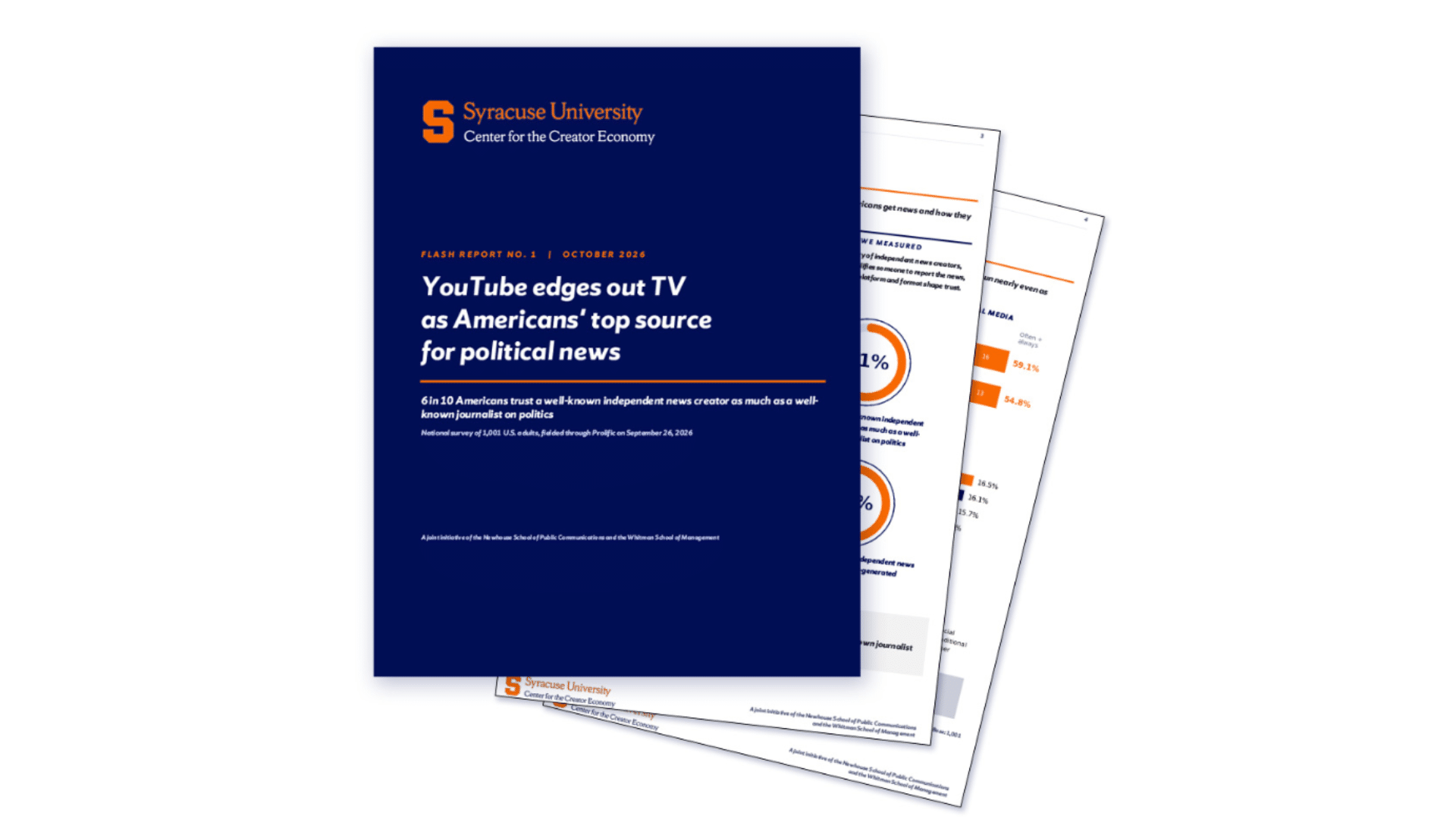
Six in 10 Americans say they trust a well-known independent news creator as much as a well-known professional journalist on political topics, according to a new survey from Syracuse University’s Center for the Creator Economy (CCE).
The findings, published in October 2026 as the center’s first “Flash Report,” also show social media has overtaken television and news sites as the primary source Americans turn to for political news. The survey polled 1,001 U.S. adults recruited through Prolific and fielded on September 26, 2026.
Social Platforms Pull Ahead of TV and News Sites
Social media now leads traditional outlets as a category for political and election news, 60.0% to 31.8%. Broken out by individual platform, YouTube ranks as the single most-used source for political or election news at 16.5%, narrowly ahead of TV news (16.1%) and print or online news sites and apps (15.7%). X follows at 14.8%, then Facebook (10.8%), TikTok (10.4%) and Instagram (7.3%). Podcasts, Substack and newsletters, and LinkedIn each drew under 4%.
More broadly, 59.1% of respondents said they get general news from social media often or always, and 54.8% said the same of political information specifically.
Trust in Creators Nearly Matches Journalists, but Roles Stay Distinct
On political topics, 60.9% of respondents said they trust a well-known independent news creator as much as a well-known professional journalist, and 61.4% said the same when comparing a creator to a major news organization. Despite that parity, 79.2% said they see a meaningful difference between an independent news creator and a journalist, and 40.9% said they trust professional journalists more than independent creators overall.
Asked how much they trust each type of source to report the news accurately, 46.3% of respondents said they trust professional journalists a lot or a great deal, ahead of news outlets at 32.8% and independent news creators at 28.3%. News outlets also drew the highest rate of outright distrust: 9.9% of respondents said they trust news outlets not at all, 2.5 times the rate reported for independent news creators (3.9%).
Corrections Carry More Weight Than Credentials
The single statement to draw the highest agreement in the survey was about accountability rather than credentials: 85.8% of respondents said they trust independent news creators more when the creators publicly correct their mistakes. A majority, 67.3%, agreed that doing the reporting matters more than holding formal journalism credentials, and 46.1% said they still trust someone’s reporting even without formal journalism training.
Platform-level credibility signals drew more mixed responses. Just 37.9% said a “verified” badge on a creator’s profile makes them trust the content more, against 36.5% who disagreed. Similarly, 36.5% agreed that they trust a journalist’s reporting more when the journalist also shares informal, personal takes on social media.
Humans Preferred Over AI, Platform Shapes Perceived Credibility
Given a choice, 77.0% of respondents said they prefer a human independent news creator over an AI-generated summary, including 48% who said so strongly. Separately, 63.0% agreed that the platform where they encounter a claim affects how credible they find it, even when the content itself is identical. Views split on short-form video specifically: 42.4% said they remember short-form news video better than longer TV segments, and 40.4% said they trust a short clip about a news story as much as a longer TV segment on the same story.
Partisan and Demographic Splits
The CCE’s regression analysis, which controlled for age, sex, race and ethnicity, party, student status and employment status, found social media news use runs highest among younger, Black and Republican respondents. Trust in independent news creators rises with social media news use and is higher among Republican and Black respondents, while trust in professional journalists and news outlets runs higher among Democratic and Black respondents. Trusting journalists more than independent creators overall is more common among Democratic, Asian and Black respondents, and the preference for a human voice over an AI-generated summary is slightly stronger among heavier social media news users and Democrats.
The survey sample was 50.6% female and 49.4% male, with a mean age of 45.8 and a range of 18 to 84. Respondents identified as 63.4% White, 11.6% Black, 10.7% mixed race, 8.1% other, and 6.2% Asian, and as 42.6% independent, 29.5% Democratic, and 27.9% Republican. Demographic comparisons were run on the 939 respondents with complete demographic data and are statistically significant at p < .05.
The CCE, launched in 2025 as a joint initiative of the S.I. Newhouse School of Public Communications and Martin J. Whitman School of Management, said it plans to publish Flash Reports on creators, audiences, and platforms on a monthly basis.
Image source: Syracuse University The full report can be foundhere
Dragomir is a Serbian freelance blog writer and translator. He is passionate about covering insightful stories and exploring topics such as influencer marketing, the creator economy, technology, business, and cyber fraud.













Six in 10 Americans say they trust a well-known independent news creator as much as a well-known professional journalist on political topics, according to a new survey from Syracuse University’s Center for the Creator Economy (CCE).
The findings, published in October 2026 as the center’s first “Flash Report,” also show social media has overtaken television and news sites as the primary source Americans turn to for political news. The survey polled 1,001 U.S. adults recruited through Prolific and fielded on September 26, 2026.
Social Platforms Pull Ahead of TV and News Sites
Social media now leads traditional outlets as a category for political and election news, 60.0% to 31.8%. Broken out by individual platform, YouTube ranks as the single most-used source for political or election news at 16.5%, narrowly ahead of TV news (16.1%) and print or online news sites and apps (15.7%). X follows at 14.8%, then Facebook (10.8%), TikTok (10.4%) and Instagram (7.3%). Podcasts, Substack and newsletters, and LinkedIn each drew under 4%.
More broadly, 59.1% of respondents said they get general news from social media often or always, and 54.8% said the same of political information specifically.
Trust in Creators Nearly Matches Journalists, but Roles Stay Distinct
On political topics, 60.9% of respondents said they trust a well-known independent news creator as much as a well-known professional journalist, and 61.4% said the same when comparing a creator to a major news organization. Despite that parity, 79.2% said they see a meaningful difference between an independent news creator and a journalist, and 40.9% said they trust professional journalists more than independent creators overall.
Asked how much they trust each type of source to report the news accurately, 46.3% of respondents said they trust professional journalists a lot or a great deal, ahead of news outlets at 32.8% and independent news creators at 28.3%. News outlets also drew the highest rate of outright distrust: 9.9% of respondents said they trust news outlets not at all, 2.5 times the rate reported for independent news creators (3.9%).
Corrections Carry More Weight Than Credentials
The single statement to draw the highest agreement in the survey was about accountability rather than credentials: 85.8% of respondents said they trust independent news creators more when the creators publicly correct their mistakes. A majority, 67.3%, agreed that doing the reporting matters more than holding formal journalism credentials, and 46.1% said they still trust someone’s reporting even without formal journalism training.
Platform-level credibility signals drew more mixed responses. Just 37.9% said a “verified” badge on a creator’s profile makes them trust the content more, against 36.5% who disagreed. Similarly, 36.5% agreed that they trust a journalist’s reporting more when the journalist also shares informal, personal takes on social media.
Humans Preferred Over AI, Platform Shapes Perceived Credibility
Given a choice, 77.0% of respondents said they prefer a human independent news creator over an AI-generated summary, including 48% who said so strongly. Separately, 63.0% agreed that the platform where they encounter a claim affects how credible they find it, even when the content itself is identical. Views split on short-form video specifically: 42.4% said they remember short-form news video better than longer TV segments, and 40.4% said they trust a short clip about a news story as much as a longer TV segment on the same story.
Partisan and Demographic Splits
The CCE’s regression analysis, which controlled for age, sex, race and ethnicity, party, student status and employment status, found social media news use runs highest among younger, Black and Republican respondents. Trust in independent news creators rises with social media news use and is higher among Republican and Black respondents, while trust in professional journalists and news outlets runs higher among Democratic and Black respondents. Trusting journalists more than independent creators overall is more common among Democratic, Asian and Black respondents, and the preference for a human voice over an AI-generated summary is slightly stronger among heavier social media news users and Democrats.
The survey sample was 50.6% female and 49.4% male, with a mean age of 45.8 and a range of 18 to 84. Respondents identified as 63.4% White, 11.6% Black, 10.7% mixed race, 8.1% other, and 6.2% Asian, and as 42.6% independent, 29.5% Democratic, and 27.9% Republican. Demographic comparisons were run on the 939 respondents with complete demographic data and are statistically significant at p < .05.
The CCE, launched in 2025 as a joint initiative of the S.I. Newhouse School of Public Communications and Martin J. Whitman School of Management, said it plans to publish Flash Reports on creators, audiences, and platforms on a monthly basis.
Image source: Syracuse University
The full report can be found here
Subscribe to Our Newsletter
Check Out Our Podcast