




Agency
Sounds Profitable: Elevating The Business Of Podcasting Through Education And Community


Bryan Barletta turned an unexpected career setback into an opportunity to bolster knowledge sharing in the podcast industry. As the founder of Austin-based Sounds Profitable, he has created a trade association where industry giants and small, independent producers pay identical fees for equal access to expertise, research, and networking. Drawing from his technical background in podcast ad technology and attribution systems, Bryan identified a crucial problem: even as podcast listenership grew, the business side operated with fragmented standards and uneven technical knowledge—issues that have persisted throughout the medium for two decades.
“The main change is the acknowledgement that this is not a quick turnaround anymore. The companies that are in podcasting are thinking about it in a five to ten-year timeline,” explains Bryan, reflecting on the industry’s shift toward long-term planning.
Founded in 2020 after Bryan was let go from Megaphone, Sounds Profitable began as an “ad tech newsletter for podcasting” but quickly expanded its mission.
“When we started, there was really a boom and a bust during the COVID cycle. I thought, ‘Wow, we’re really making it difficult to slow down to teach the people who are new to the space or to go recruit people new to the space,’” Bryan explains. What surprised him most was discovering that “it wasn’t the entry level people, only the mid level and even the C level or founders of these companies didn’t understand the basics.”
Today, with over 200 partners ranging from tech giants like YouTube and Amazon to independent producers, Sounds Profitable offers equal access to research, consulting, and networking opportunities for a flat monthly fee of $500, regardless of company size.
Creating a Unique Trade Association Model
Where Sounds Profitable differs from traditional industry associations is in its structure and approach to partnership. Rather than creating a hierarchical system with different membership tiers or focusing solely on major players, Bryan established an egalitarian model.
“We built it off of what we think a trade association should be doing for an emerging market,” Bryan says. “Priced appropriately, providing consulting discounts, access to all these fun services, all the way through what consulting and networking groups do.”
This model provides all partners—regardless of size—with the same benefits and level of access. Each paying partner receives thirty minutes of consulting time per month with either Bryan or his partner, Tom Webster, whom he describes as “the founding voice of research in podcasting, with over 21 years of experience.” This commitment to fairness extends to Sounds Profitable’s business practices as well.
“We never took equity advisory or board seats, nor did we take commission or kickback,” Bryan emphasizes. This decision stemmed from observing others in the space who accepted lucrative board positions but consequently couldn’t work with competitors. “If you’re on the board of one company, you really can’t work with their four peers or competitors, because it’s a conflict of interest.”
The result is an organization positioned to serve the entire industry rather than a particular segment. As Bryan shares, their six weekly newsletters reach approximately 10,000 readers each issue with a 45% unique open rate. All content is provided without advertisements and clearly acknowledges the partners who make it possible.

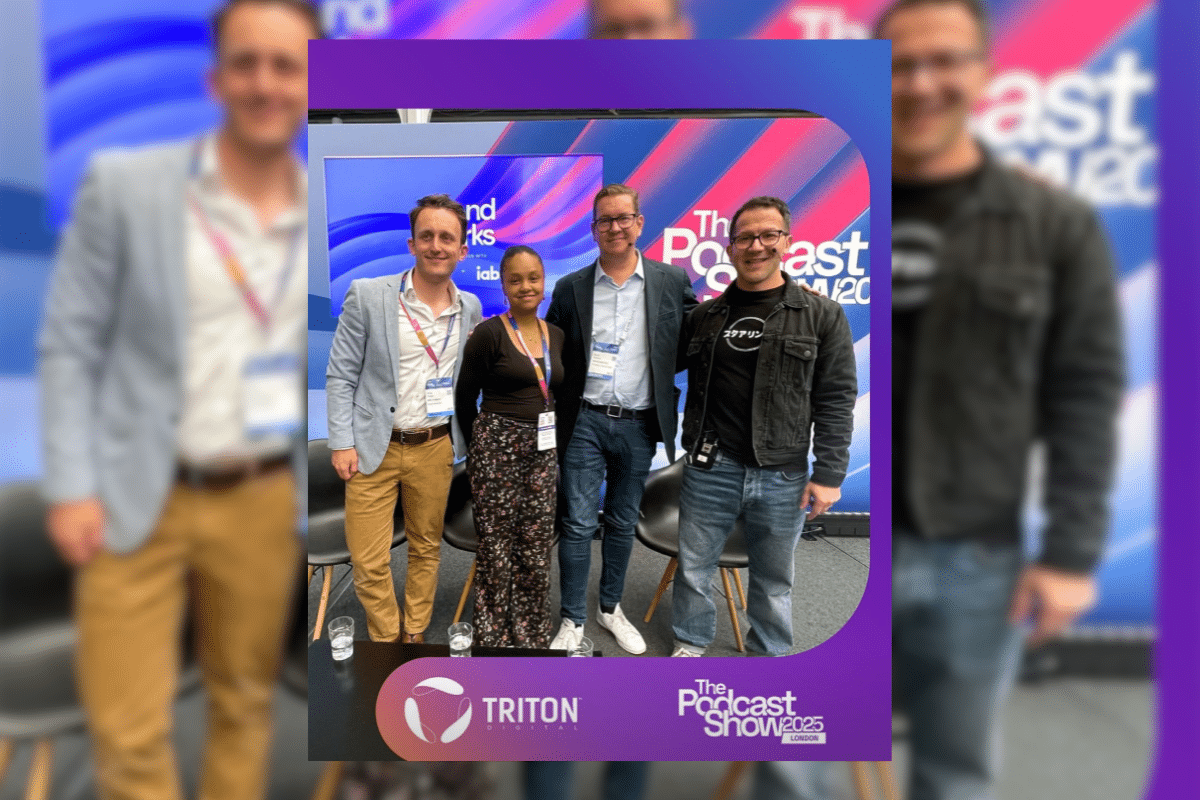
Bryan at The Podcast Show 2025 in London
Expanding Through Research and Industry Events
A pivotal moment for Sounds Profitable came three years after its founding when Webster joined the team after leaving Edison Research. This partnership expanded the organization’s research capabilities and industry impact. Sounds Profitable has also won the 2025 Content Marketing Award for “Best Data Storytelling” from The Content Marketing Institute.
On the other side, Bryan’s focus has shifted toward ensuring the podcasting industry has a stronger presence at major media and advertising events. “Events, I would say overwhelmingly, are my focus because right now the world is a very lonely place, and people who choose to work in podcasting could go get a better-paying job and have fewer hours in almost any other industry.”
His goal is to increase industry representation at events like Cannes Lions from just 20 companies to 100 or more, coordinating resources to maximize their collective impact. “How do we get our partners a base at one of the beaches so they can always have a place to go back to? How do we sign them up for all of the interesting events and get them on every list?”
This event strategy reflects Bryan’s broader vision for podcasting’s place in the media field: “I don’t think we need a place to pull people through. I think we’re the through line through every single other thing. So, how do we ensure that every space has something about podcasting? And we only do that when we all show up in force.”
Understanding Industry Changes and Challenges
The podcasting industry has undergone significant changes during Sounds Profitable’s five-year existence. One of the most notable shifts is how companies position themselves in the marketplace.
“Companies that identified as podcast companies are now viewing themselves as media companies, and are now viewing themselves as representation firms,” Bryan observes. “Not just podcast ad networks, but they’ll work with you on your newsletter and on your video and on your live events and on all of these things.”
This expansion beyond audio, Bryan points out, reflects an important reality: “There are very few people who can make a podcast be their sole and only way to be a business to make revenue.”
Another significant industry challenge involves standardizing measurements. If given a “magic wand” to fix one industry problem, Bryan would implement unified regulations for podcast apps.
“Podcast apps, the way we listen to podcasts, are more like web browsers than destinations,” he explains. “They’re not like Netflix.” The current fragmentation means that each platform—Apple Podcasts, Spotify, YouTube, and others—uses different metrics that don’t align with one another or with publishers’ hosting platforms.
“All we know is that a download happened and a little bit of information about you,” Bryan says regarding the limited data available to podcast publishers. “But the apps know everything, and they don’t share it.” This measurement challenge affects everything from advertising rates to content strategy decisions.
Empowering Creators Through Monetization Guidance
For individual creators and companies alike, sustainable monetization remains a critical concern. Bryan offers practical advice, drawing on his extensive industry experience.
“I’ve never listened to a podcast that said, ‘By the way, we wrote a book, we have a Patreon, we sell T-shirts,’ and thought that was gross,” Bryan notes. By contrast, he has abandoned shows with excessive advertising, adding, “I have listened to a podcast that was 16 minutes long with 15 ads and didn’t like it at all.”
His advice to podcasters includes planning for monetization from day one by establishing dedicated slots for promotional content, even before securing paying advertisers. “Figure out how many ads total in an episode you need and from day one put something in those ad breaks,” he suggests.
For podcasters working with advertisers, Bryan emphasizes an important distinction: “When advertisers buy, it’s advertising, it’s impressions, it’s cost per download. When you sell your inventory, it’s sponsorship. It’s an integrated package.”
On a Mission to Reshape Podcasting
Despite occasional industry turbulence, Bryan remains optimistic about the trajectory of podcasting. “Podcasting has never been more popular than it is right now, and I don’t think it’s hit its peak,” he asserts.
He views the medium’s versatility as its greatest strength. “The future is being open to opportunity, to listening to the things that the industry and the audiences want and being able to quickly adapt to it, to expand on any form of media,” Bryan explains. He envisions podcasting as complementary to other media experiences, from extending TV show universes with companion podcasts to creating connections between creators and audiences.
This adaptability extends to Bryan’s own definition of what constitutes a podcast. “As long as I can listen to it when I want, that’s a podcast,” he says.
For those interested in joining the industry, Bryan extends a personal invitation: “If you are interested in working in the business of podcasting in any capacity, I prioritize talking to people who are curious and expanding it.”
Through Sounds Profitable, Bryan continues to democratize access to industry knowledge, connect professionals across the ecosystem, and advocate for the place of podcasting in the broader media field. His vision for the industry’s future can perhaps best be summarized in his own words: “The value in the future of podcasting is being able to say ‘Yes.’”
Subscribe to Our Newsletter
Check Out Our Podcast