Tech
ShopliveX Bets U.S. Brands Are Underestimating Live Commerce’s Next Shift

When Jing Zhao watched livestream shopping capture roughly 20% of China’s total e-commerce volume, he saw not a completed story, but a preview. In the United States, the same format barely registers, hovering near 0.1% of the market. That gap is what he built ShopliveX to close.
Founded in Los Angeles in 2022, ShopliveX helps brands develop video-driven commerce strategies across short-form content, livestreaming, and paid media. Jing, a computer scientist by training who spent nearly a decade scaling Flipboard’s China operation, was among the first eight teams invited into TikTok’s beta live commerce program before TikTok Shop officially launched in the U.S.
That early access informed the company’s core premise: the conditions that made live commerce a dominant force in China are now assembling in the U.S., and most brands are not ready.
“Where you’re spending time is where the business happens,” Jing says. “And right now, people are spending more time on short video than on TV.”
From Silicon Valley to Live Commerce Pioneer
Jing’s path to live commerce is less unusual once the thread is traced. After earning a PhD in computer science at Penn State, he entered the U.S. tech industry as an engineer before pivoting into product management and growth strategy. At Flipboard, which he joined during its peak expansion after a $200 million raise, he built and led the company’s China division, doubling daily active users and navigating partnerships with Alibaba, Xiaomi, and Huawei.

He still leads Flipboard China today, running it in parallel with ShopliveX. A career organized around user acquisition, traffic conversion, and market entry across two of the world’s most competitive internet ecosystems shaped how he approaches live commerce: less as entertainment, more as a funnel.
“Throughout my career, most of my focus has been on user acquisition, traffic acquisition, growth, and client acquisition,” he says. “How you capture attention, how you convert, how you do top-funnel and then return. There’s a lot of similarity between different domains.”
When he turned his attention to the U.S. market in 2022, the appeal was straightforward. China’s live commerce infrastructure was already mature, dominated by entrenched players. The U.S. was starting from scratch. “Once you become a strong player in the U.S. market,” Jing notes, “it’s easier to expand to the rest.”
Three Pillars, One Test-and-Scale Framework
ShopliveX organizes its work around three service areas: short-form video content, livestreaming, and paid advertising. Jing describes them as interdependent, with short video feeding livestreams and paid ads amplifying top-performing content at scale.
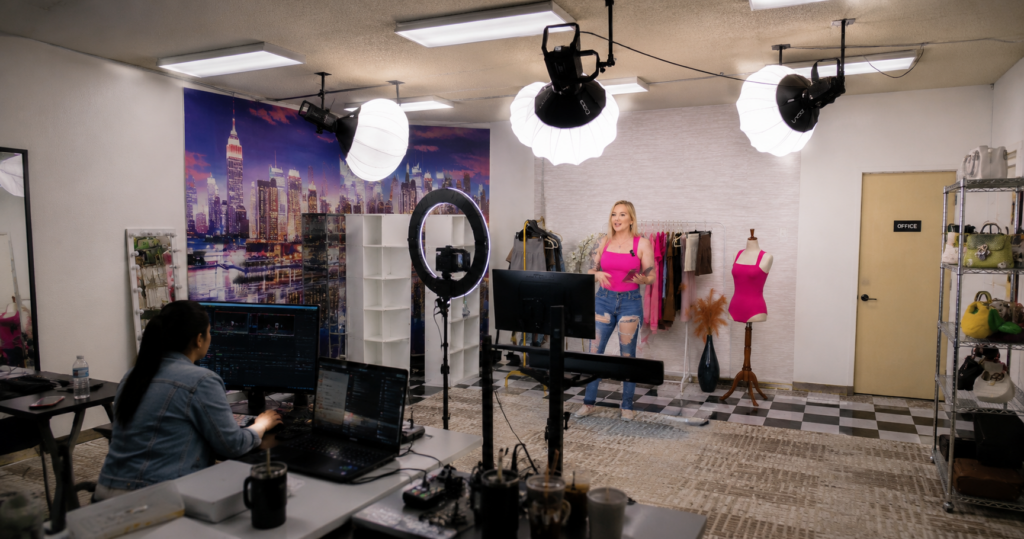
What distinguishes the company’s approach is a methodology borrowed directly from mobile product development: small, fast, low-cost tests before any major budget is committed. The process begins with AI-assisted research, scanning Amazon reviews of a brand and its competitors to extract the purchase motivations and pain points real customers have already articulated. From that analysis, a small set of scripts is built around one or two strong selling points.
Multiple video versions are then shot simultaneously, with variables as granular as background setting, clothing, or hairstyle. As Jing notes, those variables turn out to matter more than most brands expect.
“Sometimes you have a different hairstyle, and the algorithm sends you to a completely different demographic,” he says.
Once a winning creative combination surfaces, ShopliveX scales to creators whose accounts already reach the target audience, then layers in ad spend to amplify results. “We give them the right scripts, the right storyline, the right selling point,” Jing says. “They don’t need to spend their time analyzing what’s good about the product. That’s what they hate about it.”
What TikTok’s Complexity Actually Costs Brands
TikTok Shop remains the center of ShopliveX’s work. Jing describes TikTok as the most advanced player in live commerce infrastructure, having imported architecture already proven at scale through Douyin, its Chinese counterpart. But that sophistication creates its own problem.
“TikTok is so advanced that they have like 500 different features packed in, and you don’t know where to start,” he says.
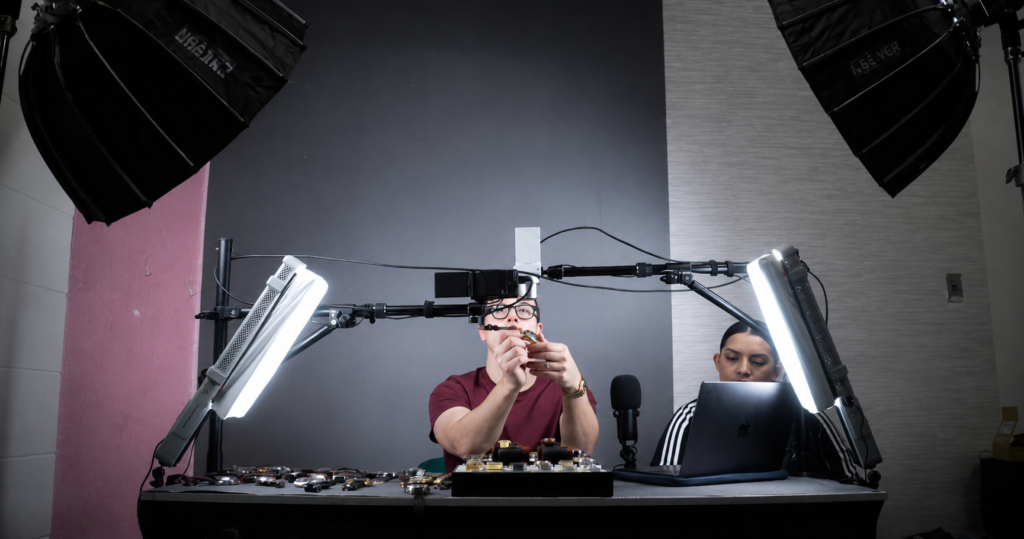
In the free consultation ShopliveX offers, Jing says the most common issue he encounters is operational paralysis: brands that have set up TikTok Shop but cannot navigate what to optimize. For first-timers, he applies the same test-and-simplify philosophy: “Don’t worry about 500 features. Look at these three things to get started. Set a goal, set a milestone, and go.”
For brands already running TikTok Shop, ShopliveX typically finds multiple fixable problems in a single account review. “We call them low-hanging fruit,” Jing says. “A very simple fix can greatly improve their performance.”
He adds that those calls serve a second purpose: every consultation expands ShopliveX’s read on where the market is struggling. “It helps us to broaden our horizon,” he says.
Small Brands Have a Structural Advantage
One of Jing’s recurring arguments is that the format’s immaturity in the U.S. creates a window that smaller brands should take seriously now.
He illustrates this with the example of Queen Cosmetics, a beauty brand he worked with early in ShopliveX’s life: a founder who had hand-produced cosmetics in her apartment, knew her audience from years as a makeup artist, and had a personal origin story that translated naturally into live video. ShopliveX built the brand’s TikTok strategy from scratch, centering content around the founder’s story rather than product features. Queen Cosmetics’ livestreams became among TikTok’s most visible in their category during 2024 and 2025, and the brand has since landed in Ulta Beauty, with additional retail expansion in progress.
The case reflects a pattern Jing sees repeatedly. On TikTok and similar platforms, large marketing budgets do not translate automatically into algorithmic reach. “Even though big brands have big money, they don’t necessarily have an obvious advantage compared to new brands,” he says. “New brands stay humble. They produce more relatable content. They’re nimble. They iterate fast.”
Large retailers, by contrast, face multi-year integration work to connect inventory, logistics, and backend systems to live commerce platforms. Small and mid-sized brands can move now, while the playing field remains relatively level, according to Jing.
Where the Market Goes From Here
The trajectory Jing describes for U.S. live commerce is not modest. In China, livestream shopping has grown to represent a notable share of total e-commerce, with individual livestream channels generating daily sales volumes that rival flagship retail stores. The U.S. is, by his estimate, in the very early stage, with short-form video currently doing the work that livestreaming will eventually take over.
“If you’re talking about livestreams, it’s probably still too early,” Jing says. “If you’re talking about short video, it’s about the right time.”
ShopliveX is positioning itself as infrastructure for that transition. The company holds certified partner status with TikTok and is an official eBay Live partner, though Jing is clear-eyed about what those credentials actually deliver. “The real game-changing thing is working with clients and actually delivering,” he says. “We got the same amount of interest from clients before and after the certification.”
His longer-term thesis rests less on platform allegiance than on the underlying attention shift. Video has captured the hours; commerce follows attention. For brands still waiting to see how live commerce develops in the U.S., Jing offers a direct read on the risk of patience.
The brands scaling on these platforms today are accumulating algorithmic history, creative know-how, and audience relationships that cannot be bought on a compressed timeline. Big companies face a particular liability. “Big brands,” he says, “actually don’t iterate that fast.”
Subscribe to Our Newsletter
Check Out Our Podcast