Creators and brands that reply to comments on their posts consistently outperform those that do not, according to new research from social media management company Buffer. The finding held across all six platforms where reply data was available (Threads, LinkedIn, Instagram, Facebook, X, and Bluesky), making it the most consistent pattern in Buffer‘s “2026 State of Social Media Engagement” report, which analyzed more than 52 million posts published through the platforms.
The Reply Effect
Across nearly two million posts from more than 220,000 accounts, posts with replied-to comments showed measurably higher engagement than posts where comments went unanswered. The estimated lift varied by platform: Threads led at 42%, followed by LinkedIn at 30%, Instagram at 21%, Facebook at 9.5%, X at 8%, and Bluesky at 5%.
Buffer used within-account fixed-effects modeling to compare each account against its own historical performance, rather than against other accounts, to control for differences in audience size and niche. On LinkedIn, 83% of profiles in the dataset performed better on posts where the account replied, the highest share among the platforms studied. On Threads, about two-thirds of accounts showed the same pattern.
The report’s authors note that the causal relationship remains uncertain. “Strong posts attract more comments, which creates more opportunities to reply. And replying to comments drives engagement up,” the report states, while cautioning that the direction of causality cannot be fully established from observational data alone.
Engagement Rates Diverge Across Platforms
The report documents a wide variation in median engagement rates across platforms in 2025. LinkedIn recorded the highest median engagement rate at approximately 6.2%, followed by Facebook at 5.6% and Instagram at 5.46%. TikTok, Pinterest, and Threads clustered in a mid-tier range of 3.6% to 4.6%. X recorded the lowest median engagement rate at approximately 2.5%.
Buffer’s data lead, Julian Winternheimer, cautioned against reading too much into year-over-year movements, particularly X’s 44% relative increase from roughly 2.0% to 2.8%. “The dramatic changes in some metrics, particularly X’s 44% increase, likely reflect changes in the user base or metric definitions rather than genuine performance improvements,” he said in the report. “The composition of accounts changes, which can have a bigger impact on medians than actual platform performance.”
Instagram recorded the sharpest year-over-year decline, falling approximately 26% from a 2024 median of 7.3% to 5.4% in 2025. The report attributes part of that shift to Instagram’s increased emphasis on views as the primary metric for creators, which dilutes traditional engagement-rate calculations. Facebook and Pinterest both posted gains, rising 11% and 23% respectively.
Format Performance Varies Sharply by Platform
The research found that content formats produce markedly different outcomes across platforms, and that strategies effective on one network do not reliably transfer to others.
On LinkedIn, carousel posts submitted as document or PDF files had a median engagement rate of 21.77%, roughly three times that of video (7.35%) and images (6.52%). Text posts (3.18%) and link posts (3.81%) lagged considerably. The report notes that even a below-average LinkedIn carousel performs roughly on par with a typical video or image post.
Instagram presents what the report describes as a split between reach and engagement. A separate analysis of more than four million posts found that Reels generate 36% more reach than carousels, while carousels produce 109% more engagement per person reached than Reels. Single images outperformed Reels on engagement by 34%. The report frames the two formats as serving different strategic purposes: Reels for audience discovery, carousels for deepening engagement with existing followers.
On Facebook, format differences were minimal. Images led with a 5.20% median engagement rate, followed by video at 4.84%, text at 4.76%, and link posts at 4.43%, a spread of less than one percentage point across all formats. On X, text posts led at 3.56%, slightly ahead of images at 3.40%. The report also identified a growing engagement divide on X between Premium and standard accounts, with Premium engagement rates rising and standard account rates declining after January 2025.
Posting Consistency Affects Growth More Than Timing
In a separate frequency analysis of 4.8 million channel-week observations from approximately 161,000 profiles on Facebook, Instagram, and X, Buffer found that accounts that did not post in a given week consistently underperformed their own baseline follower growth rates, a pattern the report calls the “no-post penalty.” Accounts posting just once or twice per week showed meaningful improvement over weeks with no posts, and accounts posting ten or more times per week averaged 32 additional followers per week compared to weeks of inactivity.
The report also identified a tension within the frequency data: while higher posting volume correlates with greater aggregate engagement and follower growth, reach per individual post tends to decline as posting frequency increases. Buffer’s conclusion is that sustainable posting cadence, prioritizing consistency over maximum volume, produces better long-term outcomes.
On timing, the report found no universal best time to post across platforms. It identified higher-performing windows on each network: Facebook posts performed better between 8 and 11 a.m. on weekdays; Instagram between 6 and 9 p.m. on weekdays; LinkedIn between 3 p.m. and 8 p.m. on weekdays; and TikTok between 8 and 11 a.m. on weekends. The report frames timing as an amplifier of existing content quality rather than a primary driver of engagement.
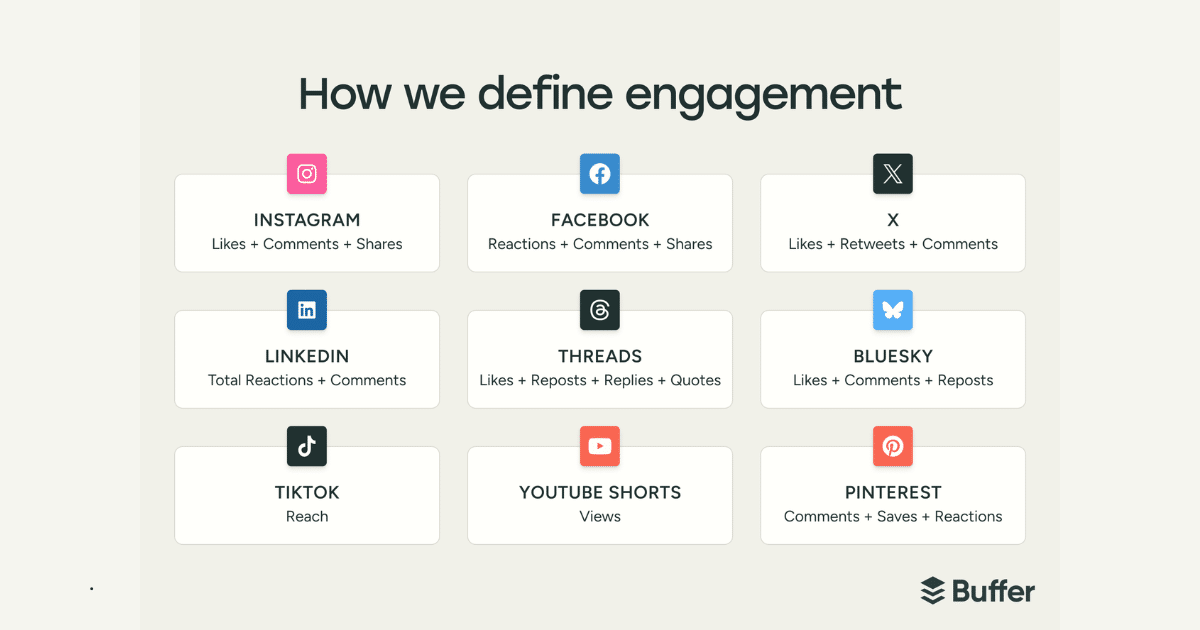
Methodology: Buffer’s analysis drew on posts published through its platform across ten social networks between January and December 2025, with year-over-year comparisons to 2024. The company used median rather than average engagement metrics throughout to account for the skewing effect of viral posts and large accounts. Engagement definitions varied by platform: LinkedIn measured total reactions and comments, including clicks; Instagram counted likes, comments, and shares; Facebook counted reactions, comments, and shares.
Image source: Buffer The full report is available here
David Adler is an entrepreneur and freelance blog post writer who enjoys writing about business, entrepreneurship, travel and the influencer marketing space.

















Creators and brands that reply to comments on their posts consistently outperform those that do not, according to new research from social media management company Buffer. The finding held across all six platforms where reply data was available (Threads, LinkedIn, Instagram, Facebook, X, and Bluesky), making it the most consistent pattern in Buffer‘s “2026 State of Social Media Engagement” report, which analyzed more than 52 million posts published through the platforms.
The Reply Effect
Across nearly two million posts from more than 220,000 accounts, posts with replied-to comments showed measurably higher engagement than posts where comments went unanswered. The estimated lift varied by platform: Threads led at 42%, followed by LinkedIn at 30%, Instagram at 21%, Facebook at 9.5%, X at 8%, and Bluesky at 5%.
Buffer used within-account fixed-effects modeling to compare each account against its own historical performance, rather than against other accounts, to control for differences in audience size and niche. On LinkedIn, 83% of profiles in the dataset performed better on posts where the account replied, the highest share among the platforms studied. On Threads, about two-thirds of accounts showed the same pattern.
The report’s authors note that the causal relationship remains uncertain. “Strong posts attract more comments, which creates more opportunities to reply. And replying to comments drives engagement up,” the report states, while cautioning that the direction of causality cannot be fully established from observational data alone.
Engagement Rates Diverge Across Platforms
The report documents a wide variation in median engagement rates across platforms in 2025. LinkedIn recorded the highest median engagement rate at approximately 6.2%, followed by Facebook at 5.6% and Instagram at 5.46%. TikTok, Pinterest, and Threads clustered in a mid-tier range of 3.6% to 4.6%. X recorded the lowest median engagement rate at approximately 2.5%.
Buffer’s data lead, Julian Winternheimer, cautioned against reading too much into year-over-year movements, particularly X’s 44% relative increase from roughly 2.0% to 2.8%. “The dramatic changes in some metrics, particularly X’s 44% increase, likely reflect changes in the user base or metric definitions rather than genuine performance improvements,” he said in the report. “The composition of accounts changes, which can have a bigger impact on medians than actual platform performance.”
Instagram recorded the sharpest year-over-year decline, falling approximately 26% from a 2024 median of 7.3% to 5.4% in 2025. The report attributes part of that shift to Instagram’s increased emphasis on views as the primary metric for creators, which dilutes traditional engagement-rate calculations. Facebook and Pinterest both posted gains, rising 11% and 23% respectively.
Format Performance Varies Sharply by Platform
The research found that content formats produce markedly different outcomes across platforms, and that strategies effective on one network do not reliably transfer to others.
On LinkedIn, carousel posts submitted as document or PDF files had a median engagement rate of 21.77%, roughly three times that of video (7.35%) and images (6.52%). Text posts (3.18%) and link posts (3.81%) lagged considerably. The report notes that even a below-average LinkedIn carousel performs roughly on par with a typical video or image post.
Instagram presents what the report describes as a split between reach and engagement. A separate analysis of more than four million posts found that Reels generate 36% more reach than carousels, while carousels produce 109% more engagement per person reached than Reels. Single images outperformed Reels on engagement by 34%. The report frames the two formats as serving different strategic purposes: Reels for audience discovery, carousels for deepening engagement with existing followers.
On Facebook, format differences were minimal. Images led with a 5.20% median engagement rate, followed by video at 4.84%, text at 4.76%, and link posts at 4.43%, a spread of less than one percentage point across all formats. On X, text posts led at 3.56%, slightly ahead of images at 3.40%. The report also identified a growing engagement divide on X between Premium and standard accounts, with Premium engagement rates rising and standard account rates declining after January 2025.
Posting Consistency Affects Growth More Than Timing
In a separate frequency analysis of 4.8 million channel-week observations from approximately 161,000 profiles on Facebook, Instagram, and X, Buffer found that accounts that did not post in a given week consistently underperformed their own baseline follower growth rates, a pattern the report calls the “no-post penalty.” Accounts posting just once or twice per week showed meaningful improvement over weeks with no posts, and accounts posting ten or more times per week averaged 32 additional followers per week compared to weeks of inactivity.
The report also identified a tension within the frequency data: while higher posting volume correlates with greater aggregate engagement and follower growth, reach per individual post tends to decline as posting frequency increases. Buffer’s conclusion is that sustainable posting cadence, prioritizing consistency over maximum volume, produces better long-term outcomes.
On timing, the report found no universal best time to post across platforms. It identified higher-performing windows on each network: Facebook posts performed better between 8 and 11 a.m. on weekdays; Instagram between 6 and 9 p.m. on weekdays; LinkedIn between 3 p.m. and 8 p.m. on weekdays; and TikTok between 8 and 11 a.m. on weekends. The report frames timing as an amplifier of existing content quality rather than a primary driver of engagement.
Methodology: Buffer’s analysis drew on posts published through its platform across ten social networks between January and December 2025, with year-over-year comparisons to 2024. The company used median rather than average engagement metrics throughout to account for the skewing effect of viral posts and large accounts. Engagement definitions varied by platform: LinkedIn measured total reactions and comments, including clicks; Instagram counted likes, comments, and shares; Facebook counted reactions, comments, and shares.
Image source: Buffer
The full report is available here
Subscribe to Our Newsletter
Check Out Our Podcast