




Influencer
Rashid Lumunye On Storytelling, Survival, And Why Dubai Is The Future For Creators

Rashid Lumunye (@rashidlumunye) is a Ugandan-born creator and entrepreneur who turned content into a sustainable business model through storytelling, education, and strategy.
When he left his home country for Dubai at age 20, he wasn’t chasing fame. He was looking for an opportunity. What began as a self-taught effort to film short videos with a secondhand smartphone eventually matured into a business, a creator community, and a creator academy.
“I didn’t know anyone when I moved to Dubai,” Rashid says. “Life was hard. I had no degree, no formal background in media. But I had one goal… to become a creator.”
Rashid grew up fascinated by visuals: sketching, filming, and experimenting with cameras. But the path to creative work wasn’t straightforward. “I was supposed to go to university and get my degree in computer technology,” he recalls. “But where I grew up, opportunities were very limited. So I decided to take a shortcut route.”
After moving to Dubai in 2018, his first job wasn’t glamorous: he worked at a veterinary clinic, assisting with daily tasks and handling basic computer operations. Still, the dream of creating content never left him.
During his off-hours, he began teaching himself videography and editing. “I didn’t even know how to use a camera,” he says. “I’d film with my phone, learn from YouTube, and edit late into the night.” After months of practice, he began producing videos for his workplace, managing the company’s social media accounts, and later joined its creative department full-time.
A turning point came when he joined Nas Daily’s production team as a videographer and editor. “That’s when I really understood what being a creator meant,” Rashid says. “Being surrounded by other creators showed me what was possible.”
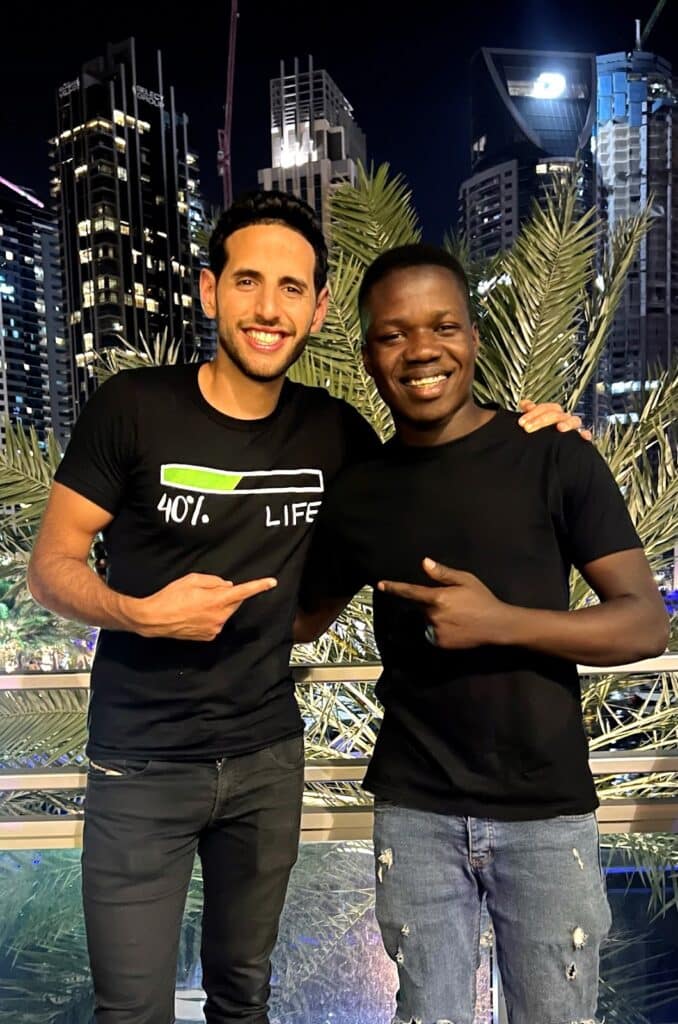
Nas Daily & Rashid Lumunye
Early Content and Inspiration
Rashid’s earliest content was simple: everyday life scenes, short travel clips, and reflections on his experiences in the UAE. “The first proper video I published was me and a friend strolling through a mall in Uganda,” he says. But his ambitions grew, inspired by creators such as Drew Binsky, Nas Daily, and Khalid Al Ameri.
“The way they told stories. That’s what inspired me,” he explains. “I wanted to show the world a different side of Uganda and East Africa. People have biases about where you come from, so I wanted to tell our stories the Ugandan way.”
Those early experiments shaped the storytelling approach that now defines his work. For Rashid, content creation isn’t about camera tricks, but emotional connection. “A good story can make or break your video,” he says. “My most viral video wasn’t even the best edited one. It was a compilation of photos with a strong story behind it. That’s what people remember.”

From Creator to Entrepreneur
As his audience grew, Rashid realized that creating content alone wouldn’t be financially sustainable. Despite achieving viral success – one Facebook video recently drew 2.5 million views – ad revenue was negligible.
“If I show you the revenue from that video, it can’t even take someone on a date,” he says with a laugh. “It’s $200.”
So he built his own business model. Today, Rashid runs two ventures: R-Creative Marketing Management, a content and media brand, and “Video Creator Pro,” a digital content academy where he trains aspiring creators in storytelling and editing.
“I lose money on every video I make,” he says. “That’s why I had to find sustainable ways to earn, not from the platforms, but from my skills.”
R-Creatives launched four months ago and is already working with a mix of personal brands and businesses. “It’s helping clients create and manage social media content,” he explains. “R-Creatives does everything from production and event coverage to full social media management.”
He founded the academy for a different reason: to help creators develop the skills he had once learned alone. “People kept asking me to teach them,” he says. “I realized I could scale that into a program. We teach video editing, storytelling, and general creator growth. But the most important thing is telling a story, not editing.”
Monetization: Building Sustainable Income
Instead of relying on platform payouts, Rashid’s revenue comes primarily from brand partnerships, consulting work, and his educational programs.
“I don’t make money directly from ads,” he says. “I monetize through brands and my community. Every video I post has a call to action that funnels people into my academy or agency.”
This diversification is part of a broader trend across the creator economy, where many influencers are shifting from sponsored posts to structured businesses. For Rashid, it’s both a creative and financial necessity. “If Instagram was paying me $5,000 a month, I wouldn’t have seen the need to start an agency,” he admits. “But creators don’t have sustainable ways to make money directly, so we have to create our own paths.”
Challenges and Lessons Learned
The biggest challenge for Rashid in his early career was a lack of guidance. “I didn’t have mentorship,” he says. “I didn’t know what steps to take to break through.”
That lack of structure forced him to learn every stage of content production through trial and error. Over time, he moved from filming on his phone to leading multi-person production teams. “Back then, it was just me doing everything,” he says. “Now there’s a scriptwriter, videographer, editor, and social media manager for each video.”
Another lesson came from dealing with brands. “Some brands still think you’re just a TikToker,” he says. “They don’t realize how much work goes into a single video, from the writing to the filming to the editing. They forget that this is a business.”
His advice for brands is straightforward: treat creators as professional partners, not hobbyists. “I want to see brands take content creation seriously,” he says. “It should be treated like any other B2B (Business to Business) partnership. There’s a team behind every piece of content.”
The Creator Economy in the Middle East
Rashid believes that Dubai has become one of the most promising hubs for creators. “If you’re a creator, the best place to be right now is Dubai,” he says.
He points to a growing ecosystem of government support and regulation aimed at professionalizing the sector. “Creators now need an advertiser permit to run paid partnerships,” he explains. “It’s free for the first three years as of 2025, and it protects creators from unfair practices. If a brand doesn’t pay you, you can take legal action.”
He also mentions initiatives like the “1 Billion Followers Summit,” which gathers top global creators, including Khabane Lame and Trevor Noah, to share knowledge with emerging talent. “The government supports creators here,” he says. “I even received my golden residency for free because I’m a creator. That doesn’t happen anywhere else.”
This formal recognition, he says, signals the region’s shift from informal content creation to structured creative entrepreneurship. “Being a creator here isn’t just about posting videos anymore,” he says. “It’s a business.”
Defining Success and Looking Ahead
For Rashid, success isn’t measured by followers or profit. “For me, success comes down to impact,” he says. “If I make a video that reaches 100,000 people and 10,000 of them are inspired, that’s success.”
Still, his ambitions are clear. Over the next five years, he plans to expand R Creatives across the Middle East and grow his personal social channels to millions of followers. “I want to scale both my business and my platforms,” he says. “That’s what I’m really working toward.”
His long-term goal is to show aspiring creators that growth starts small. “Not every creator starts with 10 million followers,” he says. “Everything starts from zero. You just build it.”
Rashid’s story, from a self-taught videographer in Uganda to an entrepreneur in Dubai, illustrates how creators are becoming entrepreneurs and educators, reshaping how creative work is valued and sustained.
“The best time to be a creator is now,” Rashid says. “There are more platforms, more users, and more ways to monetize than ever before. You just have to start.”
Subscribe to Our Newsletter
Check Out Our Podcast