





Tech
Most Brands Think They’re Winning on YouTube But Data Shows Otherwise, Says ChannelCrawler’s Jake Kitchiner

YouTube has become the most-watched streaming platform on television screens in the United States, and sponsorship spend on the platform is growing to match. What has not kept pace is brands’ ability to see what that spending looks like across the market.
Jake Kitchiner, co-founder of YouTube creator discovery platform ChannelCrawler, has spent three years watching that gap swallow budgets. His latest effort to close it is a feature he calls Brand Visibility, currently in private beta, that lets brands and agencies track competitor activity on YouTube, including which creators they are working with, how much view volume those partnerships are generating, and how that picture is changing month over month.
A public launch is planned for May 14, alongside a YouTube report examining sponsorship activity by category.
In Jake’s framing, the feature is less a product extension than a response to a specific behavior he kept observing. “Most brands actually have very limited visibility,” he says. “They’re often trying to work out what good looks like, but the bigger problem is that they don’t have a clear view of where they sit versus others, or where the opportunity really is.”
The Blind Spot Has a Structural Cause
Unlike Instagram or TikTok, YouTube does not make competitive activity easy to read, according to Jake. There is no native equivalent to a hashtag search that surfaces relevant brand examples, no standardized pricing benchmark, and no clear signal for how a competitor’s sponsorship program is actually performing versus how it appears.
“You can’t upskill yourself very quickly at all,” he says, “because you just see largely trash when you make a search for a specific hashtag.”
Long-form integrations add another layer of difficulty. On YouTube, a sponsorship is not a post. It is a placement inside a piece of content that requires a production process, negotiated at a price that varies significantly across creators and categories, and measured over a timeline that can take three to six months to show a meaningful return. For brands running lean marketing teams, that combination of complexity and opacity is often enough to push YouTube to the back of the queue.
For B2B brands attempting Influencer Marketing for the first time, the person responsible is often a digital marketer for whom YouTube has simply been added to an existing workload.
“Often, it’s someone who’s just known as the digital marketer, and they’ve just been passed socials and told to try and activate with influencers,” Jake notes, adding that YouTube is harder to start on than anything that person has done before, and the platform offers them almost no help in figuring out how to catch up.
Brands Consistently Misjudge Where They Stand
Of the patterns Jake sees most frequently, one is particularly consistent: brands that believe they understand their competitive position on YouTube are usually wrong, and the error tends to run in one direction.
During a recent conversation with a cryptocurrency brand, the company expressed confidence that it was leading its YouTube category. Brand Visibility data showed it was actually second, and a fair way behind. “That seems to be a common issue,” Jake says.
Jake notes that the misread is often less about overconfidence than about a genuine absence of data. Brands tracking their own creator activity have no straightforward way to see what similar brands are doing in parallel. Without that context, internal performance looks like market performance, and decisions get made accordingly.
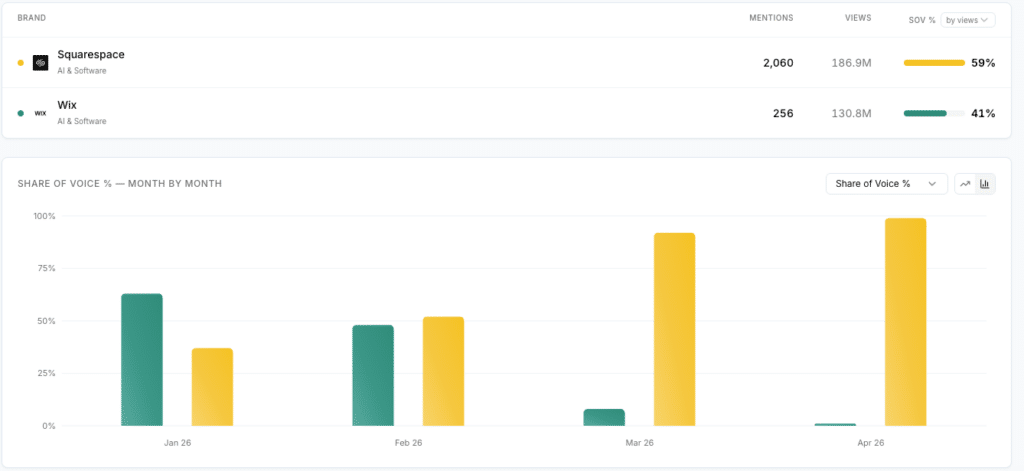
A Squarespace and Wix comparison pulled from the platform illustrates how distorted the picture can get. On raw “Share of Voice,” both brands appeared roughly competitive, at 59% to 41% from January 1 to April 30, 2026. Filtering to long-form creator partnerships only shifted the picture sharply, with Squarespace generating an estimated 26 million views compared to Wix’s 5 million. The gap had been obscured by Wix’s own YouTube channel, which was inflating aggregate figures with self-produced content rather than third-party creator activity.
Partnership Only:

“If I were an agency, I’d be looking at this as Squarespace and saying, aren’t we amazing?” Jake says. “And we’d use AI to show which mentions are paid and which ones are natural integrations or affiliate activity.”
For agencies, he adds, that kind of analysis doubles as prospecting material: a ready-made case study showing a prospective brand client precisely where it sits in the market and what closing the gap could look like.
A Tool Built for Creators That Users Redirected Toward Brands
Brand Visibility did not begin as a competitive intelligence tool. Jake’s original assumption was that the primary use case would be creator-level evaluation: which creators had been repeatedly booked by a brand, which had driven views, and whether that track record justified new investment.
User feedback redirected it. “We found it was fine, like people were quite interested in that,” Jake says, “but really they actually wanted to start searching more from the brand level.”
For agencies in particular, the more pressing question was not which creators to recommend. It was about which brands were actively spending on YouTube and whose programs were growing, so they could make a credible pitch to a prospective client. “It’s easier to convince people to expand on YouTube than it is to start on YouTube,” Jake explains. “You can go to them and say, ‘Here’s where you are now versus your competitors. Here’s what we did for somebody else in your market.’”
The NordVPN and Surfshark data captured during the product walkthrough shows how the competitive layer surfaces decisions that raw activation numbers obscure. NordVPN logged over 5,600 creator mentions in a single month, significantly more than its rivals.
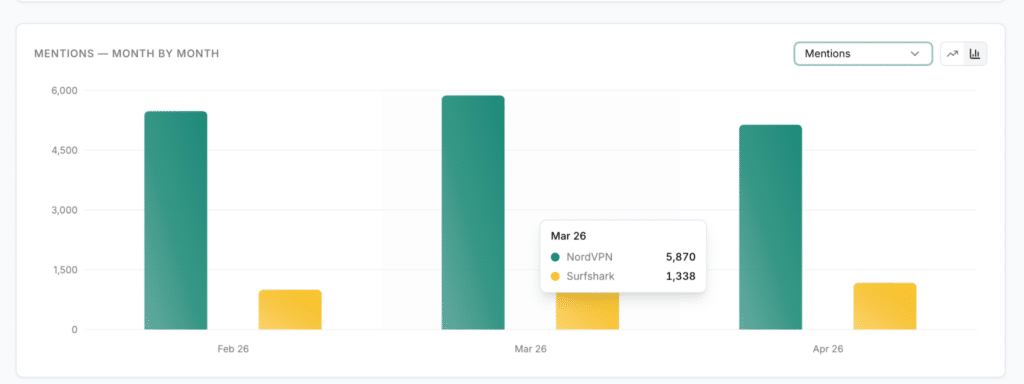

But views per mention told a more complex story. NordVPN’s affiliate program is substantially larger and more accessible than its competitors’, driving much of that volume through smaller channels. According to Jake, that scale is also a function of brand recognition built on YouTube itself: NordVPN is one of the platform’s most established sponsor names, and that familiarity makes creators more willing to affiliate and audiences more likely to convert. Surfshark concentrates its spend on creators generating higher individual view counts, a different strategic bet from a brand that has not yet accumulated the same platform equity.
The two approaches carry different implications for ROI, and raw mention count does not distinguish between them.
The Errors That Precede the Visibility Problem
Better competitive data addresses the brands that have already committed to YouTube. A separate category of errors happens before any of that is relevant, during the first attempts that tend to shape a brand’s entire subsequent posture toward the platform.
According to Jake, the most common is launching an affiliate-only program and treating its limited results as a verdict on YouTube itself. Brands trying to reduce financial risk by offering commission-only deals with no flat fee find that established creators decline, and early respondents are typically untested. “You should look at the other 97 in that hundred that didn’t actually reply to you,” he says, “because it’s not a great opportunity for them.”
The other persistent issue is undervaluing creator output. “They don’t have respect for what the creator does,” Jake says. “People think a 15-minute video may have taken half an hour to make.” Pricing assumptions imported from short-form platforms do not translate, and the resulting offers reflect that.
His baseline recommendation before any outreach begins is a simple value model: what is a view, a click, and a conversion actually worth to the brand? From there, brands can work backwards to determine the maximum they can pay a creator while still hitting a target 2-3x return on investment.
A more sophisticated version layers in persona data, since not all converters carry equal value. Jake cites a creative software brand whose photographer segment converted to higher-tier plans at a significantly better rate than other user types, justifying a higher ceiling for creator spend in that niche.
That framework also protects against a common failure mode: dismissing YouTube after one poor-looking campaign when the real problem was bad setup or bad measurement. Jake says that a brand that tracked only direct revenue from a creator whose content skewed toward awareness was never measuring the right thing to begin with.
Visibility Is One Layer. Pricing and Deal Structure Are the Next
Making competitive activity visible is what Brand Visibility addresses now. What Jake wants to build toward is the layer beneath it.
“Over time, we also want to help customers with pricing benchmarks and free tools around YouTube sponsorship decision-making,” he says, “essentially helping with what comes next after you’ve found creators that fit your brief.”
That roadmap depends on improvements to the underlying data. Much of the platform’s current sponsorship detection relies on links in video descriptions. As ad formats shift toward interchangeable in-video integrations, that signal weakens. Cleaner separation of paid partnerships, affiliate activity, and organic mentions is a problem the team is still working through.
For now, Jake frames the near-term value in terms of the confidence gap it closes. “Suddenly, people feel much more confident about diving into YouTube,” he says. “There’s a lot less guesswork in terms of what you’re supposed to go and do.”
Subscribe to Our Newsletter
Check Out Our Podcast