Tech
Canvas UGC Doesn’t Need Followers. viral.app Is Building the Infrastructure to Run It

What if reaching a million views on TikTok didn’t require any followers at all?
That is the premise behind Canvas UGC, a creator marketing model built on high-volume organic posting by brand-dedicated accounts rather than established audiences. Viral.app, launched in May 2025, was built to manage that infrastructure at scale.
Co-founder Mike Schneider did not come to the Creator Economy through marketing. The Germany-based entrepreneur spent his earlier career in venture capital and Web3 before running into the problem his platform now addresses firsthand. While trying to scale a mobile app on a limited budget in early 2025, he and his co-founder tested organic video content on TikTok and Instagram Reels as an alternative to paid acquisition. The content worked. Managing it at scale did not.
“We looked into a lot of software tools,” Mike says. “Everyone was just focused on: I have a marketplace for creators or influencers, all of these have an existing audience, I search for the fitting one, I ask for one or two videos, I pay them $500 or $5k.” What Mike needed were dozens of brand-dedicated creator accounts posting daily, with per-video tracking and performance-based payouts, none of which existing platforms were built to support.
That mismatch became viral.app, which describes itself as the operating system for high-volume UGC programs. The platform covers the full campaign lifecycle: creator sourcing, contracting, daily content tracking, and global payment compliance.

Follower Counts Are the Wrong Metric
Canvas UGC starts with a new account that has nothing. A creator sets up a dedicated TikTok or Instagram profile for a single brand and posts one to three organic videos per day. No existing audience is required. The formats, hooks, and briefs come from the brand. Viral.app tracks performance on every individual video.
“Followers, at least on TikTok, do not matter that much anymore,” Mike says. “If you have the right formats, the right hooks, and you understand how to design a video which has the potential to go viral, you can go viral with a pretty new account.”
The payment structure reflects that logic. As an example, he says, creators receive a base fee of $10 to $20 per video, deliberately low. The real upside is a performance bonus, typically $100 to $500 when a video reaches 100,000 views, capped between $1,000 and $2,000 regardless of total reach. A video that travels to three million views against a $2,000 cap delivers an effective CPM below $1. A video that stalls at 500 views costs only the base fee. Brands pay proportionally to reach; creators compensated on upside are motivated to optimize every variable in a hook.
The Brand Researches, the Creator Executes
In conventional Influencer Marketing, the creator’s personal credibility and audience relationship are what brands pay for. Canvas UGC inverts that arrangement. “The creator becomes more like an actor to basically test and experiment with ideas, hooks, and formats coming from the creative lead on the brand side,” Mike explains.
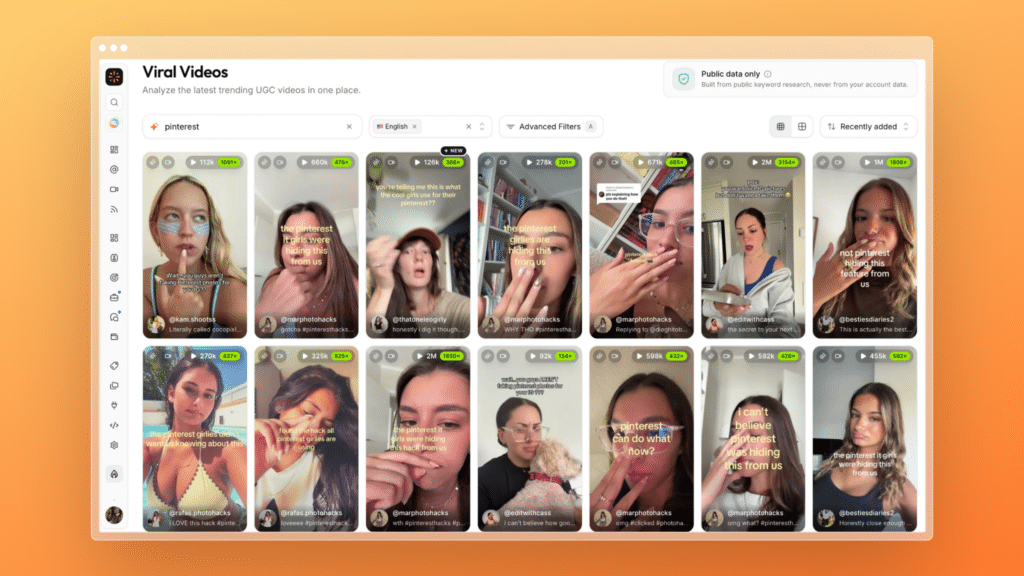
Brands build detailed briefs specifying hook styles and product presentation, drawn from their own analysis of what is currently performing in the organic feed. Creators execute variations. To support that research, viral.app includes a viral video library: daily-sourced TikTok outliers filtered to include only videos gaining substantial views in the previous 24 hours from accounts with low follower counts.
Creators in this system tend to be young, according to Mike, often students using Canvas UGC as a side income source. However, more and more well-established creators & influencers started discovering Canvas UGC. The skill required is not audience-building but the ability to read a format, replicate it convincingly, and present a product naturally enough that the video does not read as a paid promotion. Mike notes that some creators maintain a separate personal presence with a modest following while operating dedicated brand ambassador accounts under a different handle entirely.
Software Products Travel Fastest
Mike highlights software and mobile apps as the clearest fit for Canvas UGC. “Someone is scrolling on TikTok at midnight on the sofa, and the video pops up, solving a problem,” he says. “They can just search for the app in the app store, download it, and you have this reward right away.”
While potentially harder to scale, Canvas UGC can also be an option for DTC brands tapping into the creator potential of their existing customer base. Products with built-in virality have it easier to catch attention in the algorithm. Attribution is a challenge across all categories.
Canvas UGC videos reach audiences in a discovery feed with no trackable click path. Viewers who discover a product organically will often close the app, search independently, and purchase without leaving a traceable signal. “If you run this, it’s hard to go to your CFO and tell them, ‘This campaign drove exactly this amount of sales,'” Mike says. However, brands can monitor spikes in app downloads or web traffic on days when videos trend and then analyze the correlation to infer conversion rates. This is why Canvas & high-volume UGC is often used top-of-funnel to contribute to a wider marketing mix.
Existing Platforms Were Built for a Different Transaction
Most UGC and influencer platforms, according to Mike, were designed for either commission-based payouts tied to paid ad performance, or single-video submissions from vetted creators.
“Most of the established platforms, especially in UGC, are focused on commission performance for paid ads,” Mike says. “It’s less about tracking an organic content campaign end to end and then paying the creators based on the performance all of these hundreds of thousands of videos generate.”
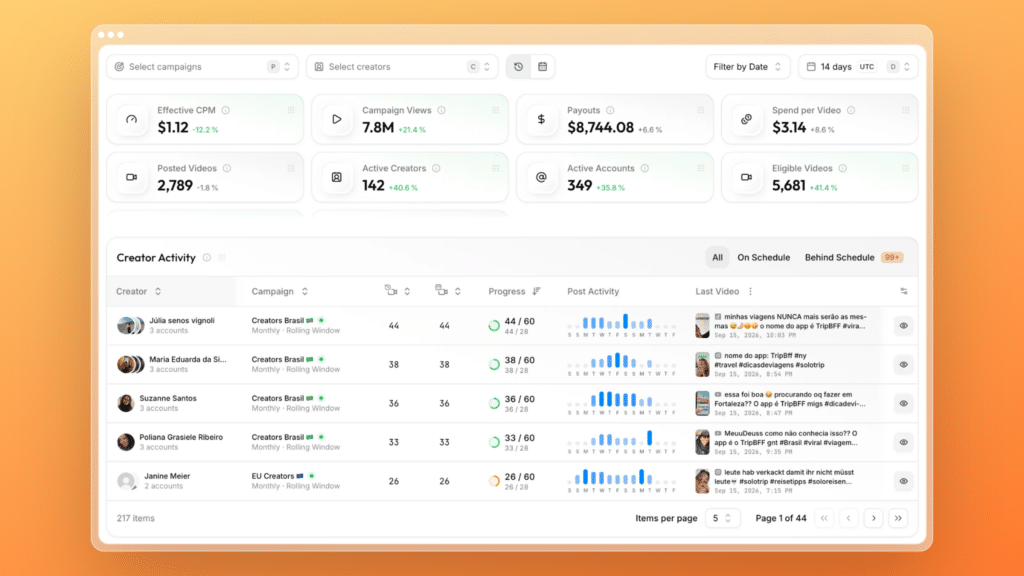
Viral.app’s stack covers creator discovery, contracting, daily organic video tracking without requiring business account connections, and global payouts through an integrated merchant-of-record provider handling currencies, taxes, and invoicing. On top, a developer API lets brands build any custom workflows on top of it. Campaigns typically draw 50 to 100 applicants within one to two days of posting on the marketplace, according to Mike. Getting the brief right, he argues, is where the economics of Canvas UGC succeed or fail. At $10 to $20 per video, a high volume of poorly briefed videos produces stalled content and expensive effective CPMs.
Organic Content Will Get More Important
Canvas UGC’s rise aligns with a platform-level shift Mike believes will accelerate regardless of what individual brands decide. “There’s way more time spent in videos from accounts you are not following compared to the accounts you’re following,” he says. “The most interesting stuff happens in the organic algorithm.”
He expects Instagram to follow TikTok’s path and eventually prioritize the discovery feed over content from followed accounts in its default view. If that shift happens, he notes, follower counts lose value across the platform. Mike also points to premium subscription tiers emerging across social platforms, where users pay to remove ads from their feeds. “The people willing to pay to not see ads are maybe the most interesting people on the platform,” Mike says.
For brands relying entirely on paid distribution, Mike argues that the economics of reaching premium-tier subscribers are likely to worsen as those models expand.
Building for the Transition From Organic to Paid
Viral.app is preparing to release two features in the coming weeks. An AI-first onboarding system will walk new users through campaign setup, brief creation, and performance interpretation without requiring prior familiarity with Canvas UGC. A second tool will identify, among a large pool of organic videos, which ones are most likely to perform as paid partnerships or Spark Ads, and streamline the boosting process with minimal manual steps.
Both features address the same problem Mike identified while scaling his own app: the complexity of running a high-volume organic creator program without dedicated infrastructure.
“It will not end,” Mike says of the algorithmic shift driving discovery content. “It will go even further in this direction.”
Subscribe to Our Newsletter
Check Out Our Podcast