Tech
MAKE Is Building Banking for Creator Income With Fanvue as Its First Flagship Partnership

A creator earning across multiple platforms and currencies is, in the eyes of most traditional banks, a compliance problem. MAKE, a banking platform registered in Anguilla’s special economic zone, is building the infrastructure to change that designation.
Founded by James Francisco Turner Lazaro, a banking industry veteran, MAKE serves what the company calls “modern earners”: digital entrepreneurs, creators, and influencers earning globally across platforms, currencies, and borders. The platform offers instant payouts, payment splits for collaborations, payroll tools, and crypto-compatible accounts, features aimed at a client whose income fluctuates rather than arriving on a fixed monthly schedule.
James Hogg, MAKE’s Director of Private Banking, is helping shape how that model reaches those clients. After six years at Ticketmaster managing client relationships for major Las Vegas venues and entertainment organizations, Hogg joined MAKE in 2024 to lead client-facing operations. The job was not focused on financial credentials; it required the ability to strip jargon from financial conversations.
“We wanted to take out the complexities of banking and turn it into a conversation between two human beings,” Hogg says, “especially at a time when human conversations seem to be more of a premium than ever.”
MAKE’s first flagship partnership embeds its banking capabilities directly into Fanvue, a London-based direct-to-fan platform reporting a $200 million annualized run rate and counting Cardi B, Alisha Lehmann, and Fabrizio Romano among its user base. Creators receiving Fanvue payouts can route them directly into their MAKE account, with no outside application process or delay.
Why Creator Income Gets Flagged Before It Gets Processed
Traditional banks are built around clients with predictable income streams. A salaried professional depositing a fixed monthly figure triggers no alerts. A creator receiving payments from seven different platforms, some based in jurisdictions the bank doesn’t recognize as established financial partners, triggers many.
“Banking problems are only a problem until you know they’re a problem,” Hogg says. “You find out they’re a problem.”
A bank can close or freeze an account without warning because transaction patterns look anomalous to systems built for different customer profiles. Hogg says creators affected by this can be operating normally before a flag suddenly appears, potentially leaving them unable to access funds already deposited.
The classification problem extends beyond irregular income. Crypto earnings, payments from platforms outside established financial networks, and income originating across multiple countries all compound the risk profile in automated systems. “There’s still this misconception that maybe it’s a cash-based industry,” Hogg says, “or that maybe these are nefarious sources of income, illegitimate sources.” That perception, he argues, doesn’t match how the Creator Economy actually functions.
The Fanvue Integration Puts Banking Where Creators Already Are
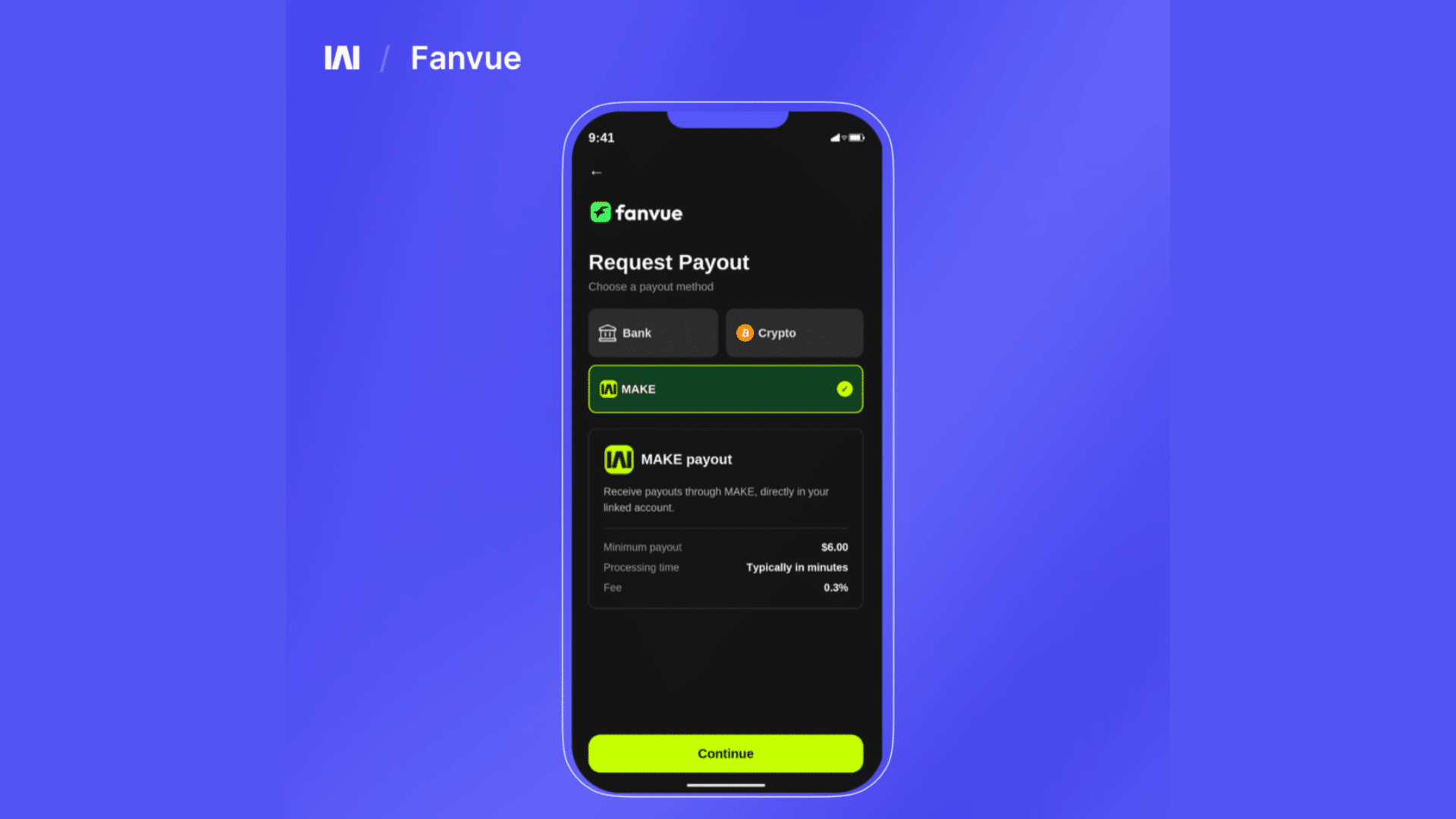
MAKE’s distribution approach is to embed inside platforms creators are already using rather than recruit them toward a standalone financial product. In the Fanvue integration, MAKE appears as a payout option at the moment creators are already managing their earnings.
For MAKE, Fanvue is explicitly a proof-of-concept for the broader integration model. Hogg is clear that MAKE is not structured around a single platform relationship. “Multiple integrations are going to exist with multiple platforms,” he says. “If the unfortunate does happen and one of those platform partners is at risk, there should be a whole litany of different platforms that we’re working with to help mitigate that.”
Success with the Fanvue integration, Hogg says, will be measured two ways: whether the embedded tools function reliably within the Fanvue environment, and whether creators on the platform who might not otherwise have discovered MAKE begin using it.
What Banking Built for Creator Income Actually Provides
Standard business accounts were not built for income that splits multiple ways between a creator, their manager, and a third collaborator. MAKE’s split payment feature handles that directly. Incoming payments can be divided automatically at the point of receipt, so a creator whose agreement allocates a percentage to management doesn’t need to manually transfer funds after each deposit.
Hogg says that instant payouts eliminate the multi-day settlement wait that characterizes most platform disbursements. Payroll tools serve agencies representing multiple creators, allowing those operations to manage outgoing payments the way a conventional employer would. The platform handles transactions across more than 22 currencies and operates in more than 50 countries.
Crypto support is among the capabilities MAKE is building toward, shaped by demand Hogg is already seeing from prospective clients. “A lot of the creators that we’re seeing and working with work a lot in crypto,” he says, “and there’s a lack of understanding in how that money moves and how that can be a legitimate form of payment.”
Income variability and unconventional earning patterns that commonly trigger account flags at traditional banks are treated inside MAKE as expected conditions rather than risk signals. “Whether that’s earning spikes, whether that’s unconventional earning, whether it’s coming from platforms or sources that aren’t necessarily recognized by that bank, there’s no risk of seeing that payment or movement of funds and the account being closed or questioned,” Hogg says.
Building Compliance Before the License Map Expands
Banking licenses are actively being pursued across markets, and Hogg frames the licensing work as one component of a broader trust-building effort. “Think of licensing as a foundation to our business rather than a ceiling,” he says.
The company has spent the past two years building KYC protocols, KYC verification, and a risk management framework designed to handle the account profiles traditional banks typically decline.
“There has been a very meticulous and deliberate process to mitigate the risk for our clients beyond just licensing,” Hogg says. The company is also in the process of recruiting a chief compliance officer, a hire Hogg describes as part of demonstrating to prospective clients that MAKE is building toward institutional standards, even while the formal licensing process continues.
Banking Stability as the Baseline
Hogg’s five-year vision for MAKE is less about any single feature than about resolving the fundamental instability that currently runs through the Creator Economy’s relationship with financial services.
“To be going along day to day thinking that your banking solution is stable and is safe and is catering for you, and then all of a sudden, overnight, to be debanked,” he says. “That’s the big part of what we’re trying to achieve: to take away that fear.”
He sees the current moment as one where institutional frameworks are still catching up to the scale and legitimacy of creator businesses. Traditional banks categorizing digital entrepreneurship as elevated risk reflects a classification system that predates multi-platform, multi-currency income as a standard business model. MAKE is building on the assumption that the categorization won’t hold.
“To empower creators to know that they have a safe, stable, useful banking solution,” Hogg says. “That’s what we’re trying to achieve.”
Subscribe to Our Newsletter
Check Out Our Podcast