







Agency
How Reflect Agency Is Embedding Diversity & Inclusion Into The Infrastructure Of Influencer Marketing

For Jackie Blake, inclusion in influencer marketing is not a creative add-on or a seasonal campaign strategy; it is operational infrastructure. As Group Influencer Marketing Director at UK-based The River Group and Managing Director of Reflect Agency, Jackie oversees how brands integrate diverse and inclusive creators into performance-driven campaigns, without treating representation as a separate or symbolic exercise.
Reflect operates inside The River Group’s wider agency ecosystem, drawing on in-house strategy, creative, social, and insights teams to deliver influencer marketing campaigns that prioritize representation while remaining accountable to brand KPIs. Founded in 2021, the London agency does not represent creators or maintain a talent roster. Instead, it advises brands on how to identify, evaluate, and work with creators from underrepresented communities using the same commercial standards applied across influencer marketing.
“The selection process is no different at all,” Jackie says. “We look at audience, demographics, channel performance, views, reach, engagement levels, and whether the brand’s product or service lands authentically with them.”
That principle – equal rigor, different outcomes – informs Reflect’s business model and explains why the agency has chosen this distinct role in the creator economy at a time when brands are under increasing pressure to show cultural relevance without drifting into performative inclusion.
From Talent Representation to Influencer Infrastructure
Jackie’s career in talent and influencer marketing spans more than three decades. She began in the early 1990s, running a modeling agency in South Africa, managing and developing talent across fashion, beauty, and advertising long before social platforms reshaped how audiences engage with media.
“Towards the end of that tenure, I’d spotted that influencer was on the rise,” she says. “There was a bit of confusion about what influencer was in comparison to models, and a lot of debate around whether they were trying to replace models. And I held up an argument for the fact that they weren’t.”
Rather than resist the shift, Jackie launched an influencer division within her modeling agency, which exposed her to the structural differences between creator-led media and traditional talent representation early on.
“That was when I first started working in the more social digital space with creators and influencers,” she says.
Five years ago, Jackie exited the modeling business and joined The River Group to lead Reflect, an agency concept that had emerged internally during a company-wide innovation exercise.
“It was a Dragon’s Den-style employee challenge during Covid,” Jackie explains. “Reflect was the winning proposition and turned into a real-life business.”
Why Reflect Exists
Jackie describes Reflect as a response to a mismatch between consumer expectations and how brands were executing inclusion in media.
“There was a huge requirement from consumers asking to see themselves reflected in media,” she said. “Yet many brands weren’t embracing it fully, or when they did, it wasn’t always done thoughtfully or authentically.”
Rather than positioning inclusion as a moral imperative, Reflect frames it as a relevance and execution problem. Brands may intend to be inclusive, Jackie says, but lack the internal understanding, processes, or partnerships required to deliver it credibly.
“In my experience, many brands believe they are engaging in inclusive marketing, but in reality, they aren’t fully doing so to the extent they could be,” she says.
That space between intent and execution is where Reflect operates. The agency works with brands to assess existing activity, identify performative patterns, and redesign creator strategies that are commercially viable and culturally grounded.
How Reflect Works With Creators
Unlike traditional influencer agencies, Reflect does not sign creators. Instead, it operates as an advisory and sourcing partner, working through creator agents and existing talent networks.
“We don’t manage or represent creators or influencers ourselves,” Jackie says. “We go about encouraging, sourcing, and securing D&I (Diversity and Inclusion) creators within our client campaigns.”
Jackie believes that structure allows Reflect to remain platform-agnostic and avoid incentives to push specific creators into briefs. It also reinforces her position that inclusive creator marketing should not require a separate evaluation framework.
“The assessment and the method of working with diverse and inclusive influencers is no different from other creators,” she says.
Reflect evaluates creators based on audience fit, brand alignment, content quality, and performance history, while accounting for the structural reality that underrepresented creators often operate in smaller ecosystems.
“The volume of diverse and inclusive influencers is not as large as one would hope,” Jackie notes. “It’s growing, but slowly.”
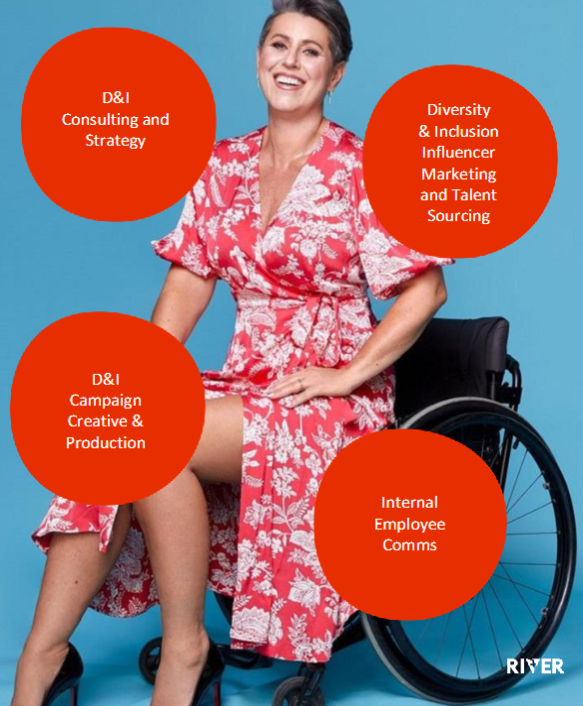
Image source: The River Group
Brand Safety and Shared Risk
For brands hesitant to work outside familiar creator archetypes, Jackie frames brand safety as a mutual responsibility rather than a limiting factor.
“Brand safety is a top priority for everyone,” she says. “It involves doing due diligence on the creator, their tone of voice, language, potential competitive conflicts, and personal stories that could affect the brand.”
She also points out that creators take on risks when partnering with brands: “Creators can be negatively affected by brands as well. It’s a two-way partnership.”
According to Jackie, this approach allows Reflect to guide brands beyond mere risk avoidance toward shared accountability, especially when working with underrepresented communities, where missteps can have “amplified consequences.”
Campaign Outcomes: From Wellness to Fashion Week
Reflect’s work spans sectors, but Jackie highlights two campaigns that illustrate how inclusion and performance intersect.
For Holland & Barrett, a British-based multinational chain of health food shops, Reflect ran a six-month brand ambassador program focused on creators of color, which produced approximately 18 Instagram Reels that generated 4.2 million organic views, according to Jackie.
“We saw a lot of website click-through and product conversions,” she says, noting that specific figures remain confidential.
In fashion, Reflect supported adaptive clothing and disability brand Unhidden, and its founder, Victoria Jenkin, who is also a member of the Reflect shadowboard, during its London Fashion Week debut, helping place disabled and diverse creators on the runway.
“That was one of the most exciting things,” Jackie says. “Getting disabled and D&I influencers onto the catwalk for her very first London Fashion Week runway.”
The moment gained attention not because it was novel, Jackie argues, but because it exposed how long the industry had avoided representation.
“It brought to the forefront the importance of paying attention to those consumers that exist in their hundreds of thousands,” she says.
Tokenism vs. Intentional Inclusion
One of the most persistent challenges Reflect addresses is tokenism, i.e., brands treating representation as a visual checkbox rather than a strategic commitment.
“A good example is Pride,” Jackie says. “Many brands participate from a commercial perspective, but when you look closer, there’s often little meaningful support for those communities.”
Reflect counters this by pushing brands to examine internal culture, employment practices, and long-term commitments, not just campaign output.
“The best change happens within,” Jackie says. “It needs to be lived and breathed every day.”
Campaign Process and Performance Accountability
Reflect’s campaign pipeline typically spans three months, beginning with deep interrogation of the brief and moving through data analysis, inclusive evaluation, and creative recommendations.
Before launch, KPIs are established to ensure performance expectations are realistic.
“If it underperforms, we go through a learning process,” Jackie says. “Why did it underperform? What are the learnings? What do we improve next time?”
In this sense, Reflect positions inclusion as measurable instead of symbolic, integrating test-and-learn cycles common in performance marketing.
Relevance Over Reach
Jackie believes one of the biggest disconnects in brand marketing is an overemphasis on reach at the expense of relevance.
“The brands that really get it right are outwardly focused,” she says. “They’re constantly talking to and about their customers, as opposed to talking about themselves.”
When audiences do not see themselves reflected, Jackie argues, trust erodes. “Engagement goes down. Trust in the brand goes down,” she says.
Creator Strategy in 2026
As brands recalibrate creator strategies in 2026, Jackie believes the most important shift is recognizing creators as partners rather than distribution channels.
“To allow them a greater degree of creative control,” she says, “because that’s how they’ve achieved what they’ve achieved.”
She also anticipates a move away from hyper-realism toward more aspirational creator content, provided brands loosen their grip. “Creators influence and inspire change,” Jackie says. “That’s what they do best.”
As for Reflect, the agency’s priorities for the current year remain consistent. “To continue promoting the message,” Jackie says, “and not let it disappear amongst the noise of business-as-usual.”
For Jackie, inclusion is not a trend cycle to ride out, but a structural correction in how brands engage creators and audiences alike.
“It’s important for people to be seen,” she concludes. “And to be represented in a really authentic way.”
Subscribe to Our Newsletter
Check Out Our Podcast