






Tech
From Printing Press to Podcast to Digital Mind: Delphi CEO on the Next Form of Media

What happens when a creator’s audience grows faster than their capacity to serve it? Fans want access to them specifically, not a team member, not a FAQ page, and there are only so many hours in a day.
Dara Ladjevardian, co-founder and CEO of Delphi, has spent three years building a platform designed to remove that constraint. Delphi allows experts, creators, and public figures to create what Dara calls “a digital version of your mind,” an AI-powered representation trained on their content, capable of answering questions in their voice around the clock. The San Francisco-based company, backed by Sequoia, Founders Fund, and Lux Capital, positions itself not as an AI product but as a new distribution channel for human expertise.
“Delphi is a human product,” Dara says. “We’re human intelligence, which is augmented by AI. AI allows human intelligence to scale, but ultimately the primitive of the product is the human.”
The company launched in November 2022. Its users today span creators, coaches, doctors, consultants, and executives. In Dara’s framing, anyone who is known for a particular thing but faces persistent demand for their time.
The Origin: A Grandfather, a Book, and a Question About Media
Dara did not set out to build a platform for cloning expertise. The origin of Delphi lies in a more personal problem.
When he was running his first startup, Friday, an AI shopping assistant, he found himself isolated and without mentors. He turned to a book written by his grandfather, a successful entrepreneur in Iran before the 1979 revolution. His grandfather had suffered a stroke and could no longer answer questions directly. So Dara fine-tuned an AI model on the book, creating a way to interact with his grandfather’s thinking.
“It wasn’t that it was giving me any unique information I could have gotten from anywhere,” he says. “But I was getting information from someone I trusted. When you hear something from someone you trust, you’re more likely to adopt it.”
That insight reframed how he thought about media. The printing press enabled people to share their thoughts at scale. Radio broadcast voices. Video gave audiences something to watch. Each advance increased reach, but none allowed two-way interaction without the original person’s direct involvement. Delphi, in Dara’s framing, is the next step: scalable reach with the personalization of a conversation.
“There’s no way to interact with someone in a scalable way unless you have their time,” he says. “We started Delphi to let people create a digital version of their mind, very much thinking about it as an evolution of media.”
How the Platform Works
Setting up a Delphi involves connecting existing content: YouTube channels, podcasts, social accounts, Notion documents, and Google Drive files. The platform ingests it automatically and updates when new material appears. Users can also complete an AI-powered interview process that asks structured questions about their thinking, opinions, and experience.
Dara describes the underlying architecture as a proprietary “mind model,” designed to capture not just facts but how someone thinks and how their views change over time.
Two features are central to the company’s operations.
First, data ownership: Delphi does not train its models on user content. “The Creator Economy is deeply concerned about IP being stripped by large language models,” Dara notes. “You own your data.”
Second, guardrails: in strict mode, the platform will not generate responses it has not been trained on, and users can configure what happens when out-of-scope questions come in.
Dara describes Delphi’s function in two modes. For most users, it acts as a “front door,” an interactive profile that fields questions instead of directing visitors to a pile of links. For high-volume creators, Dara adds, it becomes a distribution and monetization layer that captures leads, surfaces insights into audience preferences, and enables upsells.
Three Ways Creators Are Monetizing Their Expertise
The monetization models in use on the platform range from direct revenue generation to audience development tools. Dara is honest about what it takes to reach the high-end.
“We’ve had people who have had million-dollar outcomes,” he says. “But it takes a lot of effort. It’s like publishing a book. You can’t publish one and expect sales if you don’t market it.”
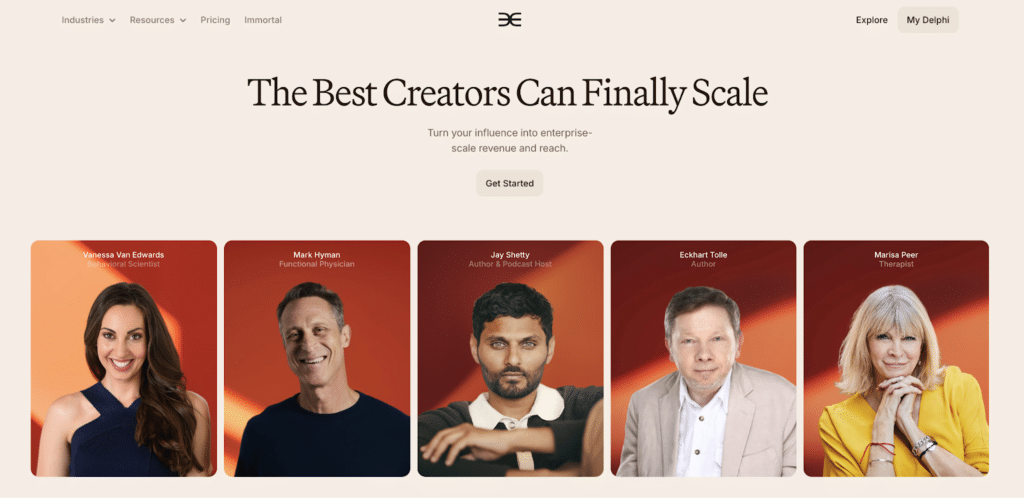
More commonly, creators bundle their Delphi into an existing course or community, adding interactive access to their expertise as part of a subscription. Dating coach Matthew Hussey offers it as a mentorship tool. Spiritual author Eckhart Tolle includes it in a content bundle for his community. Lifestyle entrepreneur and author Lewis Howes uses it as a backend for SMS marketing, enabling a mass-texted audience to receive personalized answers at scale.
The third use is free distribution: creators embed their Delphi as a public-facing interface, capturing curious visitors who would otherwise bounce off a static website and gathering data on the questions their audience is actually asking. That data, Dara argues, is itself valuable for content planning and product development.

Photo: Dara Ladjevardian with Brendon Burchard
Source: Delphi
On Cannibalization and Why In-Person Stays the Premium
The concern Dara hears most often from prospective users is about exclusivity. Creators who have built a business on being hard to reach worry that a digital version of themselves devalues the original.
His answer draws on how analogous products have historically worked. “What we’ve seen is that this increases the strength and trust of the parasocial relationship,” Dara says, “such that they actually want to subscribe to you more because the in-person is the premium. It’s always going to be the premium. Similar to how launching a book increases your value in the market, if it’s a good book, you see the same thing with Delphi.”
Three other objections surface regularly. Users ask what happens to their data, how the platform handles potentially incorrect responses in high-stakes fields like medicine or investing, and whether a digital clone will make them look inauthentic. Dara argues the perception problem is primarily a framing one. “We’re not trying to be deceptive. It’s very much like an artifact. It’s a new way of engaging, the same way a YouTube video is.”
He also notes that resistance often simply reflects unfamiliarity. “Before the printing press, we used to only hear information from each other’s mouths. And then one day, we had to get used to reading someone’s thoughts off a piece of paper. That was probably weird. You see the same thing with Delphi. It’s just a new way of content consumption.”
Discovery, Brands, and the Bigger Bet
Delphi’s near-term roadmap includes API (Application Programming Interface) and MCP (Model Context Protocol) integrations for developers building custom products on the platform, improved insights tools that surface patterns across thousands of conversations, and brand partnership mechanics that would allow sponsors to appear contextually within creator conversations.
The longer-term bet is on discovery. Dara describes the current system for finding relevant creators as outdated, driven by follower counts and algorithmic surfaces that do not reliably match the right expert to a given moment in someone’s life.
“We want to invest in a discovery platform where, based on your conversations, we can proactively recommend the best minds in the world capable of helping you with your specific situation,” he says. For creators, that would mean access to new audiences they could not reach through Instagram or TikTok, platforms where, as Dara notes, creators do not fully own or control their audience data.
The company’s foundational premise is simpler and harder to prove: that as AI commoditizes information, what people will continue to seek is expertise they trust, delivered by humans they recognize.
“Even when artificial general intelligence comes,” Dara says, “humans still matter, and we care about what other humans have to say. If that’s not true, Delphi doesn’t succeed. But I don’t think it’s going to be true.”
Subscribe to Our Newsletter
Check Out Our Podcast