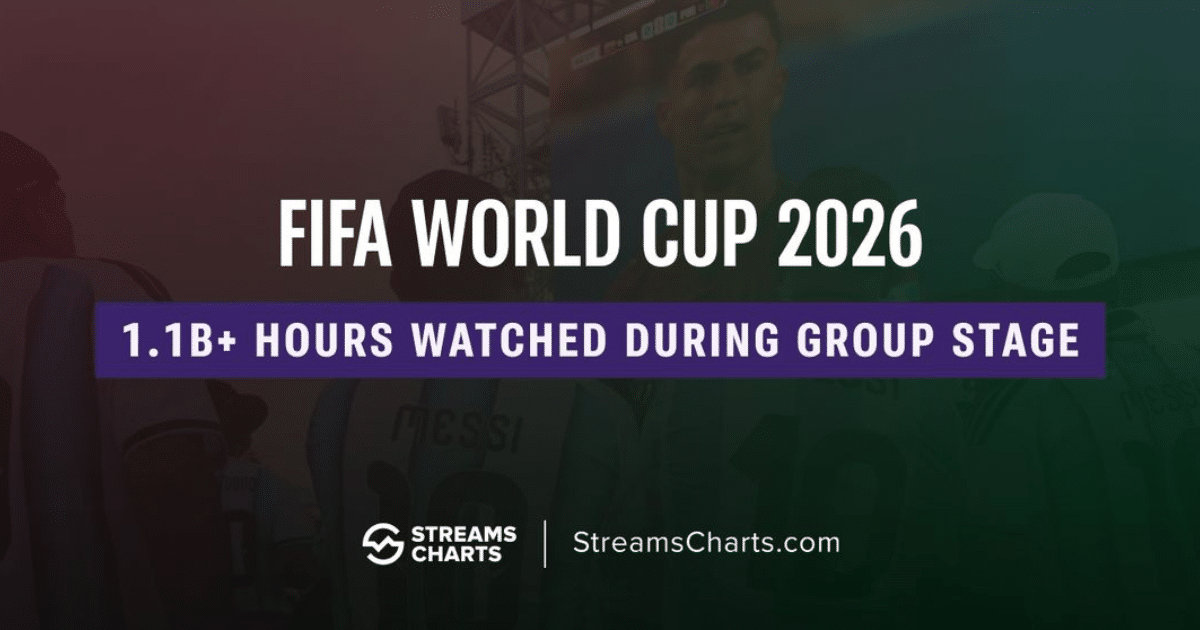
Livestreaming tied to the FIFA World Cup 2026 drove more than 1.1 billion Hours Watched during the tournament’s Group Stage, according to a new report from Streams Charts.
The figure, covering June 11 through June 29, spans licensed match broadcasts as well as watch-alongs, live commentary, simulation streams and other tournament content produced across the platforms the firm tracks. The analysis excludes linear television viewing and any proprietary streaming services outside Streams Charts’ tracking scope.
YouTube generated more than 1 billion Hours Watched on its own, representing 94.3% of all tracked World Cup-related viewing during the Group Stage. The platform’s average concurrent viewership during the tournament rose 14.5%, an increase of more than a million viewers, compared with the year’s first five and a half months, with much of that growth concentrated in Brazil, Africa, and Southeast Asia.
Regional Platforms Hit New Records, Twitch Viewership Falls
YouTube’s strongest World Cup activity came out of Brazil, where coverage from Casimiro Miguel’s channel, CazéTV, drove the platform to multiple new all-time peak viewership marks during matches involving the Brazilian national team.
South Korea showed a similar trend on its domestic platforms. CHZZK, operated by Naver, and SOOP each saw average viewership climb substantially, with local audiences tuning into both licensed coverage and creator-led streams. CHZZK set a new platform record during the Group Stage, reaching more than 4.9 million Peak Viewers and surpassing Kick’s all-time high of 4.6 million, even though CHZZK’s audience is concentrated primarily within South Korea.
Twitch saw the opposite trend, with average viewership on the platform falling more than 7.5% versus the pre-tournament period. Streams Charts links the decline to fewer licensed match broadcasts being available on Twitch, where World Cup-related activity leaned heavily on creator commentary and community coverage instead of the matches themselves.
Licensed Coverage Varied Sharply by Market
Just under 70% of total World Cup watch time came from streams airing during live matches, a category that includes licensed broadcasts, commentary, watch-alongs, watch parties, and simulation streams. The other 30% came from surrounding coverage such as previews, post-match analysis, press conferences, interviews, and recaps, much of it produced by major media outlets alongside community and IRL streamers.
Streams Charts identified no licensed live match broadcasts on its tracked platforms for the United States, Mexico, or Argentina during the Group Stage. As a result, the audiences it measured in those markets came entirely from commentary, watch-alongs, simulations, and other community-driven content. The firm notes this doesn’t necessarily mean those markets lack rights holders: coverage may be running on television or proprietary services outside its tracking scope, or simply hasn’t gone live yet on the platforms it tracks. It cites Darren “iShowSpeed” Watkins Jr. as one example. Streams Charts says that the picture could change in the knockout stage if more rights holders start streaming coverage on public platforms.
Licensed coverage was dominant elsewhere. In Brazil and South Korea, the two largest markets by World Cup-related watch time, licensed streams made up more than 65% of total Hours Watched in each. Colombia, Nigeria, and Qatar showed the same pattern, with licensed rights holders accounting for most of the tracked audience in each.
Sponsor Chat Activity Was Uneven, and Betano Was an Outlier
Streams Charts tracked mixed changes in chat mentions of official World Cup sponsors during the Group Stage, based on activity across YouTube, Twitch, and Kick. The firm cautions that the figures reflect how often audiences talked about a brand, not a direct measure of on-screen exposure, sponsorship value or campaign performance.
Coca-Cola, Visa, and Adidas each saw their share of tracked chat mentions rise between 5% and 15% compared with the pre-tournament period, while McDonald’s, Hyundai, Kia, Hisense, and Aramco recorded declines. Brands with long histories in football sponsorship, including Adidas and Coca-Cola, showed some of the strongest chat activity, though Streams Charts says the pattern wasn’t consistent across every sponsor or platform.
Betano’s case looked different. The betting brand saw a sharp jump in chat mentions during the Group Stage, which Streams Charts traces largely to creator-led affiliate campaigns rather than sponsorship exposure, as creators and viewers repeatedly shared referral links and promotional posts, especially on Kick. Streams Charts frames it as a broader caution about chat-based metrics: a spike in mentions can reflect coordinated promotion as easily as organic interest.
Image source: Streams Charts The full report is available here
Dragomir is a Serbian freelance blog writer and translator. He is passionate about covering insightful stories and exploring topics such as influencer marketing, the creator economy, technology, business, and cyber fraud.








Livestreaming tied to the FIFA World Cup 2026 drove more than 1.1 billion Hours Watched during the tournament’s Group Stage, according to a new report from Streams Charts.
The figure, covering June 11 through June 29, spans licensed match broadcasts as well as watch-alongs, live commentary, simulation streams and other tournament content produced across the platforms the firm tracks. The analysis excludes linear television viewing and any proprietary streaming services outside Streams Charts’ tracking scope.
YouTube generated more than 1 billion Hours Watched on its own, representing 94.3% of all tracked World Cup-related viewing during the Group Stage. The platform’s average concurrent viewership during the tournament rose 14.5%, an increase of more than a million viewers, compared with the year’s first five and a half months, with much of that growth concentrated in Brazil, Africa, and Southeast Asia.
Regional Platforms Hit New Records, Twitch Viewership Falls
YouTube’s strongest World Cup activity came out of Brazil, where coverage from Casimiro Miguel’s channel, CazéTV, drove the platform to multiple new all-time peak viewership marks during matches involving the Brazilian national team.
South Korea showed a similar trend on its domestic platforms. CHZZK, operated by Naver, and SOOP each saw average viewership climb substantially, with local audiences tuning into both licensed coverage and creator-led streams. CHZZK set a new platform record during the Group Stage, reaching more than 4.9 million Peak Viewers and surpassing Kick’s all-time high of 4.6 million, even though CHZZK’s audience is concentrated primarily within South Korea.
Twitch saw the opposite trend, with average viewership on the platform falling more than 7.5% versus the pre-tournament period. Streams Charts links the decline to fewer licensed match broadcasts being available on Twitch, where World Cup-related activity leaned heavily on creator commentary and community coverage instead of the matches themselves.
Licensed Coverage Varied Sharply by Market
Just under 70% of total World Cup watch time came from streams airing during live matches, a category that includes licensed broadcasts, commentary, watch-alongs, watch parties, and simulation streams. The other 30% came from surrounding coverage such as previews, post-match analysis, press conferences, interviews, and recaps, much of it produced by major media outlets alongside community and IRL streamers.
Streams Charts identified no licensed live match broadcasts on its tracked platforms for the United States, Mexico, or Argentina during the Group Stage. As a result, the audiences it measured in those markets came entirely from commentary, watch-alongs, simulations, and other community-driven content. The firm notes this doesn’t necessarily mean those markets lack rights holders: coverage may be running on television or proprietary services outside its tracking scope, or simply hasn’t gone live yet on the platforms it tracks. It cites Darren “iShowSpeed” Watkins Jr. as one example. Streams Charts says that the picture could change in the knockout stage if more rights holders start streaming coverage on public platforms.
Licensed coverage was dominant elsewhere. In Brazil and South Korea, the two largest markets by World Cup-related watch time, licensed streams made up more than 65% of total Hours Watched in each. Colombia, Nigeria, and Qatar showed the same pattern, with licensed rights holders accounting for most of the tracked audience in each.
Sponsor Chat Activity Was Uneven, and Betano Was an Outlier
Streams Charts tracked mixed changes in chat mentions of official World Cup sponsors during the Group Stage, based on activity across YouTube, Twitch, and Kick. The firm cautions that the figures reflect how often audiences talked about a brand, not a direct measure of on-screen exposure, sponsorship value or campaign performance.
Coca-Cola, Visa, and Adidas each saw their share of tracked chat mentions rise between 5% and 15% compared with the pre-tournament period, while McDonald’s, Hyundai, Kia, Hisense, and Aramco recorded declines. Brands with long histories in football sponsorship, including Adidas and Coca-Cola, showed some of the strongest chat activity, though Streams Charts says the pattern wasn’t consistent across every sponsor or platform.
Betano’s case looked different. The betting brand saw a sharp jump in chat mentions during the Group Stage, which Streams Charts traces largely to creator-led affiliate campaigns rather than sponsorship exposure, as creators and viewers repeatedly shared referral links and promotional posts, especially on Kick. Streams Charts frames it as a broader caution about chat-based metrics: a spike in mentions can reflect coordinated promotion as easily as organic interest.
Image source: Streams Charts
The full report is available here
Subscribe to Our Newsletter
Check Out Our Podcast