







Agency
Digital Voices Founder Jennifer Quigley-Jones on Why She Sold: Indie Influencer Agencies Are Running Out of Road

Influencer Marketing has moved from a test budget to a core media channel. According to Jennifer Quigley-Jones, that shift is precisely why the agencies that built this industry on scrappiness and creativity can no longer survive on those qualities alone.
Jennifer founded Digital Voices in London in 2017 with a £500 personal investment and a conviction that the industry was misreading YouTube. Nine years later, she sold the Influencer Marketing agency to PMG, a global independent marketing services and technology company, in a deal announced in January 2026.
The move completed a growth arc that took Digital Voices from a one-person freelance operation to a 70-person agency with offices in London, New York, and Costa Rica, running campaigns for Adobe, Unilever, DoorDash, and General Mills across 40 markets and 19 languages. It also gave Jennifer a platform to pursue what she sees as the industry’s next phase: integrating creator media with performance infrastructure at scale.
“The space for independent agencies is really going to be squeezed,” Jennifer says. “Brands are seeing stronger results from integrating media and influencer. They really need tech and scale.”
From YouTube Gap to Global Campaigns
Digital Voices did not begin as a broad influencer agency. It began as a collective.
Jennifer had spent 18 months at YouTube as a Strategic Partner Manager, advising UK and Ireland creators on audience growth. From that vantage point, she watched brand budgets flow almost exclusively to Facebook and Instagram. YouTube creators, who commanded significantly higher engagement because audiences spent 20 minutes watching them rather than scrolling past, were being largely ignored.
“On YouTube, you search their name, you truly follow them,” Jennifer says. “So they have higher engagement.” Beyond reach, she also observed that Influencer Marketing was being treated primarily as an awareness vehicle, with little attention to driving actual sales.
She left YouTube in 2017, spent nine uncomfortable months freelancing, then reinvested the Rolls-Royce campaign budget to hire a team. Digital Voices was born.
For two years, the agency operated as a YouTube specialist. Then Jennifer recognized the constraint. The same creators she worked with on YouTube were also active on Instagram and TikTok. Refusing to follow them across platforms was leaving campaigns incomplete and growth on the table.
“We were too specialized, if I’m honest,” Jennifer says of the early focus. The expansion into a full multi-platform agency accelerated both client wins and revenue, including 500% year-over-year growth in 2020, when COVID shuttered traditional production and forced brands to redirect budgets toward creator-led content.
Data as Armor
From the outset, Jennifer built Digital Voices around a guaranteed results model. That decision was partly pragmatic, partly structural.
In a new and unproven channel, clients needed reassurance. “You’re seen as a new media format that people are testing,” she explains. “You have to prove it works because you want the people who take a risk on you to get rewarded.”
The model worked simply: if Digital Voices underperformed on a campaign, the agency fee portion would either fund additional creator content or be returned to the client. “We don’t make money if we don’t get good results,” Jennifer says.
There was a second, less-discussed dimension to the data emphasis. As a young female founder in a nascent industry, Jennifer faced a specific kind of skepticism: the assumption that her agency was primarily creative, talent-adjacent, and soft. “You’re told as a woman, ‘You must be so creative, you must just love being close to talent,'” she says. “And you have to combat that by being like, ‘No, I love the data. I love building a business that scales.’”
That drive to prove the channel worked commercially led to what Jennifer describes as justifying three things at once: an entire new media format, her own business, and her position as an entrepreneur in an industry that did not yet have many people who looked like her.
The Double Bet
Roughly five years into the business, Jennifer reveals she had accumulated $1.2 million in retained profit. Her CFO presented it as a moment to take money off the table. Jennifer treated it as a deployment window.
She allocated half to opening a U.S. office and half to building proprietary technology, both simultaneously. “She was like, ‘This was not the point of the conversation,'” Jennifer recalls of her CFO’s reaction.
The U.S. move proved immediately material. American clients expected agencies to operate on the ground. “People love an in-person meeting in America,” Jennifer says. “They love seeing a founder hustling.” By 2025, the U.S. accounted for 50% of Digital Voices’ revenue.
The technology investment led to the development of two internal platforms. Chord, Digital Voices’ campaign management system, allows clients to approve creators, review content, and access reporting in a single interface. Composer applies nine years of historical campaign data through AI to generate performance benchmarks and predictive insights, surfacing which content formats and creator categories outperform for a given campaign objective.
“In the U.S., the expectation is that you have tech,” Jennifer explains. “If we said no, they cut you out of the room.” Building both simultaneously also changed how the company thought about operations, pushing the team toward efficiency, data collection, and global coordination.
Why PMG, and Why Now
In July 2025, Digital Voices formally opened an acquisition process. Fifty-one parties signed NDAs. Several were removed from Jennifer’s list early. By October, PMG had moved to the front.
PMG, a Dallas-based independent marketing services and technology company, had built a small in-house influencer team and was seeking a specialist partner to scale that capability. The firm operates through Alli, a proprietary marketing operating system, employs over 1,000 people globally, and counts Apple, Sephora, and Whole Foods among its clients.
For Jennifer, three factors separated PMG from the field. The first was technological ambition. “They have over 250 engineers,” she says. “What do you want to build? That was so interesting because we’d always built tech from the perspective of bootstrapping.”
The second was media integration. Jennifer sees creator-paid ads as the next structural shift, where creator-produced assets are deployed with the same targeting precision as traditional media. “Brands did a lot of tests in 2025 that showed creator assets outperform brand assets,” she says. “But we haven’t got to the sophistication where those assets have hierarchies based on customer personas, localization, and platform positioning.”
The third factor was culture. Jennifer describes a specific moment in PMG’s offices when she watched CEO George Popstefanov stop a management meeting to push back on a self-deprecating remark from one of her senior leaders. “He said, ‘I know how much money you’ve had to build this tool. You should be really proud. Don’t talk about your work that way.'” That observation settled the decision.
During the process, one unnamed party told Jennifer that at their level, they didn’t know clients’ names and didn’t expect her to either. “That was the moment I decided not to go with them,” she says.
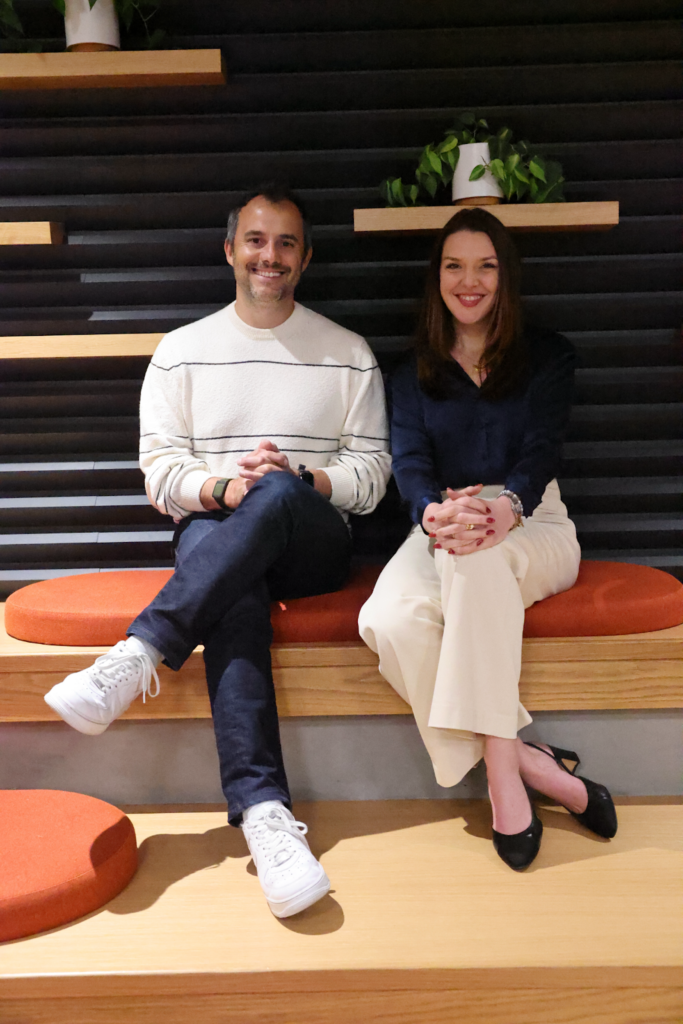
Photo: PMG CEO George Popstefanov & Jennifer Quiqley-Jones
The End of the Independent Middle
Jennifer’s assessment of where the industry leaves independent influencer agencies is direct. She believes that the window that allowed Digital Voices, Influencer.com, Whalar, and Billion Dollar Boy to grow as creative-first independents is narrowing.
“I love the stories of those journeys, but sadly, I don’t know if we’re going to have an environment that allows an agency like that to grow again in the same way,” she says.
According to Jennifer, brands increasingly expect influencer to integrate with media, affiliate, PR, and experiential. Building proprietary technology remains expensive and expertise-dependent, regardless of how accessible AI tooling has become. Without tech infrastructure, agencies cannot deliver the measurement and efficiency that growing budgets now demand.
“If you’re doing it manually without tech tools, you won’t be able to show the measurement impact, you won’t be able to brief creators at scale, you won’t be able to do reporting effectively,” Jennifer says.
She sees room for AI-powered influencer platforms and agentic AI agencies. But for the human-led, mid-sized independent that grew through the last decade on creativity and relationships alone, the pressure is intensifying.
Proving It at Scale
The stakes behind Jennifer’s argument are not only commercial. With Unilever’s CEO publicly committing to directing 50% of media spend toward social channels and expanding Influencer Marketing, the Creator Economy is no longer competing for experimental line items.
“When Influencer Marketing was in the test budget, and you were getting like maybe a $50,000 campaign, no one was really expecting you to measure,” Jennifer says. “But now you’re the core of a brand’s messaging. If you can’t prove it’s effective, it will get cut next year.”
That proof burden extends beyond clients. Jennifer estimates there are 50 million creators globally whose livelihoods depend on the industry continuing to attract investment. Many, she notes, found in the Creator Economy a form of visibility traditional media never offered: hair care creators, people with disabilities, single parents building independent livelihoods.
“We’re building an entire economy that didn’t exist before,” she says. “And I see the responsibility for proving it works not just to the client, but to this huge industry that doesn’t exist if you don’t get it right.”
As part of PMG, Jennifer plans to build out the creator paid ads ecosystem, deepen Chord and Composer’s integration with the Alli platform (PMG’s proprietary marketing operating system), and focus on industry education. She will shortly give a talk at Oxford on what CMOs need to understand about Influencer Marketing.
“We are going to spend a lot of time educating the industry,” she says, “and making people see influencer in a more professional lens.”