Larry King asked questions on CNN for twenty-five years, and he prepared for almost none of them. He was proud of this. “I never learned anything while I was talking,” he liked to say, and the not-knowing was the method: no pre-reads, no ambush, no follow-up sharp enough to make a powerful guest regret the booking. He gave the psychic Sylvia Browne a regular national platform to promote her books and take calls from the grieving. He lobbed underhand pitches to presidents, faith healers, and diet doctors alike, and in his final years he fronted paid infomercials for supplements. For this body of work he received a Peabody Award, an unbroken prime-time franchise, and, when he died in 2021, obituaries warm enough that a reader could forget anyone had ever objected.
Steven Barlett Interview w/ Ray Dalio
Steven Bartlett does a recognizable version of the same job. He sits across from people with strong convictions, asks open questions, challenges almost nothing, and lets the guest be the product. For this he has been called, in a national newspaper this July, “the Pied Piper of bullshit.” A BBC investigation in December 2024 counted an average of fourteen harmful health claims per episode across a sample of his health interviews. Joe Rogan, who holds the American version of the chair, spent early 2022 watching Neil Young pull his catalog from Spotify in protest and 270 doctors, scientists, and healthcare workers sign an open letter about his show. The two most listened-to interviewers alive operate under a level of published hostility that King never experienced in a quarter century of doing, almost, the same thing.
King owned almost nothing. CNN owned the distribution, the bookers, and the credibility; King asked the questions and drew a salary. Every news-network chair worked on those terms, Cronkite’s and Wallace’s included.
Winfrey aired the same kind of content the new hosts are attacked for, and got attacked for it first. She introduced America to Dr. Phil and Dr. Oz, gave The Secret its rocket fuel, and hosted celebrity vaccine skepticism years before it had a podcast to live on. The columnists of the late 1980s filed her genre under trash television. The attacks stopped, and they stopped for two reasons: her numbers were enormous, and after 1988 she owned the show outright through Harpo Productions, the thing King never did. The talk show made many people famous. It made exactly one of its hosts a billionaire, and the difference was not talent. It was title. By the time the criticism might have mattered, she owned the building it would have been mailed to.
King proved the interview chair, filled with pure curiosity and zero judgment, could out-rate almost anything a news division produced. Winfrey proved the chair’s value belonged to the person in it, not the institution around it, and that owning it converted fame into capital. The creator economy did not invent either lesson. It democratized them.
The heirs
Rogan is King’s scale without King’s landlord. His show moved to Spotify in 2020 in a licensing deal reported at $200 million, then renewed in 2024 in a multi-platform arrangement reported at up to $250 million, and by Edison Research’s measurement it has been the most listened-to podcast in the United States for years without interruption. No network built this. A comedian with a laptop built it, episode by episode, over sixteen years.
Bartlett is Winfrey’s ownership model at internet speed. The Diary of a CEO began in 2017 as a memoir in podcast form and is now, by the i Paper’s own reckoning, “on the cusp of overtaking Joe Rogan to become the world’s No 1 podcast,” with a YouTube channel of 18.3 million subscribers reported to be adding 900,000 a month. Bartlett told The Times he expected the show to make £20 million in 2024, mainly from advertising. But the show is the smallest piece of the business. Like Winfrey, he converts the chair into equity: a production company in FlightStory, a software product in FlightCast, a fund, and, as Net Influencer reported, co-ownership of the creator commerce platform Stan, taken at the point the company had reached $30 million in annual recurring revenue and $300 million in merchandise value. Winfrey needed two decades and a syndication lawyer to turn her chair into a balance sheet. Bartlett did it before his fortieth birthday, in public, while narrating the process as content.
Inside the industry, none of this is contested. “I look at Steven Bartlett with Diary of the CEO and his media company,” Monica Khan, a former YouTube and Meta executive who now runs Creator Revolution, told Net Influencer. “They won’t necessarily be dependent on some of these gatekeepers in the traditional side. If he wants to launch a documentary, okay, maybe he could just go do that himself. What does he need any of these other channels for?” Bryan Smiley, the former Hartbeat president who now runs Hard Carry Media, states the same point as a general law: “If you have a robust, engaged audience, you can build a substantial business, and you can do that without having to leverage the old school media gatekeepers.” Talent managers make the point in the past tense, that a celebrity once had to go through a gatekeeper and no longer does, and the dealmakers have moved on to valuation, sizing up catalogs like Rogan’s the way studios once sized up film libraries.
Pete Buttigieg on the Flagrant Podcast
And the guests have noticed. In June 2026, a sitting American vice president flew to a podcast studio to give JD Vance’s account of a live foreign crisis to Steven Bartlett. Two years earlier, Donald Trump sat for Rogan and drew 26 million views on YouTube in a day, while Kamala Harris’s campaign negotiated for the same chair and could not close the booking. A senior adviser later blamed fear of a backlash from progressive staff; Harris put it more simply in her memoir: “I regret that we didn’t do it.” The lesson took. The Democrats now maneuvering toward 2028 are working the circuit she skipped: Pete Buttigieg sat for nearly three hours on Flagrant and wrote afterward that his party “must examine not only what we have to say, but how and where we say it,” Gavin Newsom stopped renting chairs and launched his own show, and when a Texas Democrat named James Talarico sat for Rogan in July 2025, Rogan told him to run for president. For half a century, the measure of an interview franchise was who would sit for it. By that measure, the two most important chairs in the English-speaking world are no longer inside a network. Media did not lose the interview. The interview left.
The reception
The objections themselves have a shape, and the shape starts with who is making them.
The July piece calling Bartlett a conduit for misinformation ran stuffed behind an paywall, written by a critic who is himself a podcast producer. The BBC’s investigation was produced by its disinformation desk while, elsewhere in the same building, the corporation kept Bartlett under contract as a prime-time Dragon on Dragons’ Den, a fact the investigation’s own subjects gently note. The piece itself concedes that Bartlett “seems insulated from censure.”
The BBC measured Bartlett against the accuracy standards of a broadcaster. The regulation case measures podcasting against the obligations of a licensed medium. The misinformation count treats an unchallenged guest as a failure of journalism. All three require Bartlett to be a journalist. He is not one, has never claimed to be one, and neither was King, whose entire value to CNN was that he was not one. The grade comes back damning every time, and nothing happens, because the rulebook binds employees, and nobody here is employed.
There is a long precedent for this exact scene. Newspapers fought radio news to a negotiated surrender in the 1930s, restricting it by agreement to two five-minute bulletins a day. Radio’s biggest star, Fred Allen, dismissed television as “a triumph of equipment over people.” The broadcast establishment ridiculed young CNN as the Chicken Noodle Network. The columnists of 1988 filed Winfrey’s genre under trash television, a CBS News executive waved off bloggers as “a guy sitting in his living room in his pajamas writing what he thinks,” and the press of 2015 said a president cheapened his office by giving interviews to YouTubers. In every cycle, the incumbent medium’s verdict on its successor has been that the successor is illegitimate, and in every cycle the verdict has been delivered most loudly not from the top of the incumbent industry but from its working ranks, the people close enough to the new thing to see it clearly and positioned poorly enough to be passed over by it. The pattern does not prove the critics wrong. It establishes that the critique appears on schedule, whatever the facts, whenever an audience changes buildings.
Claims Without Pushback
None of this makes the health claims true. Guests on The Diary of a CEO have told its audience that a ketogenic diet can treat cancer, that proven medication is toxic, that autism and polycystic ovary syndrome can be reversed with diet. These claims are wrong, the show aired them with little challenge, and Bartlett’s defense, that “the truth is usually somewhere in the middle,” is the oldest and weakest justification in the platforming business. The Advertising Standards Authority banned three of his Facebook ads in 2024 for promoting Huel, where he is a director, and Zoe, where he is an investor, without disclosing either role. None of it can be waved away.
The sin is not new either. Dr. Oz dispensed a decade of dubious medicine from the most respected couch in America, and Sylvia Browne told a missing boy’s mother on daytime television that her son was dead, then kept her regular seat on Larry King Live; the boy was found alive four years later. What is new is that no institution stands between the host and the criticism, or between the host and the profit. The check that eventually reached Winfrey’s couch and King’s desk came from sponsors, not statutes, and the new chairs will answer to the same force. The £20 million is advertising revenue. Advertisers read the papers.
The succession
Winfrey ended her show in 2011 on her own schedule, and King died in 2021 to warm obituaries. Both are remembered as legends. Rogan and Bartlett do the same work, with the same flaws, at larger scale, and are covered as a crisis. The reason is timing: King and Winfrey won while the industry still owned a piece of them, so the industry celebrated their success as its own. Rogan and Bartlett won after the unbundling, so the industry gets nothing from their success, and covers it accordingly.
The loss goes beyond one franchise. A media company’s entire business is capturing attention, and the record of the last twenty years is that legacy media failed to adapt and innovate while the audience changed how it watched. The attention did not disappear; it moved to creators, and the creator economy has grown into every room legacy media emptied. The celebrity interview went to the podcasters, the product review went to the YouTubers, and the news itself increasingly reaches people through individuals they follow rather than mastheads they subscribe to. Nobody owns the attention of the public anymore; it is won by individuals, video by video, and held only as long as they keep earning it. Legacy media did not lose the audience to a rival institution, which would have been a familiar and survivable outcome. It lost the audience to individuals, and that is the threat: not what the new hosts say, but what their existence proves about where the audience went.
Where legacy media sees a crisis, the creator economy sees proof. The interview show has always been the cleanest test of whether media value lives in the institution or the person, because it needs almost nothing: a chair, a question, and whoever earned the right to ask it. Audiences follow people, and they always have. The coronation happened quietly, one subscription at a time, while the objections were still being drafted. The new Larry Kings are already seated.
Nii A. Ahene is the founder and managing director of Net Influencer, a website dedicated to offering insights into the influencer marketing industry. Together with its newsletter, Influencer Weekly, Net Influencer provides news, commentary, and analysis of the events shaping the creator and influencer marketing space. Through interviews with startups, influencers, brands, and platforms, Nii and his team explore how influencer marketing is being effectively used to benefit businesses and personal brands alike.


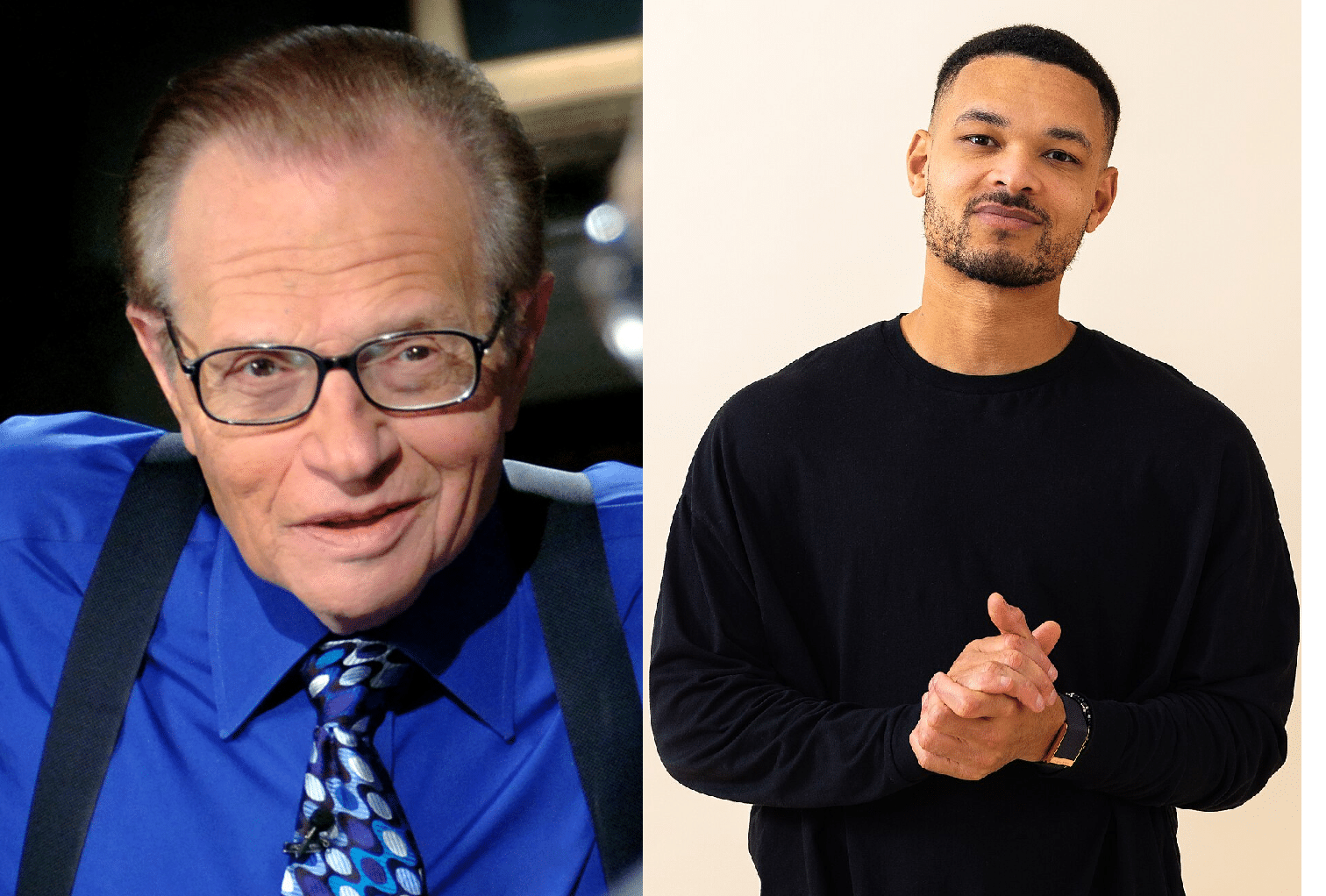








Larry King asked questions on CNN for twenty-five years, and he prepared for almost none of them. He was proud of this. “I never learned anything while I was talking,” he liked to say, and the not-knowing was the method: no pre-reads, no ambush, no follow-up sharp enough to make a powerful guest regret the booking. He gave the psychic Sylvia Browne a regular national platform to promote her books and take calls from the grieving. He lobbed underhand pitches to presidents, faith healers, and diet doctors alike, and in his final years he fronted paid infomercials for supplements. For this body of work he received a Peabody Award, an unbroken prime-time franchise, and, when he died in 2021, obituaries warm enough that a reader could forget anyone had ever objected.
Steven Bartlett does a recognizable version of the same job. He sits across from people with strong convictions, asks open questions, challenges almost nothing, and lets the guest be the product. For this he has been called, in a national newspaper this July, “the Pied Piper of bullshit.” A BBC investigation in December 2024 counted an average of fourteen harmful health claims per episode across a sample of his health interviews. Joe Rogan, who holds the American version of the chair, spent early 2022 watching Neil Young pull his catalog from Spotify in protest and 270 doctors, scientists, and healthcare workers sign an open letter about his show. The two most listened-to interviewers alive operate under a level of published hostility that King never experienced in a quarter century of doing, almost, the same thing.
The same conduct that earned King a Peabody now earns a BBC investigation. What changed between 1995 and 2026?
The chair inside the building
King owned almost nothing. CNN owned the distribution, the bookers, and the credibility; King asked the questions and drew a salary. Every news-network chair worked on those terms, Cronkite’s and Wallace’s included.
Winfrey aired the same kind of content the new hosts are attacked for, and got attacked for it first. She introduced America to Dr. Phil and Dr. Oz, gave The Secret its rocket fuel, and hosted celebrity vaccine skepticism years before it had a podcast to live on. The columnists of the late 1980s filed her genre under trash television. The attacks stopped, and they stopped for two reasons: her numbers were enormous, and after 1988 she owned the show outright through Harpo Productions, the thing King never did. The talk show made many people famous. It made exactly one of its hosts a billionaire, and the difference was not talent. It was title. By the time the criticism might have mattered, she owned the building it would have been mailed to.
King proved the interview chair, filled with pure curiosity and zero judgment, could out-rate almost anything a news division produced. Winfrey proved the chair’s value belonged to the person in it, not the institution around it, and that owning it converted fame into capital. The creator economy did not invent either lesson. It democratized them.
The heirs
Rogan is King’s scale without King’s landlord. His show moved to Spotify in 2020 in a licensing deal reported at $200 million, then renewed in 2024 in a multi-platform arrangement reported at up to $250 million, and by Edison Research’s measurement it has been the most listened-to podcast in the United States for years without interruption. No network built this. A comedian with a laptop built it, episode by episode, over sixteen years.
Bartlett is Winfrey’s ownership model at internet speed. The Diary of a CEO began in 2017 as a memoir in podcast form and is now, by the i Paper’s own reckoning, “on the cusp of overtaking Joe Rogan to become the world’s No 1 podcast,” with a YouTube channel of 18.3 million subscribers reported to be adding 900,000 a month. Bartlett told The Times he expected the show to make £20 million in 2024, mainly from advertising. But the show is the smallest piece of the business. Like Winfrey, he converts the chair into equity: a production company in FlightStory, a software product in FlightCast, a fund, and, as Net Influencer reported, co-ownership of the creator commerce platform Stan, taken at the point the company had reached $30 million in annual recurring revenue and $300 million in merchandise value. Winfrey needed two decades and a syndication lawyer to turn her chair into a balance sheet. Bartlett did it before his fortieth birthday, in public, while narrating the process as content.
Inside the industry, none of this is contested. “I look at Steven Bartlett with Diary of the CEO and his media company,” Monica Khan, a former YouTube and Meta executive who now runs Creator Revolution, told Net Influencer. “They won’t necessarily be dependent on some of these gatekeepers in the traditional side. If he wants to launch a documentary, okay, maybe he could just go do that himself. What does he need any of these other channels for?” Bryan Smiley, the former Hartbeat president who now runs Hard Carry Media, states the same point as a general law: “If you have a robust, engaged audience, you can build a substantial business, and you can do that without having to leverage the old school media gatekeepers.” Talent managers make the point in the past tense, that a celebrity once had to go through a gatekeeper and no longer does, and the dealmakers have moved on to valuation, sizing up catalogs like Rogan’s the way studios once sized up film libraries.
And the guests have noticed. In June 2026, a sitting American vice president flew to a podcast studio to give JD Vance’s account of a live foreign crisis to Steven Bartlett. Two years earlier, Donald Trump sat for Rogan and drew 26 million views on YouTube in a day, while Kamala Harris’s campaign negotiated for the same chair and could not close the booking. A senior adviser later blamed fear of a backlash from progressive staff; Harris put it more simply in her memoir: “I regret that we didn’t do it.” The lesson took. The Democrats now maneuvering toward 2028 are working the circuit she skipped: Pete Buttigieg sat for nearly three hours on Flagrant and wrote afterward that his party “must examine not only what we have to say, but how and where we say it,” Gavin Newsom stopped renting chairs and launched his own show, and when a Texas Democrat named James Talarico sat for Rogan in July 2025, Rogan told him to run for president. For half a century, the measure of an interview franchise was who would sit for it. By that measure, the two most important chairs in the English-speaking world are no longer inside a network. Media did not lose the interview. The interview left.
The reception
The objections themselves have a shape, and the shape starts with who is making them.
The July piece calling Bartlett a conduit for misinformation ran stuffed behind an paywall, written by a critic who is himself a podcast producer. The BBC’s investigation was produced by its disinformation desk while, elsewhere in the same building, the corporation kept Bartlett under contract as a prime-time Dragon on Dragons’ Den, a fact the investigation’s own subjects gently note. The piece itself concedes that Bartlett “seems insulated from censure.”
The BBC measured Bartlett against the accuracy standards of a broadcaster. The regulation case measures podcasting against the obligations of a licensed medium. The misinformation count treats an unchallenged guest as a failure of journalism. All three require Bartlett to be a journalist. He is not one, has never claimed to be one, and neither was King, whose entire value to CNN was that he was not one. The grade comes back damning every time, and nothing happens, because the rulebook binds employees, and nobody here is employed.
There is a long precedent for this exact scene. Newspapers fought radio news to a negotiated surrender in the 1930s, restricting it by agreement to two five-minute bulletins a day. Radio’s biggest star, Fred Allen, dismissed television as “a triumph of equipment over people.” The broadcast establishment ridiculed young CNN as the Chicken Noodle Network. The columnists of 1988 filed Winfrey’s genre under trash television, a CBS News executive waved off bloggers as “a guy sitting in his living room in his pajamas writing what he thinks,” and the press of 2015 said a president cheapened his office by giving interviews to YouTubers. In every cycle, the incumbent medium’s verdict on its successor has been that the successor is illegitimate, and in every cycle the verdict has been delivered most loudly not from the top of the incumbent industry but from its working ranks, the people close enough to the new thing to see it clearly and positioned poorly enough to be passed over by it. The pattern does not prove the critics wrong. It establishes that the critique appears on schedule, whatever the facts, whenever an audience changes buildings.
Claims Without Pushback
None of this makes the health claims true. Guests on The Diary of a CEO have told its audience that a ketogenic diet can treat cancer, that proven medication is toxic, that autism and polycystic ovary syndrome can be reversed with diet. These claims are wrong, the show aired them with little challenge, and Bartlett’s defense, that “the truth is usually somewhere in the middle,” is the oldest and weakest justification in the platforming business. The Advertising Standards Authority banned three of his Facebook ads in 2024 for promoting Huel, where he is a director, and Zoe, where he is an investor, without disclosing either role. None of it can be waved away.
The sin is not new either. Dr. Oz dispensed a decade of dubious medicine from the most respected couch in America, and Sylvia Browne told a missing boy’s mother on daytime television that her son was dead, then kept her regular seat on Larry King Live; the boy was found alive four years later. What is new is that no institution stands between the host and the criticism, or between the host and the profit. The check that eventually reached Winfrey’s couch and King’s desk came from sponsors, not statutes, and the new chairs will answer to the same force. The £20 million is advertising revenue. Advertisers read the papers.
The succession
Winfrey ended her show in 2011 on her own schedule, and King died in 2021 to warm obituaries. Both are remembered as legends. Rogan and Bartlett do the same work, with the same flaws, at larger scale, and are covered as a crisis. The reason is timing: King and Winfrey won while the industry still owned a piece of them, so the industry celebrated their success as its own. Rogan and Bartlett won after the unbundling, so the industry gets nothing from their success, and covers it accordingly.
The loss goes beyond one franchise. A media company’s entire business is capturing attention, and the record of the last twenty years is that legacy media failed to adapt and innovate while the audience changed how it watched. The attention did not disappear; it moved to creators, and the creator economy has grown into every room legacy media emptied. The celebrity interview went to the podcasters, the product review went to the YouTubers, and the news itself increasingly reaches people through individuals they follow rather than mastheads they subscribe to. Nobody owns the attention of the public anymore; it is won by individuals, video by video, and held only as long as they keep earning it. Legacy media did not lose the audience to a rival institution, which would have been a familiar and survivable outcome. It lost the audience to individuals, and that is the threat: not what the new hosts say, but what their existence proves about where the audience went.
Where legacy media sees a crisis, the creator economy sees proof. The interview show has always been the cleanest test of whether media value lives in the institution or the person, because it needs almost nothing: a chair, a question, and whoever earned the right to ask it. Audiences follow people, and they always have. The coronation happened quietly, one subscription at a time, while the objections were still being drafted. The new Larry Kings are already seated.
Subscribe to Our Newsletter
Check Out Our Podcast